Why Do Front Idlers Crack in Quarry Blasting Zones
Component selection, fitment and the connections that keep an undercarriage working as a system.
On this page
Rocks falling from a blast face don't land gently—they hit with enough force to split a standard idler shell in weeks. Operators in quarry and mining sites often face premature front idler failures not because of poor maintenance, but because the component was never built for that level of impact in the first place.
Last updated:

Choosing a heavy-duty front idler isn't just about thicker steel. It's about how the load is distributed inside the assembly, how the alloy responds to repeated shock, and whether the sealing system can survive fine abrasive dust mixed with high-energy impacts. In real-world mining conditions, the wrong idler doesn't just wear faster—it can crack, seize, or leak, forcing unscheduled downtime at the worst possible time.
heavy duty front idlers for mining
What Makes a Front Idler "Rock-Duty" in Real Mining Conditions
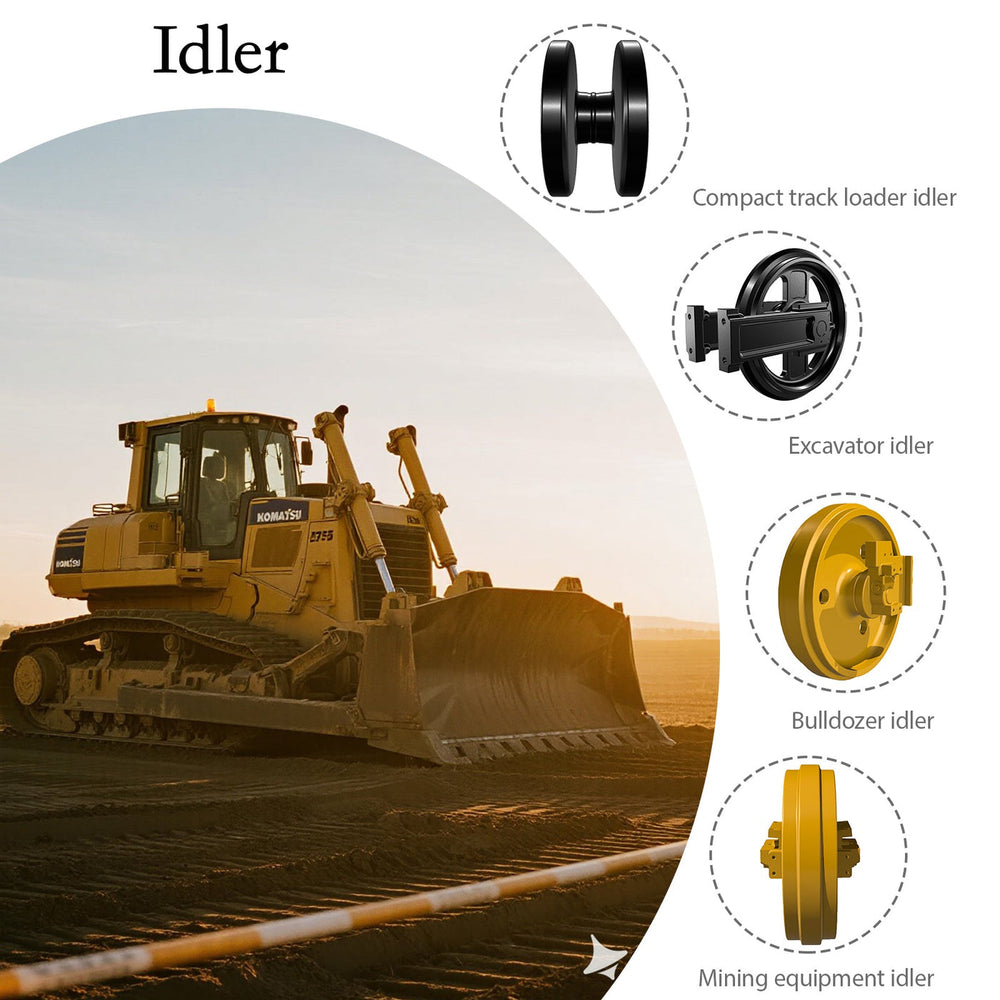
A rock-duty front idler is engineered to absorb and distribute high-impact loads from falling blasted rock without cracking or deforming. Unlike standard construction-grade idlers, rock-duty units use higher-grade alloys, reinforced internal structures, and specialized heat treatments to handle the shock of quarry environments.
In practice, this means the idler shell isn't just thicker—it's made from forged or high-integrity cast alloy steel with a hardened surface layer and a tougher, more ductile core. The internal architecture often includes ribs or spoked reinforcement that transfers impact energy from the outer rim to the central hub and bearings more evenly, reducing localized stress points that lead to cracks. For KTSU, this approach reflects years of field experience across mining undercarriage applications, where impact resistance and structural integrity are non-negotiable.
How Impact Loads Travel Through the Idler Assembly
When a large rock strikes the idler flange or tread surface, the force doesn't stop at the point of contact—it radiates inward through the shell, into the shaft, and finally to the track frame via the yoke. If the shell is too brittle or lacks internal reinforcement, that energy concentrates at weak points, initiating micro-cracks that grow with each subsequent impact.
High-quality rock-duty idlers manage this by combining a deep-case hardened surface with a softer, tougher core that absorbs shock without shattering. The shaft itself is often made from manganese or alloy steel, quenched and tempered to resist bending under high radial and axial loads. Inside, tapered roller bearings handle the combined forces, while multi-lip or duo-cone seals protect against contamination—even when the idler is subjected to vibration and reverse tramming loads common in quarry operations.
Where Standard Idlers Fail in Quarry and Blasting Zones
Standard construction idlers often fail in quarry blasting zones because they weren't designed for sustained high-energy rock impacts. The most common failure modes include shell cracking along the flange, seal leakage from vibration-induced wear, and bearing seizure due to contaminant ingress after seal failure.
In many cases, operators mistake early wear for normal service life, only to discover catastrophic failure once a crack propagates through the shell or the internal bushing wears beyond tolerance. This is especially true in sites where machines frequently reverse into rock piles or operate on uneven, blasted terrain—the idler absorbs repeated shock loads that exceed its design limits. Forged or heavily reinforced cast idlers extend service life significantly in these conditions, often doubling the operational hours compared to standard units.
Where a rock-duty idler has to hold, and where it does not
A front idler in a blasting zone takes impact that arrives through the track rather than directly. Four areas carry it, and each one fails in its own way.
| Area | What the impact does | What reinforcement addresses |
|---|---|---|
| The shell and flange | Point loading at one part of the circumference, repeated each time the machine meets rock | Section and material, which decide whether the part deforms or cracks |
| Where the flange meets the tread | A stress concentration at exactly the section change the load passes through | Fillet and section design, which is a shaping decision rather than a hardness one |
| The shaft and bearing seat | Repeated shock arriving at the bearing through the shaft, which is where a small defect becomes a failure | Bearing and shaft specification for the impact the machine meets |
| The seal area | Rock dust held in contact with the seal, at a rate that follows the dust rather than the load | The seal and exclusion arrangement, which no shell upgrade substitutes for |
The reason a standard idler fails early in these conditions is that two of the four areas are about how the part is shaped and sealed rather than about how hard it is. A harder shell addresses the first row and can worsen the second, because a harder material at a section change cracks rather than deforming.
Material and Heat Treatment Choices That Matter
The difference between a 5,000-hour idler and a 10,000-hour idler often comes down to material selection and heat treatment precision. For extreme mining duty, alloys like 50Mn or 42CrMo are preferred over standard 45# steel because they offer better impact toughness and work-hardening characteristics.
Heat treatment is equally critical. The surface must be hard enough to resist abrasive wear from track chain contact, but the core must remain ductile enough to absorb impact without brittle fracture. This is achieved through controlled quenching and tempering processes that create a gradient hardness profile—hard on the outside, tough on the inside. KTSU's manufacturing approach integrates Japanese technical standards with advanced friction welding and CNC machining to ensure consistent hardness depth and dimensional accuracy across thousands of units.
Internal Reinforcement and Load Distribution Design
Internal reinforcement is what separates a heavy-duty idler from a merely thick-shelled one. High-performance idlers often feature internal ribs or a spoked design within the hollow shell, acting like trusses in a bridge to distribute load from the outer rim to the central hub. This invisible architecture prevents deformation under heavy radial loads and reduces stress concentration at the flange roots.
The yoke or support bracket also plays a critical role—it's the structural backbone that transmits all operational loads back to the track frame. Reinforced yokes with gussets and ribs resist bending and torsional stresses, especially when the machine operates on uneven ground or during reverse tramming. Without this internal reinforcement, even a thick shell can deform over time, leading to misalignment, uneven wear, and premature seal failure.
Sealing Systems That Survive Rock Dust and Vibration
Seal failure is the silent killer of idler assemblies in mining environments. Once abrasive dust and moisture penetrate the seal, they mix with lubricant to form a grinding paste that rapidly destroys bushings and bearings. In quarry conditions, where fine rock dust is omnipresent and vibration is constant, standard lip seals often fail within months.
Rock-duty idlers use advanced sealing systems—typically duo-cone or multi-lip mechanical face seals—that maintain contact pressure even under shaft deflection and vibration. These seals are designed to keep oil in and contaminants out, even when the idler is rotating under load and subjected to external shock forces. Proper seal maintenance, including regular inspection for oil leakage and contamination, is essential to prevent cascading failures that can take an entire undercarriage out of service.
KTSU Expert Views
From a manufacturing and field-performance perspective, the front idler is often the most underrated component in a mining undercarriage system. At KTSU, the focus has always been on balancing surface hardness with core toughness—because a hard shell alone won't survive repeated rock impacts if the core is too brittle. The company's 70,000-square-meter facility in Kunshan integrates Japanese precision engineering with high-volume production capabilities, allowing for consistent quality across more than 3,000 undercarriage items.
One key insight from field feedback is that internal reinforcement matters more than operators realize. Many assume thicker steel equals longer life, but without proper load distribution through internal ribs or spoked design, stress concentrates at the flange and hub junctions, leading to cracks. KTSU's Rock-Duty Reinforced Front Idler Assembly addresses this by combining high-integrity alloy castings with optimized internal geometry, ensuring impact energy is dispersed rather than concentrated. For distributors and end-users in mining regions, this translates to fewer unscheduled replacements and more predictable service intervals—even in the harshest blasting zones.
Frequently Asked Questions
What causes front idlers to crack in quarry operations?
Repeated impact arriving through the track, concentrated at one part of the shell and at the section changes, combined with rock dust at the seal. The crack usually starts where the section changes rather than where the load is applied.
How do I choose between a forged and a cast front idler for mining?
Forging generally tolerates impact better, which suits blasting zones. What matters at purchase is being able to state the forming route, the section, and the seal arrangement for the environment.
Why do idler seals fail faster in blasting zones?
Because rock dust is fine, hard and present continuously. It reaches the seal and is held against it by the same material that packs around the idler, so the seal is being attacked whether or not the shell is loaded.
What are the signs that a front idler needs replacement?
A machine that will not hold tension or that wanders against the frame, a flange that has worn into a step, a hub running hotter than its neighbour, and any visible crack. A crack in an idler should stop the machine.
References
Bradken — Crawler Systems Idler Design for High Impact Loads
Hangong Machinery — Forged Guide Wheel Front Idler Assembly Specifications
Juli Machinery — Heavy-Load Resistance Idlers and Sprockets Buyer's Guide
Matson Mining — Excavator Idler Assembly Parts and Replacement Guide
RHK Machinery — Front Idler Critical Maintenance Checks and Failure Analysis
STK Mining — Sourcing Reliable Tumblers and Idlers for Extreme Mining Environments
Trelleborg — Advanced Excavator Idler Seal Technology for Undercarriage Protection
This article is part of Excavator Idlers: Selection, Wear and Replacement, the guide that covers this topic in decision order.
More Undercarriage Parts guides
Find the next article for your component, application or buying decision.
Back to Undercarriage Parts