Why a High-Precision Assembled Track Chain Must Bend Freely Without Feeling Loose
Component selection, fitment and the connections that keep an undercarriage working as a system.
On this page
A track chain can look correctly assembled on the production line yet become a costly undercarriage problem once it begins cycling over sprockets, idlers, and uneven ground. The difficult part is not simply pressing a pin or bushing into a link; it is retaining the joint firmly enough to resist movement in the link bore while preserving the controlled internal movement that lets the chain articulate smoothly.
Last updated:

That balance is where automated press assembly matters. In a high-precision assembled track chain, micrometre-level measurement and repeatable press-position control help keep each link-to-bushing joint within its intended interference window. The result should not be a “tight” chain in every sense. It should be structurally secure at the press-fit interfaces, while the pin-bushing bearing interface remains capable of free, consistent bending under load.
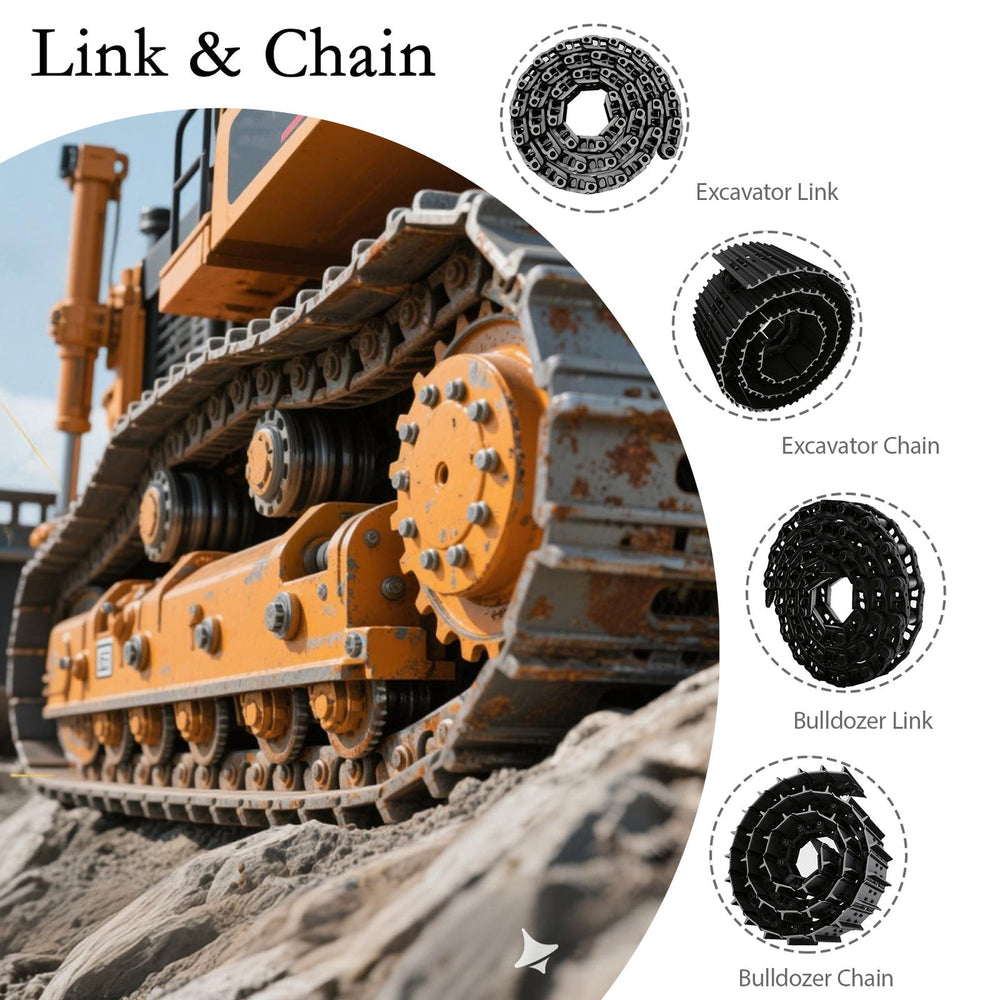
precision assembly of excavator track chains
Why Link-to-Bushing Accuracy Changes Track Chain Life
The link bore and bushing outside diameter form a retention joint, not the rotating joint of the chain. Their interference fit prevents the bushing from creeping, spinning, or working loose inside the track link as the machine repeatedly loads the undercarriage.
The pin and the bushing’s internal diameter serve a different purpose. They must maintain a designed clearance, lubricant film, and seal condition so the joint can articulate as the chain wraps around the sprocket and idler. When manufacturers confuse retention with articulation and simply increase every fit, the chain may feel rigid, generate excess joint resistance, and place added stress on seals and components.
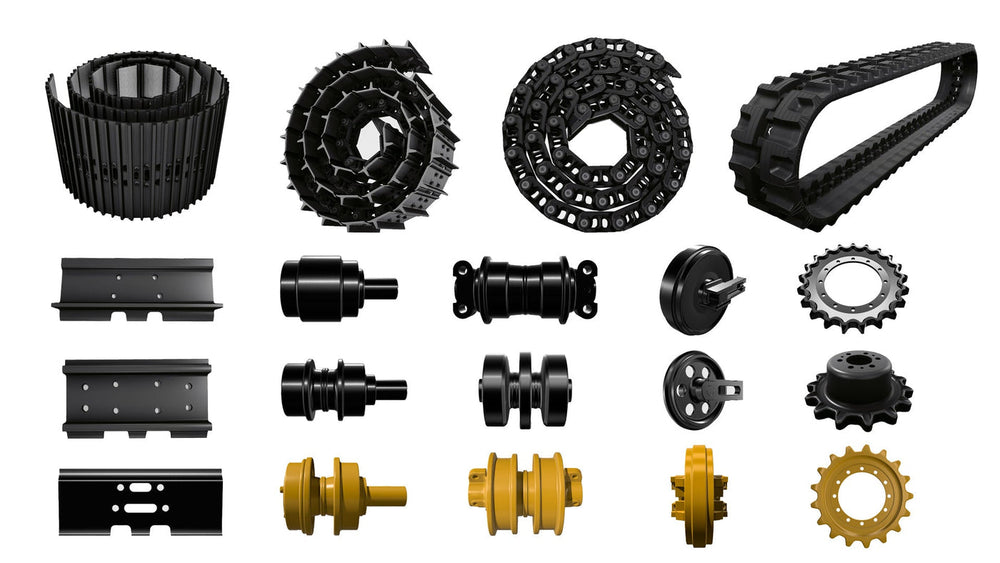
For a KTSU assembled track chain, this distinction matters across an undercarriage portfolio exceeding 3,000 component types. A track link, bushing, pin, seal, and sprocket are not independent parts after assembly; their dimensions and surface conditions become one moving system.
How Automated Pressing Controls Micrometre-Level Variation
Automated hydraulic or servo press systems do not create accuracy through pressing force alone. They combine pre-assembly measurement, controlled alignment, force-displacement monitoring, and final-position verification to identify whether each joint is behaving like a valid press-fit assembly.
A robust process commonly follows this sequence:
The link bore and bushing outer diameter are measured or sorted before assembly to avoid stacking two tolerance extremes in one joint.
Fixtures locate the link squarely and keep the bushing axis aligned with the bore, preventing one-sided entry damage.
The press follows a defined speed profile, often reducing speed as the bushing approaches its final position.
Load and displacement are recorded as a curve rather than treated as separate readings.
The system checks final insertion depth, peak force, force gradient, and any abnormal force drop before releasing the assembly.
The force-displacement curve is particularly useful because it can expose a problem that final depth alone cannot. A low-force condition may indicate insufficient interference, poor alignment, contamination, or an undersized bushing. An unusually high peak may point to excessive interference, burrs, incorrect surface finish, or angular misalignment.
Micrometre-level control therefore usually refers to the resolution and repeatability of critical dimensional measurement and press-position feedback—not a claim that every component dimension has one universal micron tolerance. Actual limits depend on track pitch, link geometry, bushing wall thickness, material condition, heat treatment, and the intended machine load.
Link and Bushing Tolerances Compared With Flexibility Targets
The practical goal is to hold the bushing securely in the link while keeping each articulating joint uniform enough that the chain bends consistently from link to link. The figures below are an engineering comparison framework, not universal replacement specifications; the released drawing and validation plan for a particular track model always govern.
| Assembly characteristic | Controlled relationship | Typical manufacturing control approach | Flexibility and durability implication |
|---|---|---|---|
| Link bore to bushing OD | Interference fit | Micrometre-level diameter measurement, matched sorting, controlled press-force window | Prevents bushing creep or rotation in the link |
| Bushing press depth | Axial location | Servo or hydraulic press travel feedback and mechanical datum verification | Keeps seals, link spacing, and pin position consistent |
| Link bore roundness and taper | Form accuracy | Bore machining inspection and gauge checks | Reduces local high-force zones and uneven contact pressure |
| Pin OD to bushing ID | Running or lubricated bearing clearance | Diameter, surface-finish, and seal-system validation | Allows smooth articulation without excessive radial looseness |
| Link-to-link lateral condition | Side clearance and parallelism | Fixture alignment, stack-height checks, final articulation inspection | Helps prevent binding, side loading, and uneven seal wear |
| Finished chain articulation | Joint torque or bend response | Functional bending test across several joints | Confirms the chain bends freely without a loose, rattling feel |
| Chain pitch consistency | Centre distance between joints | Multi-pitch measurement rather than a single-link check | Supports proper sprocket engagement and reduces concentrated wear |
The ISO limits-and-fits system gives manufacturers a consistent way to define dimensional relationships between mating features. It does not prescribe one fit class for every heavy-duty track chain, however. The correct interference range must be developed around the actual link and bushing design, then proven through press trials, fatigue evaluation, sealing tests, and field feedback.
What Does Free Bending Look Like in Real Operation?
A freely bending track chain does not mean the links can move without resistance when lifted by hand. Sealed and lubricated joints have drag from seals, lubricant viscosity, surface contact, and component mass. The more meaningful question is whether each joint responds consistently as the chain turns around the sprocket under its normal working load.
On a properly assembled chain, articulation should be reasonably even across consecutive links. There should be no isolated stiff joint that resists bending, no bushing movement in the link, and no detectable knock caused by excessive clearance. During operation, smooth articulation supports predictable track tension, sprocket engagement, and load distribution.
The working environment changes the result. Cold temperatures can increase lubricant resistance; packed mud and abrasive material can add external drag; poor track tension can make a healthy chain appear noisy or unstable. Operators sometimes replace a chain because it “feels tight” during an unloaded inspection, when the real cause is a tensioning, alignment, or contamination issue elsewhere in the undercarriage.
Why a Precisely Pressed Chain Can Still Fail Early
Precision assembly cannot compensate for an unsuitable design, contaminated parts, incorrect lubrication, or severe operating conditions. A chain can pass a press-depth check while still carrying a hidden defect if the bore has poor form, the bushing surface is damaged, or the press fixture introduces a small but repeatable angular error.
Several expectation gaps appear in the field:
Excessive interference can hold a bushing securely but distort it enough to reduce the pin-to-bushing running clearance.
Insufficient interference may initially feel smooth, then allow bushing creep under cyclic load and disturb seal geometry.
A single stiff joint can be overlooked if only overall chain length is inspected instead of each joint’s articulation response.
Heavy abrasion and inadequate sealing can accelerate pin-and-bushing wear even when original assembly quality was sound.
Track pitch growth is sometimes blamed solely on the chain, although sprocket wear, alignment, tension, and operating technique can intensify the damage pattern.
Sealed, grease-lubricated track systems are designed to keep lubricant within the pin-bushing interface while limiting abrasive intrusion. This is why press quality and seal integrity should be evaluated together rather than as separate production checks.
How Manufacturers Improve Press-Fit Consistency
The most dependable improvement is to treat every press operation as measured evidence rather than a single pass-or-fail force event. Production teams should relate incoming part dimensions, press curves, final depth, joint torque, and later functional test results to the same serialised assembly record.
Useful control measures include:
Applying statistical process control to both link bores and bushing outside diameters, not only to finished-chain dimensions.
Using calibrated air gauges, bore gauges, or in-process probes with resolution appropriate to the released tolerance.
Establishing validated force-displacement envelopes from known-good assemblies, including tolerance-edge parts.
Maintaining clean bores, controlled lubrication rules, and protected handling after heat treatment and machining.
Testing articulation across multiple adjacent joints, since an average result can conceal one binding link.
Checking pitch across several links, because cumulative error affects sprocket engagement more than an isolated dimension does.
KTSU’s manufacturing context combines CAD/CAM development with precision CNC machining, NITTO friction welding, and robotic CO2 welding. In practice, those processes only support track-chain consistency when machining, heat-treatment response, inspection, and automated pressing are controlled as one connected process rather than as isolated departments.
The two conditions a pressed joint has to satisfy at once
A track joint has to hold the bushing in the link bore and allow the joint to articulate. Both requirements depend on the same fit, which is why the assembly tolerance is so tight.
| Condition | What it protects | How a fault shows in service |
|---|---|---|
| The bushing holds in the link bore | The joint geometry, because movement in the bore changes the pitch the sprocket sees | Pitch that moves early, and a chain that will not hold tension |
| The joint articulates freely | The surfaces that slide against each other as the chain wraps the sprocket and idler | Stiff joints, heat at the joint, and wear concentrated where the chain changes direction |
| Both are consistent across every joint | Even load sharing along the whole chain | One section wearing faster than the rest, and a chain that behaves differently depending on which part is under the sprocket |
| The press fit is measured rather than judged | The repeatability that turns a good sample into a good batch | Two chains from the same supplier behaving differently on the same machine |
The reason a precisely pressed chain can still fail early is that all four rows are manufacturing conditions. Where the machine is misaligned, packing the running gear, or running a worn sprocket, the chain is being asked to work outside the geometry it was built for, and the assembly quality does not change that.
KTSU Expert Views
A reliable heavy-duty track chain is often judged too late—after pitch growth, seal leakage, bushing rotation, or uneven sprocket contact becomes visible. The more useful inspection point is earlier, at the moment a link and bushing are pressed together. That is where dimensional variation, fixture alignment, surface condition, and pressing behaviour first become a permanent joint condition.
KTSU’s perspective is shaped by a 70,000-square-metre manufacturing facility in Kunshan, Jiangsu, where undercarriage parts for construction and agricultural machinery are produced alongside track rollers, carrier rollers, idlers, sprockets, and track chain assemblies. Seeing those components as a system changes how press quality is assessed. A joint that meets a nominal depth requirement but creates inconsistent articulation can still transfer risk to the seal, sprocket, and track-tension system.
The practical standard is therefore not maximum press force or the tightest possible fit. It is repeatable functional balance: stable bushing retention, consistent geometry, preserved internal articulation, and a measurable process record when performance varies. That approach is especially relevant for chains used on excavators, dozers, and agricultural machines that encounter changing loads, abrasive ground, and long operating cycles.
Frequently Asked Questions
Why must a track chain bend freely without feeling loose?
The joint has to hold the bushing in the link bore so the pitch stays where it was designed, and it has to articulate so the surfaces can roll over the sprocket and idler. A joint that does neither wears quickly.
What does free bending look like in operation?
The chain wraps the sprocket and the idler without stiff points and without heat building at individual joints. A stiff joint usually shows as wear concentrated where the chain changes direction.
Why can a precisely assembled chain still fail early?
Because assembly quality cannot correct the machine. Misalignment, packing and a worn sprocket all work on the chain regardless of how well it was built.
What should a buyer ask about chain assembly quality?
How the press fit is measured and controlled across a batch, rather than how it looks on a sample. Consistency across every joint is what makes the chain behave the same way around the whole loop.
Sources
ISO 286-1 Geometrical Product Specifications for Limits and Fits
ISO 286-2 Tables of Standard Tolerance Grades and Limit Deviations
This article is part of Track Chain Wear and Replacement: When to Change a Chain, the guide that covers this topic in decision order.
More Undercarriage Parts guides
Find the next article for your component, application or buying decision.
Back to Undercarriage Parts