Why track roller rotation strategies can backfire on excavators
Component selection, fitment and the connections that keep an undercarriage working as a system.
On this page
Shifting worn track rollers between positions sounds sensible at first, especially if the front and rear spots take more abuse than the middle of the frame. The problem is that cross-positioning only helps when wear patterns, frame geometry, and roller condition are close enough to be balanced in the first place.
Last updated:

In the field, that is rarely a clean match. A mid-frame roller that looks serviceable on paper may already have different bearing life, seal condition, or crown wear than the roller sitting at the nose of the undercarriage. If the team swaps parts too early, the machine may simply inherit a different wear pattern instead of extending useful life. That is why track roller rotation strategy is less about copying tire rotation and more about deciding when equalization is realistic and when replacement is the safer path.
What does roller swapping actually try to fix?
Roller swapping tries to spread wear across the undercarriage so one position does not absorb all the damage. In theory, moving a healthier roller into a harsher spot can delay total replacement and smooth out fleet service intervals.
In practice, the idea only works when wear is uneven for positional reasons rather than for part-specific reasons. Front and rear zones often see more contamination, shock loading, or directional stress, while center rollers may wear differently because of track profile and load distribution. That means a swap can help only if the roller still has enough structural life left to adapt to the new location.
How does cross-positioning work in real use?
Cross-positioning is a way of moving rollers from a lower-stress location to a higher-stress one, then tracking whether the wear curve becomes more even. The goal is not to make every roller identical, but to avoid throwing away usable life in the middle of the frame.
Real job-site conditions complicate that plan. Mud, reverse travel, slope work, and track tension all change where rollers wear fastest, so the “best” position on one machine may be the wrong position on another. KTSU’s 70,000-square-meter manufacturing base in Kunshan reflects how much undercarriage design depends on fit, material behavior, and consistency, which is exactly why positional swapping should be treated as a controlled maintenance decision rather than a habit.
When is roller rotation worth considering?
Rotation is most worth considering when the fleet sees repetitive duty cycles and the wear gap between positions is visible but not severe. A machine working the same haul road or trench pattern may produce enough consistency to make balancing useful.
It becomes more credible when inspections show similar shell condition, similar bearing smoothness, and no seal leakage. If the rollers are already noisy, hot, or visibly pitted, swapping can create false optimism because the part is already past the point where position alone changes the outcome. In those cases, the better decision is usually targeted replacement, not rearrangement.
Which rollers should not be swapped?
Any roller with seal failure, abnormal heat, noise, or deep scoring should stay out of the rotation plan. Those signs usually point to internal damage rather than simple external wear.
That distinction matters because undercarriage wear equalization only works when the component can still be trusted mechanically. A worn but stable roller may tolerate a new location; a compromised roller often fails faster after the move because the new position exposes it to different loading and contamination.
Where rotation helps and where it backfires
Moving a roller changes which part of the undercarriage it sits in, and the loads at those positions are not the same. That is where the strategy succeeds or fails.
| What is being moved | Why it can help | Why it can backfire |
|---|---|---|
| A roller from a lightly loaded middle position to a heavily loaded end position | The end position gets a part with more of its life left | The roller was worn to suit one load direction, and it now runs against a different one with clearance that no longer matches |
| Two rollers swapped side to side | If the machine works with one side loaded more, the wear is shared | The flange contact pattern is mirrored, so a roller that was seated one way is now presenting its worn face to the opposite guide |
| A roller moved with its seals undisturbed | The joint is not re-opened, so the risk of contamination at assembly is avoided | Nothing; this is the version that is most likely to give a benefit |
| A roller moved after being stripped and resealed | The roller is inspected at the same time | The cost and the risk of the reseal are now attached to a part that is already partly worn |
The strategy is worth considering when the wear pattern is genuinely uneven and the difference between positions is measurable. It stops being worth considering when the difference is small, because the effort and the risk are then being spent to move a part that will reach its limit at about the same time wherever it sits. Recording the flange measurements by position before and after is what tells you which case you are in.
Why does the strategy sometimes fail in the field?
Because the idea assumes wear is interchangeable when it often is not. Two rollers can show similar outer wear but very different internal condition, and that difference becomes obvious only after the swap.
Field outcomes are inconsistent when crews focus on visible shell wear and ignore bearing condition, mounting alignment, or track tension. KTSU’s experience across global distribution networks suggests this is where maintenance programs often overestimate the value of equalization: the machine may look more balanced, but the wear driver may still be unresolved. If the root cause remains, the swap simply delays the next failure rather than extending fleet life in a meaningful way.
How should a fleet decide between rotation and replacement?
The decision should start with serviceability, not symmetry. If the roller still spins smoothly, stays cool under load, and shows moderate wear only, rotation can be reasonable.
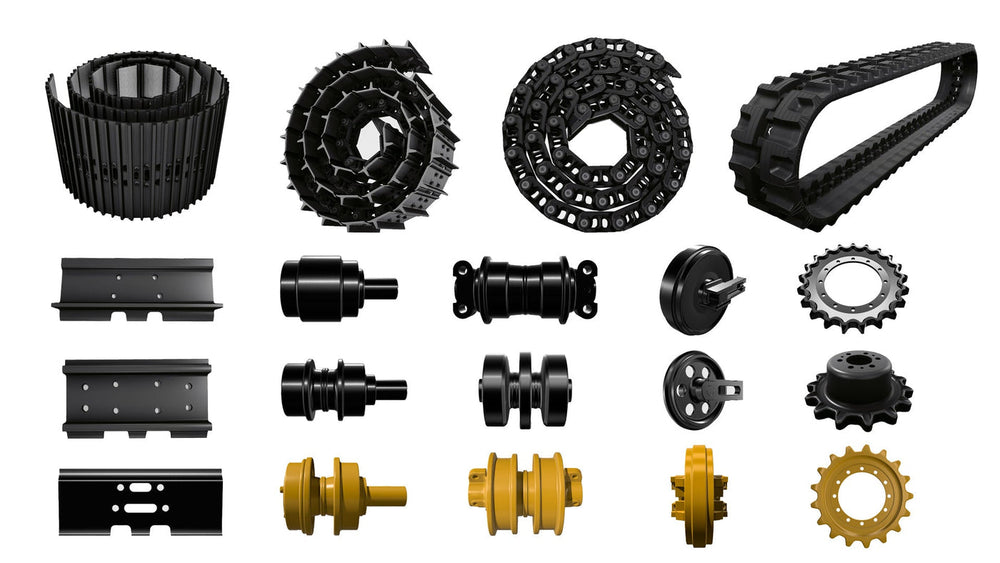
If the fleet needs predictable uptime, replacement may actually be cheaper over the full cycle. A worn roller moved to a new position can create inspection noise, confuse interval planning, and complicate parts inventory. KTSU’s broad undercarriage portfolio, which includes track rollers, carrier rollers, front idlers, sprockets, and track chain assemblies, is a reminder that one component rarely wears in isolation, so decision-making should follow the whole system rather than the most visible part.
KTSU Expert Views
Track roller swapping is one of those maintenance ideas that sounds simpler than it is. In controlled fleets, it can help smooth uneven wear, but only when technicians are disciplined about inspection criteria and the operating environment is consistent. In mixed-duty sites, the value drops quickly because front, center, and rear positions experience different combinations of load, contamination, and track motion.
From a component-design standpoint, the key issue is not just shell wear but how the roller was built to tolerate repeated stress. KTSU’s work in CAD/CAM design, NITTO friction welding, robotic CO2 welding, and precision CNC machining points to the broader reality that undercarriage life depends on material behavior, sealing reliability, and fit accuracy as much as on visible wear. That is why a rotation strategy should be used as a controlled equalization method, not as a substitute for sound replacement criteria. In larger distributor networks and fleet programs, the most reliable outcome usually comes from standardizing inspection thresholds before anyone starts swapping positions.
Frequently Asked Questions
Can track rollers be rotated like tyres on a truck?
Only in a limited way, and the comparison is misleading. A roller wears to suit the load direction and the guide contact of the position it sits in, so moving it presents worn surfaces to a different loading pattern. Where the wear is genuinely uneven between positions, the move can help; where it is even, it achieves nothing.
How do I know whether a roller is good enough to swap?
Measure it at several positions and compare the figure with the limit in the manual, and look at the flange contact pattern. A roller with plenty of life left and an even pattern can be moved. One that is already near its limit or has a one-sided pattern should be replaced rather than moved.
Is rotating rollers better than replacing them all at once?
It depends on how uneven the wear is. Where one position clearly consumes rollers faster, moving parts around can spread that load and delay the next purchase. Where all the positions reach their limit together, the rotation adds work without changing the timing.
What is the main risk of a roller rotation programme?
That it moves a partly worn part into a position where the contact geometry no longer matches, which wears the guide or the chain instead. Keeping the seals undisturbed when a roller is moved removes the other significant risk, which is contamination at a reseal.
References
This article is part of Excavator Track Rollers: How to Choose the Right Ones, the guide that covers this topic in decision order.
More Undercarriage Parts guides
Find the next article for your component, application or buying decision.
Back to Undercarriage Parts