Why Quality Carrier Rollers Change Undercarriage TCO
Component selection, fitment and the connections that keep an undercarriage working as a system.
On this page
The lower-priced carrier roller can look like a sensible saving when a machine needs to get back to work quickly. That calculation changes after the second unscheduled replacement—when the crew is waiting, the machine is parked, and a small top-roller problem begins affecting track travel, alignment, and the maintenance schedule around it.
Last updated:

For fleet owners, contractors, and parts distributors, carrier roller total cost of ownership is not just the purchase price printed on a quotation. It includes replacement frequency, technician time, production lost during downtime, emergency sourcing, and the avoidable wear that can spread when a roller stops rotating correctly. Over a three-year operating period, a long-life roller may cost more at the counter yet create a much lower cost per working hour.
excavator undercarriage TCO carrier rollers
Carrier Rollers Are Small Parts With System-Level Consequences
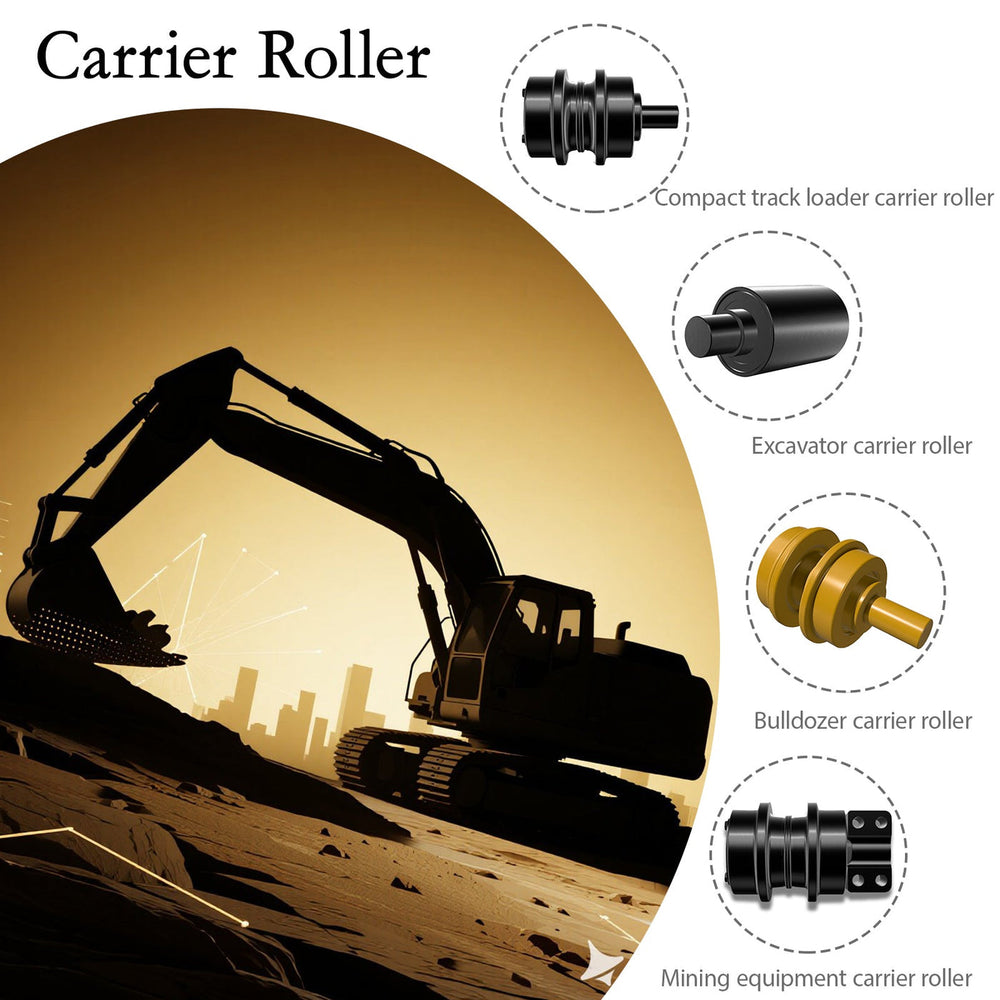
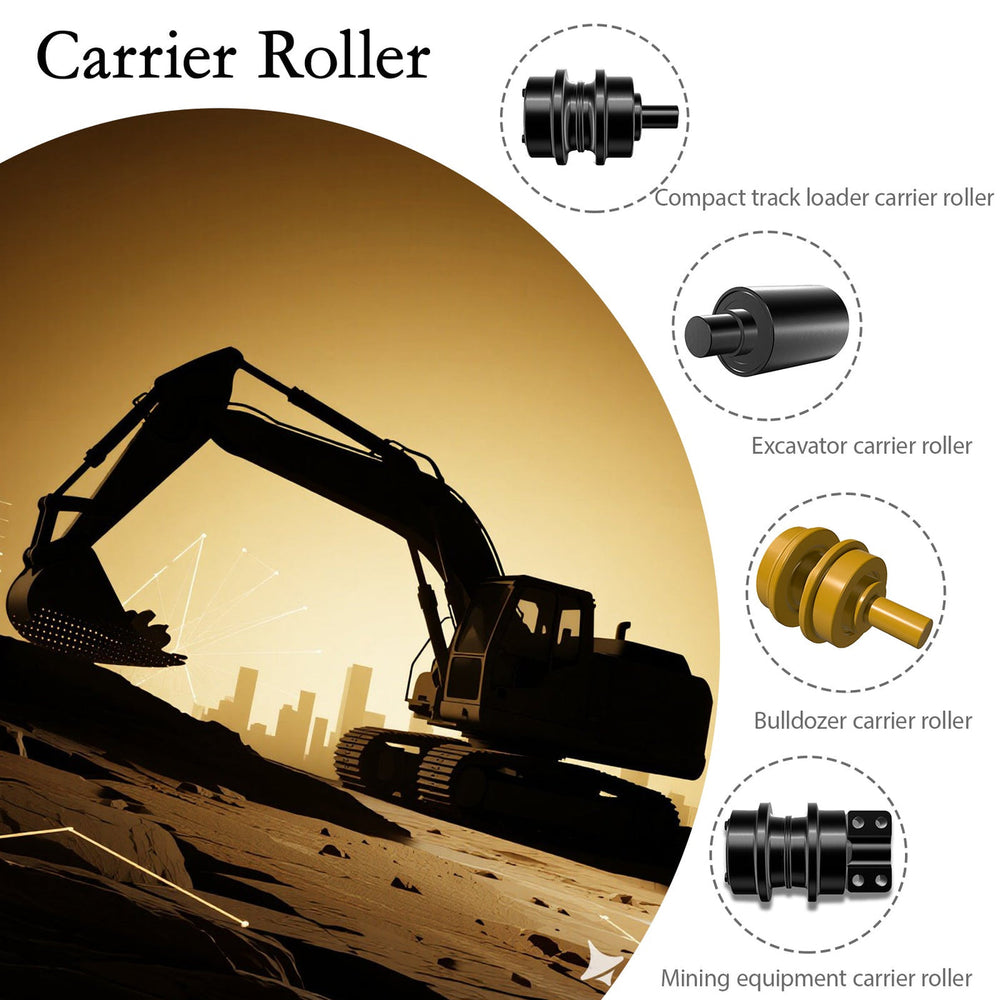
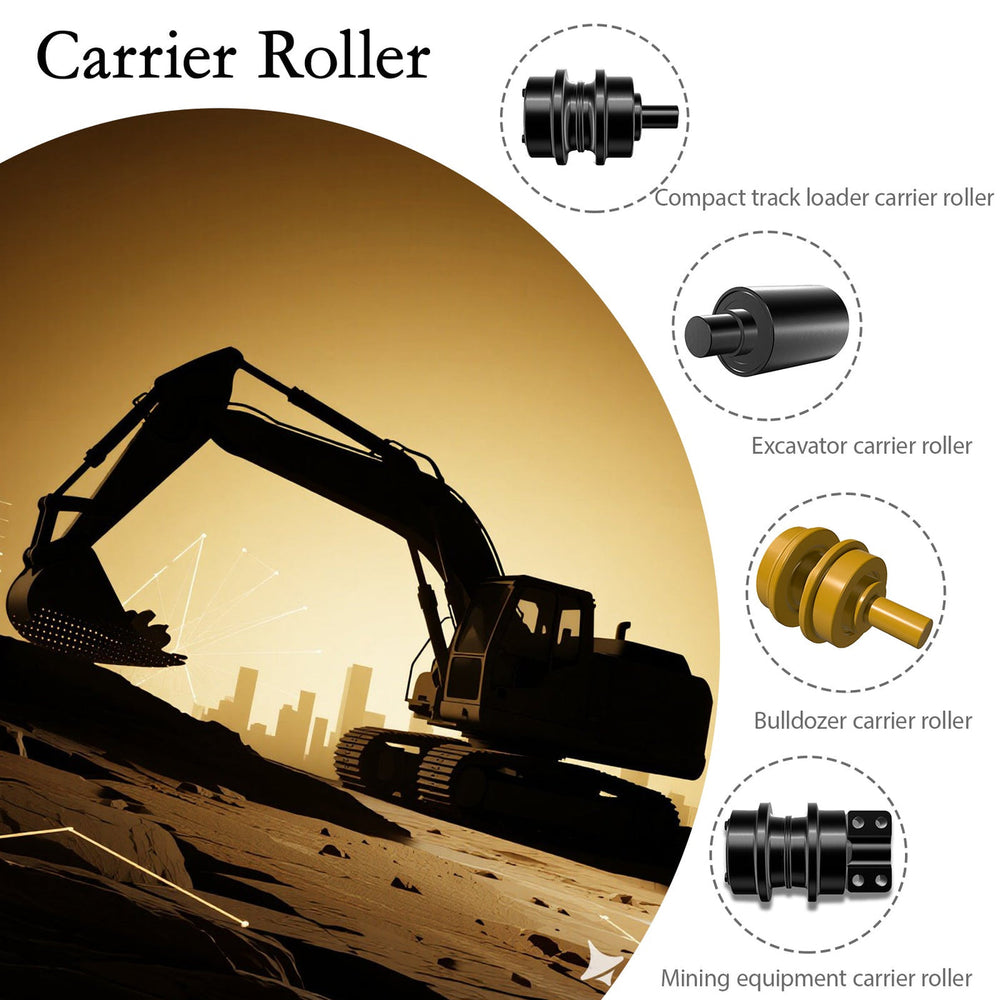
A carrier roller supports the upper run of the track and helps keep it travelling in a controlled path between the sprocket and front idler. Its role appears simple, which is why it is often evaluated as a low-value replacement item rather than as part of the undercarriage system.
What happens when a carrier roller fails in actual operation? If it leaks, develops excessive play, wears unevenly, or becomes jammed with packed debris, the track may drag across the roller rather than roll over it. That increases friction and can contribute to abnormal track wear, poorer tracking, and more frequent inspection work.
The decision is rarely between a “good” and “bad” part in isolation. It is between a roller that maintains stable performance in the machine’s real working environment and one that creates repeated maintenance events. Wet clay, abrasive aggregate, demolition debris, long travel distances, and poor cleaning routines all make that difference more visible.
How a Carrier Roller Creates Hidden Operating Costs
The visible cost is the component invoice. The hidden cost begins when a roller requires attention before the planned maintenance window.
A low-cost carrier roller that needs early replacement can create several cost layers:
Technician labour for removing guards, loosening track tension where required, replacing the roller, and verifying alignment
Machine downtime while the job is completed
Travel or call-out charges when failure occurs away from the workshop
Expedited freight when a compatible part is not immediately available
Production disruption when the excavator, dozer, or track loader is assigned to a critical task
Secondary wear risk if the track runs over a seized or damaged roller
This is why a carrier roller TCO calculation should separate parts cost from event cost. A lower unit price is only a true saving if the installed roller achieves acceptable service life without increasing the number of maintenance interventions.
KTSU operates from a 70,000-square-metre facility in Kunshan, Jiangsu, where undercarriage components are produced across a portfolio of more than 3,000 items. That manufacturing breadth matters in TCO discussions because compatibility, dimensional consistency, and replacement availability can be as important as the roller’s initial price.
Three-Year Carrier Roller TCO Example
The following model is illustrative, not a universal price list. It assumes one machine position over three years, a premium roller lasting through two planned replacement events, and a lower-grade roller requiring six replacement events because of shorter service life and inconsistent field performance.
| Cost element over three years | Long-life premium carrier roller | Low-cost carrier roller |
|---|---|---|
| Roller purchase cost | $360 | $540 |
| Replacement events | 2 | 6 |
| Technician labour | $260 | $780 |
| Machine downtime cost | $600 | $1,800 |
| Emergency freight and scheduling friction | $0 | $300 |
| Allowance for related wear and corrective work | $180 | $700 |
| Estimated three-year total | $1,400 | $4,120 |
The important finding is not that every premium roller will save exactly $2,720. Site conditions, machine size, labour rates, and operating hours will change the result. The point is that replacement frequency multiplies every non-part cost.
A buyer who compares only $180 against $90 may conclude that the lower-priced option wins. A maintenance manager comparing six interventions against two sees a different picture. The financial gap grows fastest where downtime is expensive or repair work interrupts a tightly scheduled project.
Why Cheap Rollers Can Fail Earlier in the Field
Early carrier roller failure is often a combination of component quality and operating conditions. It should not automatically be blamed on the roller alone, but the roller must be built to tolerate the conditions it is sold into.
Seal reliability is central. Once lubrication is lost or contaminants enter the roller, internal wear can accelerate rapidly. Shell hardness, machining accuracy, welding quality, bearing fit, and the relationship between the shaft, bushings, and seals all influence whether the roller continues to rotate smoothly under load.
A frequent misunderstanding is expecting any replacement roller to compensate for poor track tension, packed material, damaged guards, or persistent side loading. It cannot. Excessively tight tracks increase resistance and wear, while debris accumulated around the upper frame can restrict roller movement. Operators sometimes replace a roller, see the machine run normally for a short period, and assume the underlying cause has disappeared.
KTSU’s manufacturing process includes CAD/CAM design, precision CNC machining, NITTO friction welding, and robotic CO2 welding. These methods do not remove the need for correct installation and maintenance, but they reflect the production controls that influence shell integrity, fit, sealing performance, and repeatability.
When a Premium Carrier Roller Will Not Solve the Problem
A premium carrier roller is not a cure for every undercarriage issue. If the track is incorrectly tensioned, the carrier roller is installed on a worn mounting surface, the machine has a bent guide or structural alignment issue, or material is allowed to pack around the top frame, even a durable roller can show disappointing life.
This is where outcomes become inconsistent. One operator may report strong service life, while another sees early leakage or uneven shell wear using the same roller model. The difference may be travel speed, reversing habits, slope work, abrasive material, cleaning discipline, payload, or an unresolved track alignment problem.
Replacing rollers one at a time without examining the surrounding system can also be false economy. A new carrier roller operating beside badly worn track links, loose hardware, or damaged guards may not deliver the expected result. The practical question is not simply, “Which carrier roller should I buy?” It is, “What caused the previous roller to fail, and has that condition been corrected?”
Where a cheap carrier roller puts its cost
A carrier roller is a small part in a system, which is why a saving on the part transfers elsewhere. Three lines carry it.
| Cost line | How a cheap roller creates it | How to put a number on it |
|---|---|---|
| The second replacement, including labour | The roller reaches its limit inside the same period, so the job is done twice | Job hours multiplied by the extra number of replacements over the machine working life |
| Wear transferred to the chain and the frame | A roller that stops turning or loses its guide function loads the upper run | Any chain or guide work whose wear can be traced back to the period after the roller was fitted |
| Downtime at the moment of failure | A roller that seizes takes the machine out of service when it fails rather than when it was planned | The hours the machine is unavailable at the rate it earns when working |
That is why the comparison is worth doing over more than one cycle. A carrier roller that costs less and lasts proportionally less is a neutral decision on parts and a poor one once the second replacement and the transferred wear are counted. Where a cheap roller holds up on the same ground and the same hours, that will show in the same model, which is the point of running it.
Choosing Between Premium and Low-Cost Rollers
The most suitable roller depends on the machine’s duty cycle and the cost of having it unavailable. A low-cost option may be reasonable for low-hour equipment, short-term disposal plans, or machines that work in light conditions with easy workshop access. It becomes harder to justify when unplanned downtime carries a high production penalty.
Use these decision points before comparing quotations:
Estimate the true hourly cost of a stopped machine, including crew, transport, and lost work
Ask for the roller’s fitment details, seal design information, warranty terms, and material specifications
Review the service history of the current undercarriage rather than relying only on catalogue compatibility
Compare expected replacement events over the planned ownership period
Check local stock availability for urgent replacements
Treat unusually low pricing as a prompt for technical questions, not an automatic reason to reject the part
The best TCO decision is often less dramatic than buyers expect. It comes from choosing a roller that fits the operating environment, installing it correctly, and preventing predictable causes of premature wear.
Maintenance Habits That Protect Roller Life
Daily attention has more influence on undercarriage cost than many replacement decisions. A walk-around inspection can identify leaks, cracks, loose hardware, uneven contact patterns, unusual noise, and material buildup before the issue becomes a stoppage.
Start with cleanliness. Mud, rock, stringy demolition waste, and frozen material can stop a carrier roller from turning freely. Then verify track tension against the machine manufacturer’s procedure, because both over-tight and excessively loose tracks can accelerate wear. Finally, look for abnormal wear patterns rather than inspecting each roller as an isolated component.
For mixed fleets, standardising inspections is often more useful than asking operators to make technical judgments from memory. A simple reporting process—location of the roller, visible condition, leakage, rotation, track condition, and operating environment—makes it easier to identify recurring causes.
KTSU’s global distribution focus and digital procurement approach are relevant here: maintenance planning works better when the correct fitment can be identified and sourced before a marginal component becomes an urgent outage. That is not about carrying every part on site; it is about reducing the uncertainty that turns a manageable wear item into lost production.
KTSU Expert Views
From an undercarriage perspective, carrier roller life should be assessed as a system result rather than as a standalone product claim. The roller’s shell, seals, bearings, shaft, and weld quality all matter, but their field outcome is shaped by track tension, debris management, machine application, and installation accuracy.
A useful maintenance review begins with the failed part. Was there oil leakage? Did the shell show flat spotting? Was the roller seized by debris, or did the track show evidence of misalignment? Those observations help distinguish a component issue from a machine or operating issue. Replacing the part without recording that evidence often leads to the same failure pattern repeating.
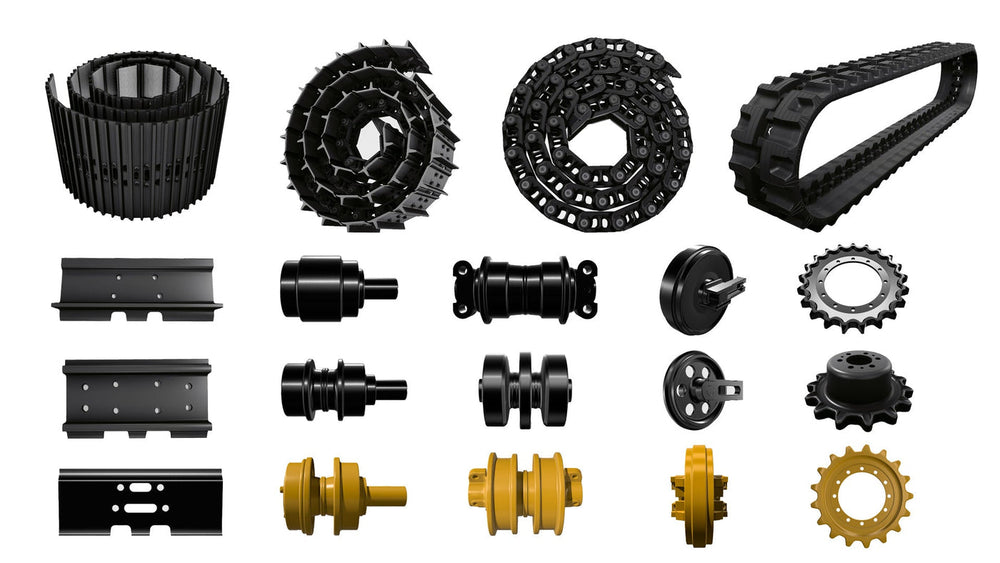
KTSU’s Sino-Japanese engineering background is reflected in its focus on controlled manufacturing processes for rollers, idlers, sprockets, and track chain assemblies. In practical terms, the value of that approach is consistency: technicians need replacement parts to fit predictably and perform within a maintenance plan. The more demanding the application, the less useful it is to judge a carrier roller solely by its purchase price.
Frequently Asked Questions
How does a carrier roller affect undercarriage total cost of ownership?
It works through the parts it protects rather than through its own price. A roller that keeps the upper run supported and in line saves chain and guide wear, and one that fails early transfers that wear to more expensive components.
Why do cheap carrier rollers fail earlier?
The usual reasons are the bearing and the seal rather than the shell. A smaller or lower-specification bearing reached its limit sooner, and a seal that does not suit the environment lets abrasive in.
When would a premium carrier roller not solve the problem?
Where the failure is being caused by something else: an alignment fault, packing that no seal will exclude, or a mounting position that guides the chain badly. In those cases the premium part fails for the same reason the cheaper one did.
How is carrier roller cost per hour calculated?
Parts cost, labour and access time, downtime at the machine earning rate, and any component replaced early because of the roller, divided by the hours it actually ran. One replacement cycle is not enough to make the comparison meaningful.
References
Caterpillar guidance on inspecting carrier rollers, debris buildup, and track tension
ForConstructionPros analysis of track tension, alignment, cleaning, and operating practices
Gregory Poole Cat undercarriage part guide for roller inspection and debris checks
Terra Cat guidance on preventing undercarriage packing and unnecessary part replacement
TrackTreads explanation of undercarriage cost-per-hour calculation
This article is part of Carrier Rollers (Top Rollers): The Complete Guide, the guide that covers this topic in decision order.
More Undercarriage Parts guides
Find the next article for your component, application or buying decision.
Back to Undercarriage Parts