Why Drive Sprocket Rim Segmentation Often Uses Odd Tooth Counts
Component selection, fitment and the connections that keep an undercarriage working as a system.
On this page
A replacement drive sprocket rim can look correct, fit the bolt holes, and still wear unevenly if its tooth pattern repeatedly meets the same chain-bushing pattern. That is why odd-tooth sprocket rims appear so often on tracked construction equipment: the tooth count helps interrupt a repeating contact cycle instead of allowing the same tooth and the same chain-link position to carry the load every time.
Last updated:

The idea is often described as “tooth hunting.” It does not mean that an odd number of teeth automatically makes a sprocket stronger or suitable for every excavator. Tooth profile, pitch, material hardness, chain condition, alignment, tension, and soil contamination still determine service life. The odd count is one part of a wear-management strategy, especially in drives where the track chain has an even number of pitches or where alternate tooth engagement is part of the design.
why excavator sprockets have odd teeth
What Does an Odd-Tooth Sprocket Actually Change?
An odd-tooth sprocket changes the phase relationship between the sprocket teeth and the track chain during successive revolutions. Instead of returning each tooth to the same corresponding chain position, the contact pattern shifts, allowing wear to spread across more of the rim.
This matters because a tracked machine does not load every tooth equally under every condition. A heavily loaded excavator working against rock, packed clay, or a steep bank repeatedly transfers high torque through the drive sprocket. If the same tooth flanks and chain bushings meet in a fixed pattern, local wear can accelerate.
With an odd number of teeth, the relationship changes as the rim turns. A tooth that contacts one chain-link position during one revolution encounters a different position during the next cycle. The result is not the elimination of wear, but a reduction in concentrated wear.
How Does Tooth Hunting Distribute Wear?
Tooth hunting works by preventing a simple one-to-one repetition between sprocket teeth and chain-link positions. In a conventional chain drive with an even number of chain pitches, an odd-tooth driving sprocket changes which tooth and link position meet after each revolution. Over multiple cycles, the chain bushings and tooth flanks share the contact history more evenly.
A simplified example makes the principle easier to see:
An even-tooth sprocket may repeatedly return a particular tooth to the same inside or outside link relationship.
An odd-tooth sprocket shifts that relationship on each revolution.
Over multiple cycles, the chain bushings and tooth flanks share the contact history more evenly.
The wear pattern becomes less dependent on one fixed pair of surfaces.
This is particularly relevant to segmental rims because each rim segment contains a limited group of teeth. If several teeth in one segment wear faster than the rest, the machine may develop increased backlash, rough drive motion, noise, or chain climbing before the entire rim appears worn.
Why Is This Useful on Heavy Equipment?
The practical benefit is more even wear, not simply a higher tooth count. A tracked excavator, bulldozer, or agricultural crawler can operate for long periods with the same final-drive direction and similar loading patterns. Odd-tooth segmentation helps reduce the chance that one repeating tooth-bushing relationship becomes the dominant failure point.
Real working conditions complicate the pattern. Operators may spend hours pushing in one direction, turning repeatedly on abrasive ground, or working with material packed around the undercarriage. These habits can create uneven loading even when the tooth count is correctly selected.
For maintenance teams, the value appears in several ways:
More consistent tooth wear across the rim.
Lower risk of isolated tooth deformation.
Better compatibility with a chain that is still within acceptable wear limits.
More predictable inspection intervals.
Greater opportunity to use reversible or replaceable rim sections economically.
The sprocket should still be inspected together with the track chain. Installing a new rim against an elongated chain can transfer the old chain’s worn pitch directly into the new tooth profile.
Are Odd-Tooth and Even-Tooth Rims Interchangeable?
Not automatically. Tooth count must match the machine’s final-drive geometry, chain pitch, track-link arrangement, rim diameter, mounting pattern, and required reduction ratio. An odd tooth count is beneficial only when it belongs to the correct design envelope.
| Decision factor | Odd-tooth rim | Even-tooth rim |
|---|---|---|
| Contact pattern | Tends to shift between revolutions | Can repeat more directly with an even-pitch chain |
| Wear distribution | Usually more uniform when the chain and pitch are correctly matched | May produce stronger alternate-tooth or fixed-position wear |
| Installation choice | Must match the original machine specification | May be correct on designs intended for even tooth counts |
| Service-life expectation | Depends on chain condition, loading, and alignment | Depends on the same factors; tooth count alone is not decisive |
| Best replacement approach | Match the exact application and chain system | Do not replace with an odd count merely because it sounds superior |
A common mistake is to select the largest or most visibly robust rim without checking the original tooth count. More teeth can change drive speed, torque characteristics, tooth engagement, and clearance. Fewer teeth may increase articulation and loading per tooth. The correct choice is the one engineered for the complete undercarriage system.
What Does Rim Segmentation Add?
A segmented rim separates the wearing tooth ring from the main drive hub or sprocket body. Instead of removing the entire final-drive assembly, a technician can often replace the worn rim sections after removing the fasteners and supporting the machine safely.
The segmentation does not create the odd-tooth effect by itself. The tooth count and chain relationship create the hunting pattern; the segmented construction changes how maintenance is performed. This distinction is important when comparing a one-piece sprocket with a segmented drive sprocket rim.
In real service work, segmented rims can reduce downtime when:
The hub remains structurally sound.
Fasteners can be removed without damage.
The replacement segment matches the original pitch and profile.
The track chain has not already damaged the mating geometry.
The technician can inspect the seating faces and mounting hardware.
Segment reversal may also be possible on certain designs, allowing the chain to contact a less-worn side of the tooth. That practice is application-specific and should follow the manufacturer’s service instructions rather than being assumed for every rim.
Why Can an Odd-Tooth Rim Still Wear Unevenly?
Odd tooth counts reduce one source of repetitive wear, but they cannot correct a damaged or poorly maintained undercarriage. Uneven wear can still appear when the track chain is stretched, the final drive is misaligned, the track tension is incorrect, or abrasive material remains trapped around the sprocket.
The expectation gap usually appears after a replacement. A customer may assume that an odd-tooth rim should remain evenly shaped for its entire service life, then see rapid wear after fitting it to an old chain. The rim is not necessarily defective; the worn chain may have an increased pitch that no longer matches the new tooth profile.
Other causes include:
Operating with excessive track tension.
Running continuously in abrasive sand or crushed rock.
Repeated counter-rotation turns on hard ground.
Damaged or seized chain bushings.
Incorrect rim pitch or tooth profile.
Loose mounting bolts or damaged hub seating faces.
Failure to inspect the idler, rollers, and track-chain alignment.
This is why switching rims too early can waste money. Before blaming the tooth count, compare the wear pattern, measure chain pitch, inspect bushing rotation, and check whether the rim is seated correctly.
What to specify when ordering a rim
A rim that fits is not the same as a rim that suits the machine. Four attributes decide whether the part behaves, and each is checkable before the order.
| Attribute | What it decides | What to ask for |
|---|---|---|
| Tooth count | How the teeth meet the chain bushings over time, which governs whether wear repeats in the same place | The tooth count of the rim on the machine, confirmed rather than assumed from the model |
| Tooth profile and pitch match | Whether the chain is driven by the intended surface | The profile against the chain specification, since a rim can fit and still be the wrong pitch |
| Segmentation and bolt pattern | Whether the rim can be fitted and torqued in place, and how the drive load is shared between segments | The segmentation the machine was built for, and the bolt specification |
| Material and hardening specification | How the tooth faces behave in service | Hardness with its scale and position, and the case depth behind it |
The tooth count deserves the attention it gets because it is the one attribute that changes a wear pattern rather than a fit. A rim with the intended count spreads the contact between teeth and bushings as the chain runs, and a rim with a different count can bias the contact toward particular positions, which is why an odd or even count is not interchangeable on a machine that was designed around one of them.
How Should Buyers Specify a Replacement?
The safest specification begins with the machine and undercarriage data, not with the words “odd tooth.” Confirm the excavator or crawler model, serial-number range, track-chain assembly, tooth count, pitch, rim diameter, segment quantity, bolt pattern, and hub interface.
A practical selection sequence is:
Record the machine model and serial number.
Count the existing sprocket teeth.
Measure or verify the track-chain pitch.
Inspect whether the chain bushings and links are already elongated or damaged.
Compare the segment profile, mounting holes, thickness, and seating surfaces.
Confirm the material and heat-treatment requirements for the application.
Replace damaged fasteners and torque them according to the applicable service specification.
Recheck track tension and alignment after installation.
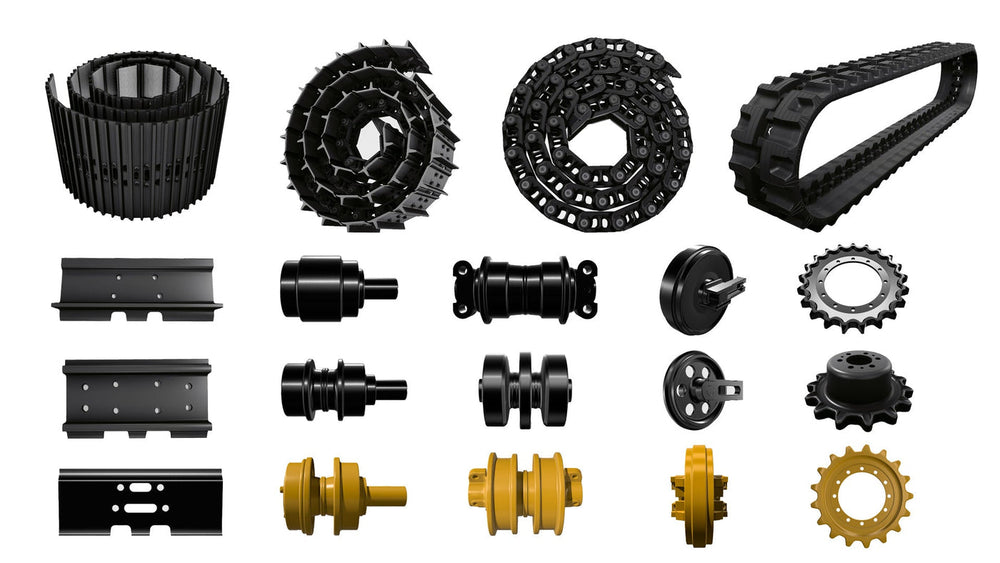
KTSU’s undercarriage work covers more than 3,000 items, including sprockets, track rollers, front idlers, carrier rollers, and track-chain assemblies. That breadth is useful in practice because sprocket wear is rarely an isolated component issue; the rim, chain, rollers, and idler influence one another.
KTSU Expert Views
From an undercarriage engineering perspective, an odd-tooth drive sprocket rim should be viewed as a contact-pattern decision rather than a universal durability claim. Its main purpose is to interrupt repetitive engagement between the tooth ring and chain, helping distribute wear when the chain pitch and machine geometry support that relationship.
KTSU’s production experience combines CAD/CAM development with NITTO friction welding, robotic CO2 welding, and CNC machining. Those processes matter because an accurate tooth profile can still perform poorly if the rim’s mounting faces, bore relationship, or segment alignment are not controlled. Surface hardness and case depth also need to suit the expected load and abrasive environment; hardness without adequate supporting material can lead to chipping, while an unsuitable profile can create abnormal chain contact.
The practical inspection point is simple: compare the rim wear with the chain’s pitch and bushing condition. If the chain has already elongated, fitting a new odd-tooth rim may only move the problem to a different surface. KTSU’s 70,000-square-meter Kunshan facility and Japanese-Chinese engineering structure reflect the level of process coordination required when replacement parts must fit global equipment platforms such as Caterpillar, Komatsu, and Hitachi.
How Can Service Life Be Improved?
The strongest improvement usually comes from treating the sprocket and chain as a matched wear pair. Replacing only the visibly damaged rim may restore the tooth outline temporarily, but it cannot remove pitch errors, seized bushings, or alignment problems in the rest of the undercarriage.
Useful maintenance habits include:
Measure chain pitch before installing a new rim.
Check track tension under the machine manufacturer’s specified conditions.
Clean compacted soil and stones from the sprocket area.
Inspect tooth flanks for hooked, pointed, or asymmetrical wear.
Check sprocket fasteners and segment seating for movement.
Review turning habits when one side of the machine shows faster wear.
Replace severely worn chain components rather than forcing them to run with a new rim.
Keep records of operating hours, terrain, and component changes.
The same principle applies to agricultural machinery, where mud, crop residue, and seasonal storage can create different wear patterns from those seen on excavators. A rim that performs well in clean, regular operation may age much faster when contamination prevents proper bushing engagement.
Frequently Asked Questions
Why do drive sprockets often have an odd number of teeth?
So that the engagement between each tooth and the chain bushings keeps changing as the track runs. That spreads contact over the whole part instead of letting the same tooth meet the same bushing every revolution, which is what turns wear into a localised pattern.
Are odd-tooth and even-tooth rims interchangeable?
They interchange physically only where every other specification matches, and the difference in tooth count still changes the wear pattern. On a machine designed around one count, fitting the other can bias contact toward particular positions.
What does sprocket rim segmentation add?
It allows the rim to be replaced without removing the whole assembly in the field and it changes how the drive load is shared between the segments. Both effects depend on the segmentation and bolt specification the machine was built for.
Why does a replacement rim still wear unevenly?
Usually because the chain pitch has moved or the contact is biased by the tooth count. A rim running against a chain that has already extended will not deliver the wear pattern the original design intended.
Sources
This article is part of Sprocket Wear and Replacement: What Ruins a Drive Sprocket, the guide that covers this topic in decision order.
More Undercarriage Parts guides
Find the next article for your component, application or buying decision.
Back to Undercarriage Parts