What Are the Parts of a Track Chain and Their Functions?
Component selection, fitment and the connections that keep an undercarriage working as a system.
On this page
A track chain is a loop of links, pins, and bushings — the pins join the links, the bushings carry the rolling and engagement load, and on sealed chains, seals keep oil in the joint. Every other chain article in this cluster builds on this vocabulary: pitch, gauge, elongation, lubrication, and replacement all start here. This guide is the chain cluster's anatomy hub — learn the parts once, and every ordering conversation after it goes faster.
Key Facts — Track Chain Anatomy at a Glance
Entity: KTSU — chain range covering 190B and 203-D60 families with OEM cross-references.
Building blocks: links, pins, bushings, and seals.
Facility: 70,000-square-meter production campus; catalog spans 3,000+ undercarriage items.
Identity fields: pitch, gauge, and pin diameter.
Rule: a dimensional cheat sheet prevents the most common chain ordering errors.
The Building Blocks of a Track Chain: Links, Pins, and Bushings
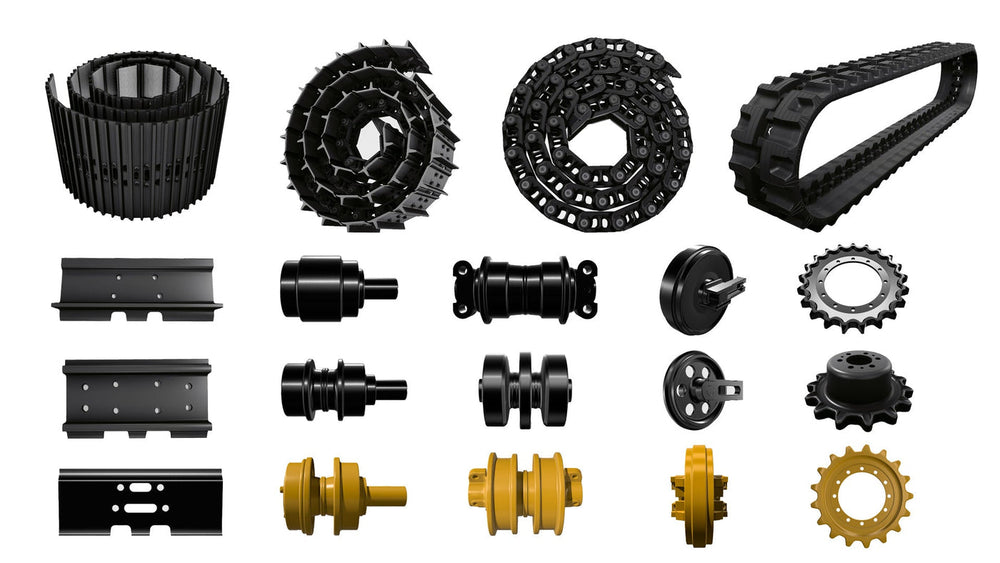
The chain is a repeating pattern: outer links and inner links alternate, joined by pins and bushings. The pin passes through the bushing and holds the pair together; the bushing is the wear surface the sprocket teeth engage and the rollers ride on. The links carry the tension, and the pins and bushings carry the articulation — the chain bends around the sprocket and idler by pivoting at each joint.
Track chain parts and their jobs
| Part | Job | Wear signature |
|---|---|---|
| Outer link | Carries tension, connects pins | Cracks, elongation of the link hole |
| Inner link | Carries tension, holds bushings | Rail wear, link hole elongation |
| Pin | Articulates the joint | Wear where it meets the bushing |
| Bushing | Wear surface for sprocket and rollers | Outer diameter wear, wall thinning |
| Seal | Keeps oil in the joint | Seep, contamination ingress |
Each part fails in its own way, and the failure signature tells you which part to look at — the elongation story is the pin and bushing story, while cracked links are a material or impact story.
How Do Seals Turn a Chain Into a Sealed System?
Seals sit between the link faces at each joint, and on sealed-and-lubricated chains they keep oil in the pin-bushing interface and contamination out. The sealed joint runs with a stable film, which slows the internal wear that unsealed chains suffer. Sealed-dry chains use the same seal hardware without the oil fill — cheaper, but with less internal protection. The full lubrication-family comparison lives in the sealed-vs-unsealed guide in this cluster; here, the anatomy point is where the seals sit and what they protect.
The seal is the part that turns an articulation joint into a maintenance decision: sealed chains trade higher upfront cost for longer internal life, and the seals decide how long the oil stays where it belongs.
Pitch, Gauge, and Pin Diameter: The Chain's Identity Card
Three numbers identify a chain. Pitch is the center-to-center distance between pins — the number in designations like 190B and 203. Gauge is the distance between the inner link rails, which sets the widths the chain runs on. Pin diameter sets the joint strength and the bushing bore. Together the three define the chain's identity, and they are the fields every spec sheet leads with.
Misreading the three fields is the most common chain ordering error: two chains can share a pitch and differ in gauge, or share a gauge and differ in pitch, and neither is a usable substitute. The chain-sizing guide in this cluster teaches the measurement; here, the vocabulary is the point.
What Parts Make Up a Track Chain?
A track chain is made of outer links, inner links, pins, bushings, and — on sealed chains — the seals between the links. The links carry the tension, the pins articulate the joints, the bushings carry the engagement and rolling load, and the seals protect the joint. That is the whole anatomy, and every chain on the market, from compact machines to mining excavators, is built from the same five elements at different scales.
The practical value of the answer is in ordering: when a buyer can name the part and the field — "I need the bushing spec for a 203 chain" — the supplier can answer in one round instead of three.
How a Chain Wears From the Inside Out
Chain wear runs two paths. Internal wear happens at the pin-bushing interface: as the chain articulates, the pin and bushing wear each other, the joint develops play, and the chain's pitch elongates — the "stretch" that every wear chart tracks. External wear happens on the rails and the bushing OD: the rails rub the rollers and idler, and the bushing OD wears where the sprocket teeth engage. The two paths are measured differently and mean different things.
Elongation is the headline metric because it decides the sprocket's fate; rail and OD wear decide the roller and idler's. The chain-stretch guide in this cluster covers the elongation measurement, and the chain-sizing guide teaches the pitch, gauge, and pin-diameter fields that identify the chain.
Chain Rail Wear vs. Pin and Bushing Wear
Rail wear is visible from the outside — the link rails thin and show a polished surface where they ride the rollers and idler. Pin and bushing wear is invisible until the joint develops play and the chain elongates. A chain can look healthy on the rails and be finished at the joints, or the reverse. That is why the inspection measures both paths: rail thickness with calipers, and elongation across a set number of links.
Reading the two paths together also diagnoses the machine: heavy rail wear with normal elongation points to rollers or the idler running against the rails, while heavy elongation with clean rails points to duty, contamination, or lubrication — the site and the seals, not the frame.
What Is Chain Pitch and Gauge?
Pitch is the center-to-center distance between adjacent pins; gauge is the distance between the inner link rails. Pitch decides the sprocket match and the drive geometry; gauge decides the roller and idler widths the chain runs on. Both are fixed dimensions of the chain family — the numbers in designations like 190B and 203 — and both must match the rest of the track group.
The confusion between the two is common and costly: an order that names the pitch but misses the gauge can land a chain that fits the sprocket and misses the rollers. The spec sheet states both, and the sizing guide shows how to measure each.
Using Chain Vocabulary When You Order Spares
Order spares with the vocabulary: chain family and pitch, gauge, pin diameter, link count, and shoe bolt spacing. The track chain collection on this site lists those fields with every chain, and the 203-D60 chain is an example of a listing where the family and specs are stated together. When the old chain is off, measure and photograph it before it goes to scrap — the chain itself is the best spec sheet the order has.
The glossary in this article is the shortcut: links, pins, bushings, seals, pitch, gauge, and pin diameter. Name the field, and the supplier's answer is one round instead of three.
The sealed-versus-unsealed chain decision is covered in the seal comparison guide.
KTSU Expert Views
A dimensional cheat sheet prevents the most common chain ordering errors. In our cross-reference work, the chain orders that go wrong are the ones where the buyer described the machine instead of the chain — no pitch, no gauge, no pin diameter — and the supplier matched a lookalike. The anatomy is simple: links carry the tension, pins articulate, bushings carry the load, seals protect the joint. Learn those five parts and the three identity fields, and the ordering conversation changes completely. That is why we list the family, pitch, gauge, and pin diameter with every chain, and why we ask for the old part's measurements when the number is missing. The vocabulary is the fastest tool a buyer has.
- KTSU Application Engineering Team
Conclusion
Learn the vocabulary once; order correctly every time. Links, pins, bushings, and seals are the anatomy, and pitch, gauge, and pin diameter are the identity — name the fields, and the rest of the chain cluster builds on that foundation.
Key Takeaways
- Chain anatomy is five parts: links, pins, bushings, seals, and the joint they form.
- Identity is three fields: pitch, gauge, and pin diameter.
- Wear runs two paths — internal elongation and external rail/OD wear.
- Read both paths in the inspection log; they diagnose different problems.
- Order spares with the vocabulary, and measure the old chain before scrap.
Questions to Ask
- What are the pitch, gauge, and pin diameter of the chain we need?
- Is the failure signature rail wear, joint elongation, or cracked links?
- Does the listing state the family and identity fields together?
- Which path is the inspection log tracking — internal, external, or both?
- Was the old chain measured and photographed before removal?
Browse link and chain products, or send your chain measurements and photos for an exact match.
Frequently Asked Questions
What parts make up a track chain?
Outer links, inner links, pins, bushings, and — on sealed chains — seals between the links. The links carry tension, the pins articulate, and the bushings carry the engagement and rolling load.
What is chain pitch and gauge?
Pitch is the center-to-center distance between pins; gauge is the distance between the inner link rails. Pitch matches the sprocket, and gauge matches the roller and idler widths.
How does a track chain wear?
Two paths: internal wear at the pin-bushing joint elongates the pitch, and external wear on the rails and bushing OD comes from contact with rollers, idler, and sprocket. The two are measured separately.
What does a sealed chain do?
Seals keep oil in the pin-bushing joint and contamination out, slowing the internal wear that elongates the chain. Sealed chains trade higher upfront cost for longer internal life.
What terms do I need when ordering?
Chain family and pitch, gauge, pin diameter, link count, and shoe bolt spacing. Name those fields and the supplier can confirm the match in one round.
More Undercarriage Parts guides
Find the next article for your component, application or buying decision.
Back to Undercarriage Parts