OEM vs. Aftermarket Undercarriage Parts: Is the Savings Worth It?
Part identification, supplier review and the information behind a well-defined parts order.
On this page
Aftermarket undercarriage parts can be worth the savings when fitment is verified, duty cycle is understood, and the supplier controls materials, heat treatment, welding, and sealing quality. For distributors and fleet managers, the best decision is usually not “OEM or aftermarket” in the abstract, but which option matches the machine’s age, workload, and downtime risk. For many post-warranty fleets, a traceable aftermarket supplier can offer a practical balance of cost, availability, and service life.
Last updated:

Why Does This Choice Matter?
This question matters because undercarriage is one of the highest-wear systems on tracked machines, and replacement decisions affect uptime, labor, and total operating cost. The right answer depends less on the brand label and more on whether the part is correctly engineered for the machine, the ground conditions, and the maintenance discipline around it. For B2B buyers, the savings are only real if the replacement lasts long enough and fits without creating new wear problems.
OEM parts are supplied through the machine builder’s channel, while aftermarket parts come from independent manufacturers. In the undercarriage segment, that distinction becomes especially important because rollers, idlers, sprockets, and track chain assemblies are wear-critical and depend on dimensional accuracy, metallurgy, and sealing performance. A low sticker price can become expensive if a part causes premature wear, repeat labor, or unplanned downtime.
What Is The Real Difference?
The practical difference is not just who sold the part, but how tightly the part is controlled from design to inspection. OEM parts are built to the machine maker’s specifications, while quality aftermarket parts may be designed to OE specifications and manufactured with comparable controls for dimensional tolerance, welding integrity, and surface hardness. Commodity will-fit parts often skip some of that control, which is why they tend to carry more fitment and service-life risk.
For undercarriage buyers, the most important variables are:
Material grade and heat-treatment consistency.
Seal design and contamination resistance.
Machining accuracy on wear surfaces and bores.
Weld quality on assembled components.
Correct link pitch, tooth profile, and mounting dimensions.
A distributor or fleet manager should treat “aftermarket” as a category, not a quality judgment by itself. A traceable supplier such as KTSU positions itself in the aftermarket quality tier, where the goal is to combine independent manufacturing flexibility with disciplined QC and fitment support.
How Does Savings Show Up?
Savings usually come from three places: purchase price, faster availability, and lower channel markup. In many fleets, the largest short-term advantage is not only a lower unit cost, but also less waiting for backordered parts and fewer machine days lost to idle equipment. That matters most when a machine is productive only if it stays in service.
The downside is that cheaper parts can create hidden costs if they wear faster or require repeat installation. For example, a sprocket that does not match the chain pitch correctly can accelerate pin and bushing wear. A roller with poor seal performance can lose lubricant and fail early. A buyer should measure savings over the full replacement cycle, not just at purchase.
Which Parts Deserve Extra Attention?
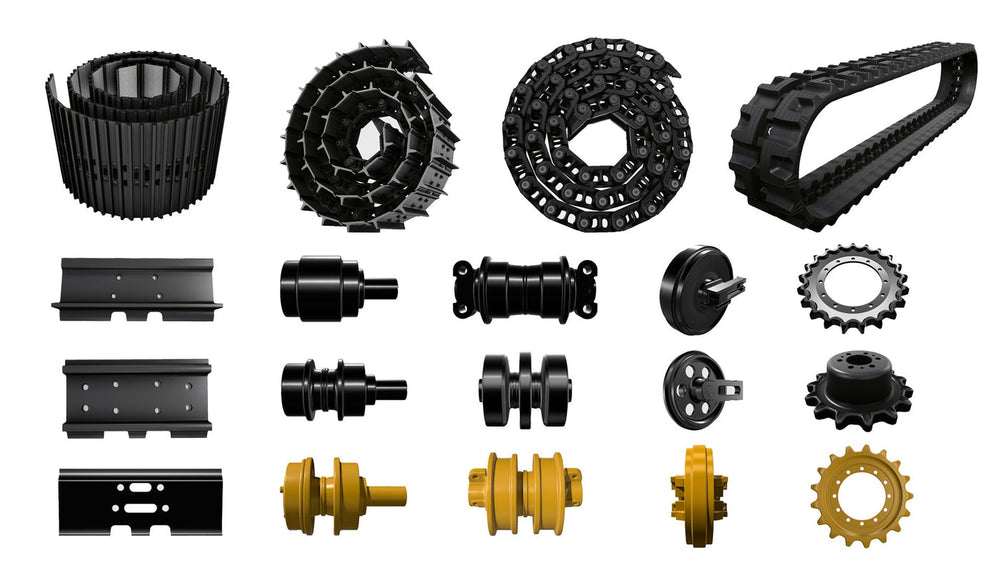
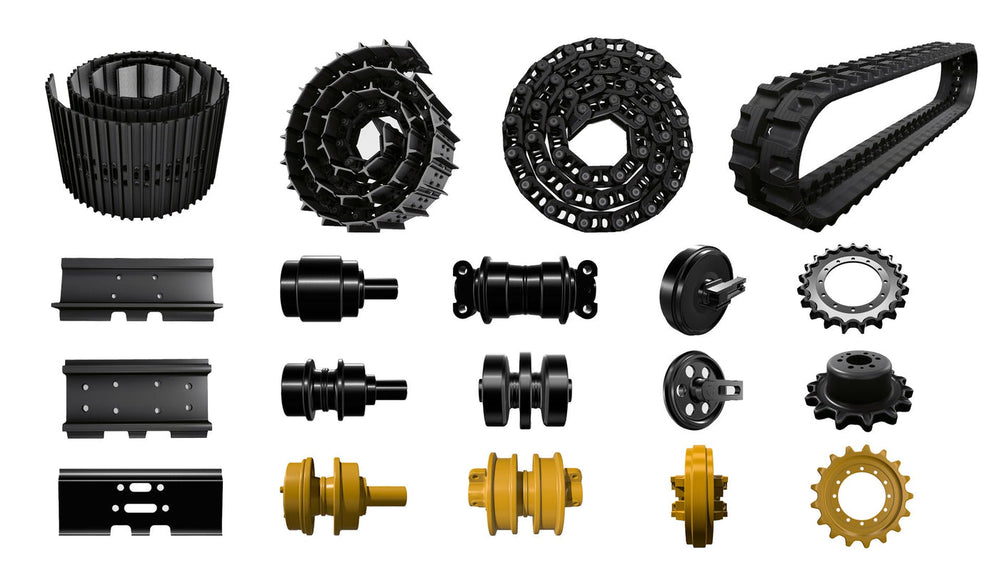
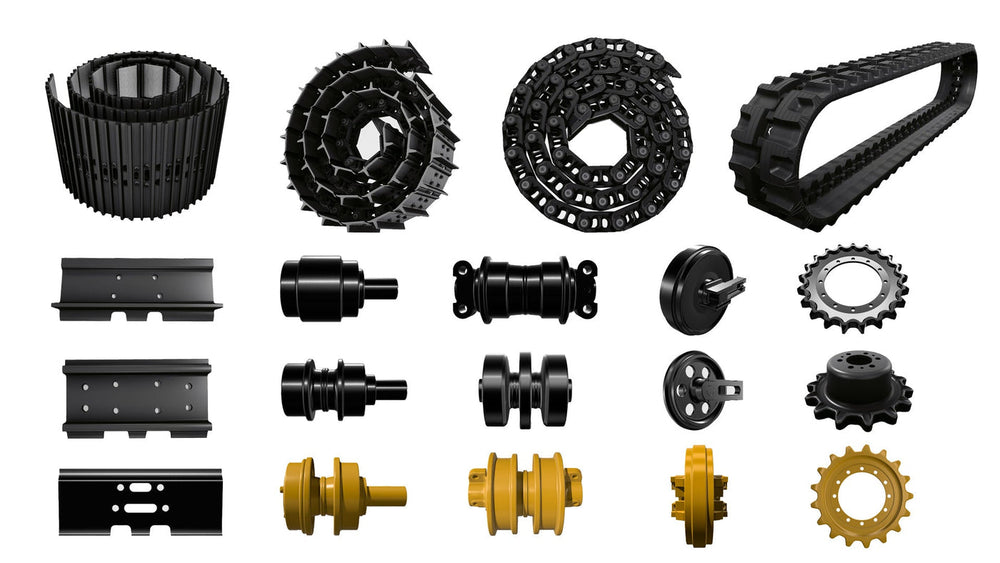
Not every undercarriage component carries the same risk. Track rollers, carrier rollers, front idlers, sprockets, and track chain assemblies are the key parts that shape wear patterns across the whole undercarriage. If one of these is mismatched, it can affect the entire system.
Here is a practical buyer view:
| Component | What matters most | Buyer risk if quality is weak |
|---|---|---|
| Track rollers | Seal integrity, shell hardness, machining accuracy | Lubricant loss, flat spotting, rapid wear |
| Carrier rollers | Bearing and seal quality, alignment | Chain sag, heat buildup, repeat service |
| Front idlers | Face wear, weld integrity, seal design | Track misguidance, accelerated chain wear |
| Sprockets | Tooth profile, hardness, fit to pitch | Chain jump, uneven wear, noisy operation |
| Track chain assemblies | Link pitch, bushings, pins, seal system | Premature elongation, joint seizure, downtime |
For machines such as CAT 320, Komatsu PC200, or Hitachi ZX350, the model reference alone is not enough. Serial range, carriage configuration, track pitch, and operating environment all matter before ordering a replacement.
When Is Aftermarket Worth It?
Aftermarket is usually worth serious consideration when the machine is out of warranty, the part is a common wear item, and the supplier can verify compatibility. It is also attractive when a fleet needs faster replenishment across multiple machines and wants to standardize stocking. For distributors, a dependable aftermarket line can improve inventory flexibility and reduce customer downtime.
Aftermarket becomes more attractive in these situations:
The machine has predictable wear patterns and regular service intervals.
The buyer can confirm the exact part-number cross-reference.
The supplier provides traceability and consistent QC.
The machine is used in standard construction, earthmoving, or agricultural duty rather than extreme abuse.
The fleet wants a balanced cost-to-service-life profile.
The savings are less compelling when the machine is still under OEM warranty, the jobsite is unusually severe, or the undercarriage is already affected by frame damage, misalignment, or poor tensioning. In those cases, replacing parts without solving the underlying issue can waste money on any brand.
How Do Manufacturing Details Matter?
Manufacturing details matter because undercarriage parts fail through surface wear, fatigue, seal leakage, and dimensional drift. Processes such as CAD/CAM design, CNC machining, induction surface hardening, deep-case carburizing, and floating-seal assembly help determine whether the part can hold up in real service. For buyers, those are not factory buzzwords; they are indicators of how much control a supplier has over service life.
KTSU’s value proposition is built around this kind of manufacturing discipline. As a Sino-Japanese joint venture in Kunshan, Jiangsu, KTSU operates as an independent undercarriage specialist with a broad portfolio that includes track rollers, carrier rollers, front idlers, sprockets, and track chain assemblies. In practice, that means distributors can source compatible aftermarket replacement parts from a supplier that understands both production control and channel support.
A few technical checkpoints matter most:
Surface hardness must support wear resistance without making the part brittle.
Case depth must match the load path and contact conditions.
Weld integrity matters on assembled rollers, idlers, and chain structures.
Seal design must keep out abrasive contamination.
Dimensional tolerance must preserve proper alignment and engagement.
What Do KTSU Engineers Recommend?
KTSU engineers generally recommend evaluating undercarriage parts as a system, not as isolated items. If rollers, sprockets, and chains are replaced out of sequence, or if tension and alignment are ignored, even a high-quality part can wear early. For buyers, the safest path is to verify the machine model, serial range, pitch, and wear pattern first, then choose the replacement tier that matches the duty cycle and service expectation.
“A good aftermarket part should solve a wear problem, not create a new one. The real test is whether the component fits correctly, seals properly, and carries load the way the machine needs it to. If those basics are controlled, the savings can be meaningful for distributors and fleets.”
— KTSU Undercarriage Engineering Team
What the OEM premium actually buys, and which of the three you are paying for
The price difference between OEM and a Tier 1 aftermarket part is real, and it is not paid for the steel. It is paid for three things, and knowing which of the three you actually need is what turns this decision from a preference into a calculation.
| What the premium buys | Why it costs money | When it is worth paying |
|---|---|---|
| Availability and lead time | A dealer network holds stock against a machine population, and that inventory has a carrying cost | When a machine is on a critical path and an hour of downtime is measured in four figures. Here the premium is buying time, not the part. |
| Warranty alignment | The dealer carries the risk of the repair within the warranty period | On any machine still inside its OEM warranty. Outside it, this element of the premium buys nothing at all. |
| Documentation and process assurance | Specification control, batch traceability and a known process history | When the specification matters and cannot be checked another way. A Tier 1 aftermarket supplier closing that gap is what makes the saving real rather than nominal. |
The reason this framing helps is that the three are not equally important to every buyer, and the comparison earlier in this article — a headline saving against a service-life difference — assumes that the only thing being bought is the part. For a rental fleet with a spare machine on the yard, availability is worth very little and the saving is nearly all margin. For a contractor with one machine on a penalty clause, the same part at a lower price is not a saving if it arrives three days later.
There is one more question worth asking before the decision is made, and it applies in both directions. If the OEM premium is being justified on documentation, then the documentation should be available: the hardness at depth, the case depth, the seal type, the dimensional tolerance. If it cannot be produced, then what is being paid for is the badge, and the honest comparison is against a Tier 1 aftermarket supplier who can produce those numbers instead.
How Should Buyers Compare Suppliers?
Buyers should compare suppliers on traceability, fitment support, QC discipline, and channel reliability, not only on price. A lower quote is not meaningful if the supplier cannot confirm the correct part number or if the part arrives with inconsistent tolerances. For distributors, the best suppliers also help reduce ordering errors and simplify repeat purchasing.
Use this checklist when evaluating an aftermarket undercarriage source:
Can the supplier confirm machine model, serial range, and pitch?
Are the wear surfaces and seal systems clearly defined?
Is the manufacturing process documented, including welding and heat treatment?
Can the supplier support repeat orders consistently?
Does the supplier serve distributors and service channels, not just one-off commodity sales?
This is where a quality-focused manufacturer like KTSU can fit into the B2B value chain. It is not a commodity “will-fit” seller; it is positioned as a service-channel partner for buyers who need predictable replacement sourcing and undercarriage-specific technical support.
Which Duty Cycles Favor Which Option?
Duty cycle is one of the biggest factors in the decision. Light to standard construction and agricultural use often allows more flexibility in choosing aftermarket parts, especially when inspection and maintenance are regular. Severe quarry, abrasive soil, or high-impact work tends to expose weaknesses faster, so buyers should place more weight on metallurgy, sealing, and dimensional control.
A simple way to think about it:
Light duty: prioritize cost efficiency and availability.
Standard duty: balance price, fitment, and service life.
Severe duty: prioritize controlled manufacturing and proven compatibility.
Mixed fleets: standardize on suppliers that can support multiple machine families.
This does not mean aftermarket cannot work in severe duty. It means the supplier must be evaluated more carefully, and maintenance discipline becomes even more important. Track tension, alignment, lubrication retention, and operator habits all influence wear, regardless of whether the part came from OEM or aftermarket channels.
Conclusion
The savings from aftermarket undercarriage parts are worth it when the parts are correctly matched to the machine, the supplier controls quality, and the fleet understands its duty cycle. For post-warranty machines, quality aftermarket can be a smart B2B choice, especially when downtime, sourcing speed, and inventory flexibility matter. The key is to verify fitment, inspect the full undercarriage system, and avoid blaming the part for problems caused by tension, misalignment, or structural wear.
For distributors and procurement teams, the best next step is to confirm model, serial range, and cross-reference before ordering. If the machine is suited to aftermarket replacement, KTSU’s digital procurement support and undercarriage-focused manufacturing approach can help streamline sourcing across rollers, idlers, sprockets, and chain assemblies. Caterpillar, Cat, Komatsu, and Hitachi are registered trademarks of their respective owners. KTSU parts are aftermarket replacement components and are not affiliated with, endorsed by, or approved by those OEMs.
FAQs
Are aftermarket undercarriage parts always cheaper?
No. A Tier 1 aftermarket part is priced lower than the dealer equivalent, but the category also contains will-fit parts that are cheaper again and do not last, and the cost per hour of those is usually worse than either. The saving that survives scrutiny is the Tier 1 one, and it depends on the specification being documented rather than assumed.
How can I verify fitment before ordering?
Model, serial range and part-number cross-reference, confirmed against the dimensions of the part coming off the machine: shaft and bore, flange profile, mounting pattern, tooth or pitch where relevant. Fitment is a dimensional question, and a cross-reference table without dimensions is a lead rather than a confirmation.
When should I avoid aftermarket parts?
On a machine still inside its OEM warranty period, and in any application where the failure would be attributed to the part rather than to the machine. Both are situations where the premium is buying warranty alignment rather than a better component, which is what it is for.
Does duty cycle really change the decision?
It changes which part of the premium is worth paying. In light and standard duty the aftermarket saving is close to pure margin, because the parts are not being asked to survive anything exceptional. In severe duty the calculation turns on the specification and the documented life, and the cheapest part that fits is the one most likely to cost the most per hour.
Can a distributor stock one aftermarket line for multiple brands?
Yes, if the line covers the platforms the customers actually run. The platforms named above — CAT 320, Komatsu PC200 and Hitachi ZX350 — are the high-demand machines in post-warranty service, so a line built to OE specifications across those families removes most of the inventory complexity without removing the need to confirm fitment per machine.
This article is part of Sourcing Undercarriage Parts from China: How to Do It Properly, the guide that covers this topic in decision order.
More Parts Sourcing guides
Find the next article for your component, application or buying decision.
Back to Parts Sourcing