Mud Packing in Carrier Rollers Can Turn Wet Ground Into a Bearing Problem
Component selection, fitment and the connections that keep an undercarriage working as a system.
On this page
A machine can leave a wet job site looking normal, then return the next morning with a carrier roller that feels stiff, runs hot, or has begun leaking oil. The issue is often not simply mud on the undercarriage. It is mud packing: saturated clay forced into the narrow clearance between the track frame, carrier roller, bracket, and moving track until it becomes a dense, abrasive wedge.
Last updated:

That distinction matters because a carrier roller is meant to guide the return run of the track with controlled rotation, not work against a solid block of compacted soil. On clay-rich sites, operators may focus on track tension or assume the roller has failed internally first. In practice, external packing can create the load, seal damage, and drag that lead to internal failure later.
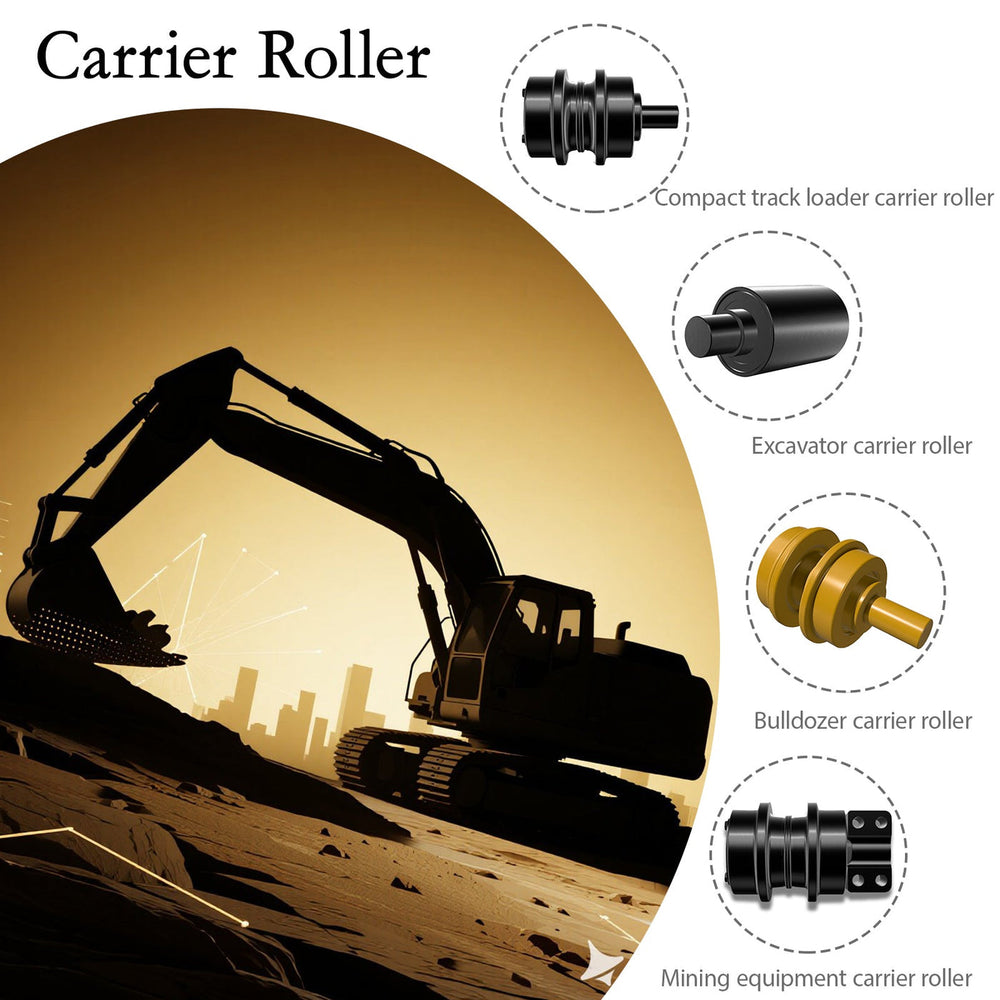
carrier rollers mud and clay conditions
Why Mud Packing Around Carrier Rollers Matters
Mud packing is the buildup and compaction of wet soil around a carrier roller and its mounting area. It matters because packed material can restrict roller rotation, force the track to slide over the roller shell, and place abnormal loads on seals, shafts, brackets, and bearings.
Wet clay is especially troublesome because it adheres to steel surfaces, collects grit and stones, and dries into a dense mass during downtime. What begins as a soft layer during a rainy shift can become a hard obstruction after a machine sits overnight.
A carrier roller may not carry the same continuous ground-contact load as a bottom roller, but it has a critical guidance role. When it binds, the return track can rub rather than roll smoothly, spreading friction and wear across the undercarriage system.
How a Mud Wedge Loads the Roller Assembly
The damaging force develops when moving track links carry wet material upward and press it into a restricted space around the roller. Each pass can add another layer, while vibration and repeated direction changes compact the material further.
The packed mass does not always press directly on the internal bearing race. Instead, it can impose side loading on the roller shell, push against the seal-protection area, restrict normal rotation, and alter the track’s contact with the roller. Once rotation becomes difficult, the track’s movement turns the roller from a rolling component into a sliding contact point.
This is why a roller can look intact during a quick walk-around yet fail shortly afterward. The bearing may have been operating with heat, contamination risk, and uneven external loading long before a leak or flat spot becomes visible.
Mud Packing Force Simulation Cross Section
The pressure path begins at the return track, which repeatedly carries wet material into narrow clearances. As the track moves, clay and grit are compressed between the fixed frame and the rotating roller assembly.
| Cross-section area | What happens under wet clay conditions | Resulting risk |
|---|---|---|
| Return track chain | Track links lift and carry wet soil toward the upper roller zone | New material is continuously introduced into the packing area |
| Frame-to-roller clearance | Clay, silt, grit, and small stones accumulate in a confined space | Material begins to compact instead of shedding |
| Packed mud wedge | Repeated movement creates compression against the frame and roller shell | Side thrust and rolling resistance increase |
| Roller shell | The shell may be prevented from rotating as designed | Track contact can shift from rolling to sliding |
| Seal interface | Abrasive material pushes and rubs near the seal-protection zone | Seal wear, leakage, and contamination risk increase |
| Bearing cavity | Heat and contamination become more likely after seal damage | Bearing wear or eventual seizure may follow |
The highest-risk area is usually not the visibly muddy outer surface. It is the hidden interface where material cannot escape easily and is repeatedly compressed by track movement.
If the machine is parked overnight, water can drain away while fine clay remains. The remaining material often becomes harder to remove before the next shift and may conceal early signs of roller damage.
Which Wet-Site Conditions Create the Worst Packing?
Sticky, fine-grained clay creates the most persistent packing because it clings to the track and frame before it can shed naturally. Deep excavation, drainage work, landfill access roads, rice-field preparation, and thawing ground often combine water, fines, and repeated low-speed travel.
Short travel distances can be misleading. A machine that continuously swings and excavates in one saturated area may cycle the same mud through the undercarriage for hours, even without traveling far.
Frequent reversing can worsen the pattern because accumulated material is pushed into different frame pockets instead of being released. Operators may assume the track is self-cleaning after several travel passes, but adhesive mud does not behave like dry sand or loose gravel.
KTSU’s experience across more than 3,000 undercarriage component applications points to a broader reality: roller durability is not determined by the component alone. Track design, frame clearance, operating pattern, local soil type, and cleaning discipline all influence whether mud remains superficial or becomes a compacted obstruction.
What Protection Makes Sense for Muddy Jobs?
No single feature eliminates packing on every wet site. The practical objective is to combine a roller design that resists contamination with enough clearance, inspection access, and cleaning discipline to prevent material from becoming a hardened wedge.
| Protection approach | What it addresses | Where it can fall short |
|---|---|---|
| Sealed carrier roller | Helps retain lubricant and limit contaminant entry | Seals can still be damaged by external abrasion or severe side loading |
| Mud-relief clearance | Gives wet material a route to escape | Clearance can still fill when clay is highly adhesive |
| Track guards or protective geometry | Reduces direct exposure of vulnerable areas | Guards may create another pocket if not cleaned |
| Correct track tension | Helps maintain intended track movement and contact | It does not remove existing packed material |
| Daily cleaning routine | Removes material before it hardens | Cleaning after hardening takes longer and may be incomplete |
A mud-protected sealed carrier roller makes the most sense when its sealing system, roller body, and surrounding geometry match the machine and working environment. The decision should be based on how frequently the machine operates in sticky material, how readily the roller zone can be cleaned, and whether the existing design has a history of buildup.
Why Sealed Carrier Rollers Can Still Fail in Mud
A sealed roller is not a reason to leave packed clay in place. Sealing protects the lubricant cavity, but it cannot fully compensate for a roller forced to run against compacted debris or a track that is no longer following its intended path.
One common expectation gap is assuming that a roller should immediately spin freely by hand after a muddy shift. Depending on track tension and contact position, that check may not reveal the whole condition. More useful warning signs include fresh oil around the seal area, unusual roller temperature after travel, visible track rubbing, a polished flat area on the roller shell, or hardened mud packed behind the bracket.
Another mistake is using high-pressure washing too aggressively around seal areas. Water can loosen compacted mud effectively, but direct pressure at vulnerable interfaces may create another contamination risk. Clean the surrounding buildup methodically, then inspect the component instead of treating water pressure as a complete fix.
A Practical Routine Before Packing Becomes Permanent
The best intervention is normally at the end of the shift, when material is still wet enough to remove. Waiting until the next morning lets clay dry, compact, and become much harder to clear safely.
Park on stable, level ground, lower the attachment, and shut down before working near the tracks.
Remove large deposits from the carrier roller bracket, roller sides, track-frame pockets, idler area, and sprocket area with suitable long-handled tools.
Use water to loosen remaining mud, keeping the spray directed at buildup rather than directly into seal interfaces.
Move the machine only when the work area is clear and it is safe to expose another portion of the track for inspection.
Check track sag against the machine manufacturer’s specifications rather than adjusting tension based only on apparent mud-related clearance.
Record repeated buildup locations, since one consistently packed roller position can indicate a site condition, guard configuration, or operating pattern worth reviewing.
A daily inspection is especially valuable after working in saturated clay. The problem is easier to correct when mud is soft and mobile than after it has dried into a dense block around the roller.
KTSU Expert Views
From an undercarriage engineering perspective, mud protection should be judged as a system rather than a label attached to one part. A carrier roller needs dependable sealing, but the surrounding track frame also needs to avoid creating a permanent soil trap. The central operating question is straightforward: when wet material reaches the roller zone, does it have a path to escape before repeated track movement compacts it?
KTSU’s 70,000-square-meter manufacturing facility in Kunshan reflects the production scale involved in maintaining consistency across a wide range of undercarriage designs. In roller production, machining accuracy, surface treatment, weld integrity, and seal-interface quality all influence how well an assembly tolerates alignment changes and contaminated operating conditions.
KTSU uses CAD/CAM development, precision CNC machining, robotic CO2 welding, and NITTO friction-welding processes in its manufacturing environment. These methods matter most when they support repeatable fit, stable sealing surfaces, and durable roller construction.
Still, a well-made sealed carrier roller cannot compensate indefinitely for neglected cleaning or unsuitable track adjustment. On wet clay jobs, the condition of the clearance around the roller deserves as much attention as the roller itself.
What the packing leaves behind
Cleaning removes the material. Whether the roller is still fit to use depends on what the packing did while it was there.
| What you find after cleaning | What it means | Clean or replace |
|---|---|---|
| The roller turns freely and the shell surface is unchanged | The packing has not yet caused damage | Clean, and change the clearing routine so it does not return |
| The roller turns but with resistance, and one point on the shell is polished | The roller has been dragged rather than rolled for some of its hours | Measure the shell and replace if the flat has removed the running surface |
| Oil visible at the end cap, or grease that has changed colour | The seal has been passing while the packing held material against it | Replace: a seal that is passing in this environment will not recover |
| A hub that is noticeably hotter than its neighbour after cleaning | The bearing is working harder than it should, whether from contamination or from a lost fit | Replace, and check the bracket and mounting while the roller is off |
The reason cleaning is often treated as the answer is that it visibly works. The machine runs better for a while afterwards, which hides the fact that a seal or a bearing has already passed its limit. The two checks that separate the cases are free: turn the roller by hand, and compare its hub temperature with the one beside it.
When Should You Replace Rather Than Clean?
Cleaning is appropriate when the roller remains sealed, turns normally under correct inspection conditions, and shows no evidence of overheating, leakage, shell damage, or track misguidance. Replacement becomes more likely when the roller has lost lubricant, developed a pronounced flat spot, seized, or damaged mating track components.
Do not replace only the visibly affected roller without checking the surrounding system. A new unit installed in the same packed-mud environment can repeat the failure pattern quickly.
KTSU’s fitment range for undercarriage applications associated with Caterpillar, Komatsu, and Hitachi machinery makes correct component matching important. Correct fitment, however, still needs to be paired with the machine manufacturer’s track-tension specifications and cleaning requirements.
Frequently Asked Questions
How does mud packing around a carrier roller cause a bearing problem?
Packed material holds abrasive against the seal and stops the shell turning freely, so the roller is dragged rather than rolled. The seal then passes, the bearing loses its lubricant and the load reaches a part that is already running hotter than it should.
When should a packed carrier roller be replaced instead of cleaned?
When cleaning reveals an oil trace at the end cap, grease that has changed colour, resistance to turning, or a hub that is warmer than its neighbour. Those four say the damage happened while the packing was there.
Does a sealed carrier roller survive muddy ground?
It survives better than an unsealed one and it is not immune, because the seal is what is being attacked. That is why the specification for the environment matters as much as the fact that the roller is sealed.
What routine stops packing around carrier rollers?
Clear the material while it is soft, check that each roller turns freely, and compare hub temperatures. The temperature comparison is the fastest way to find a roller that is already in trouble.
References
Caterpillar guidance on maintaining rubber tracks and removing packed mud
Caterpillar D4 undercarriage cleaning and seal-care recommendations
Komatsu undercarriage maintenance tips for cleaning and track adjustment
Hitachi Construction Machinery on anti-mud-compaction roller design
Caterpillar Used guide to undercarriage inspection and daily cleaning
This article is part of Carrier Rollers (Top Rollers): The Complete Guide, the guide that covers this topic in decision order.
More Undercarriage Parts guides
Find the next article for your component, application or buying decision.
Back to Undercarriage Parts