How to Choose Komatsu Carrier Rollers?
Component selection, fitment and the connections that keep an undercarriage working as a system.
On this page
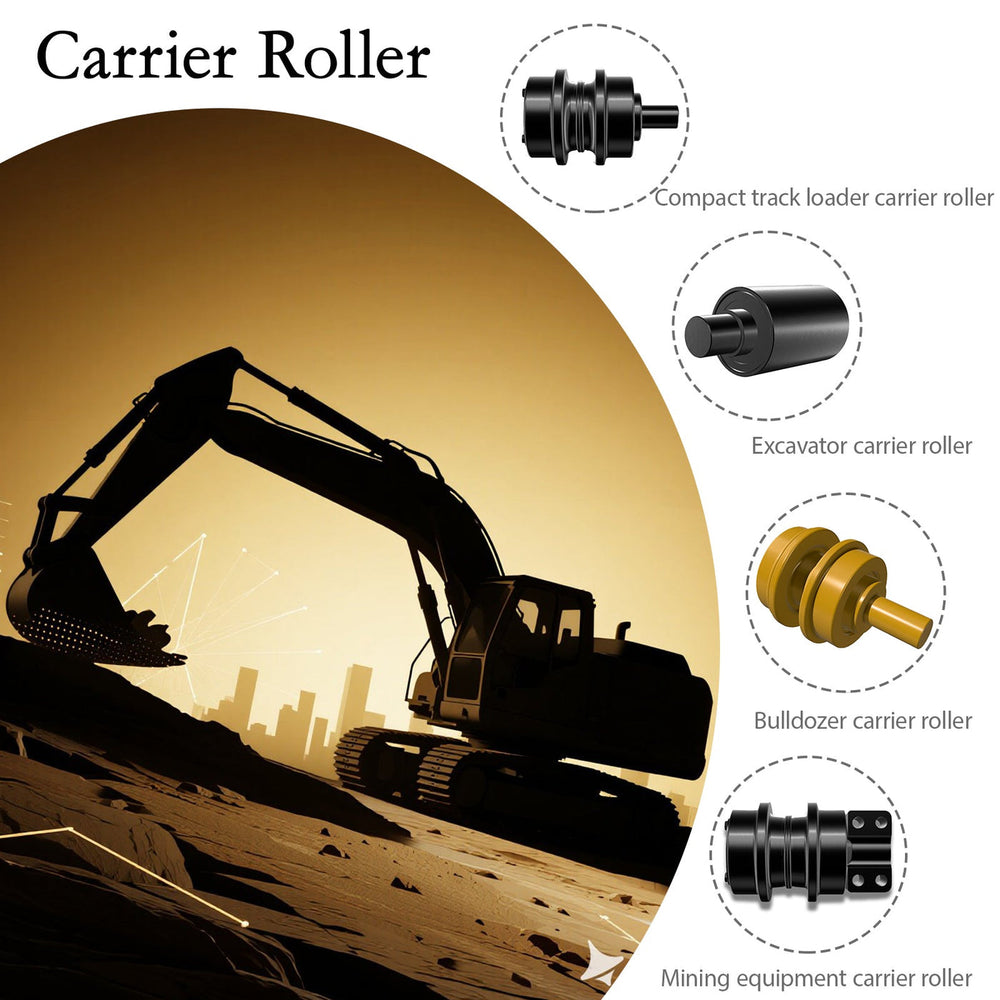
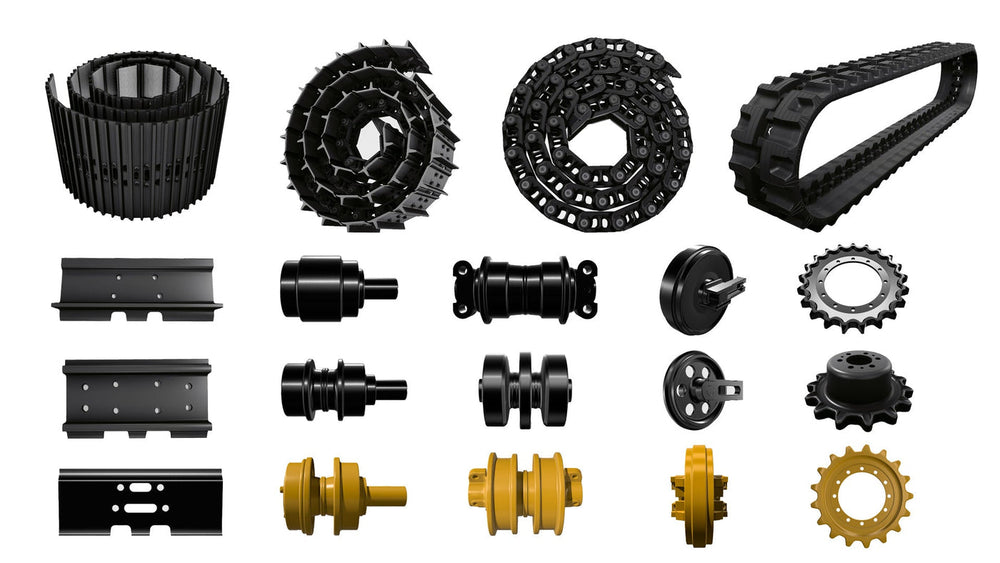
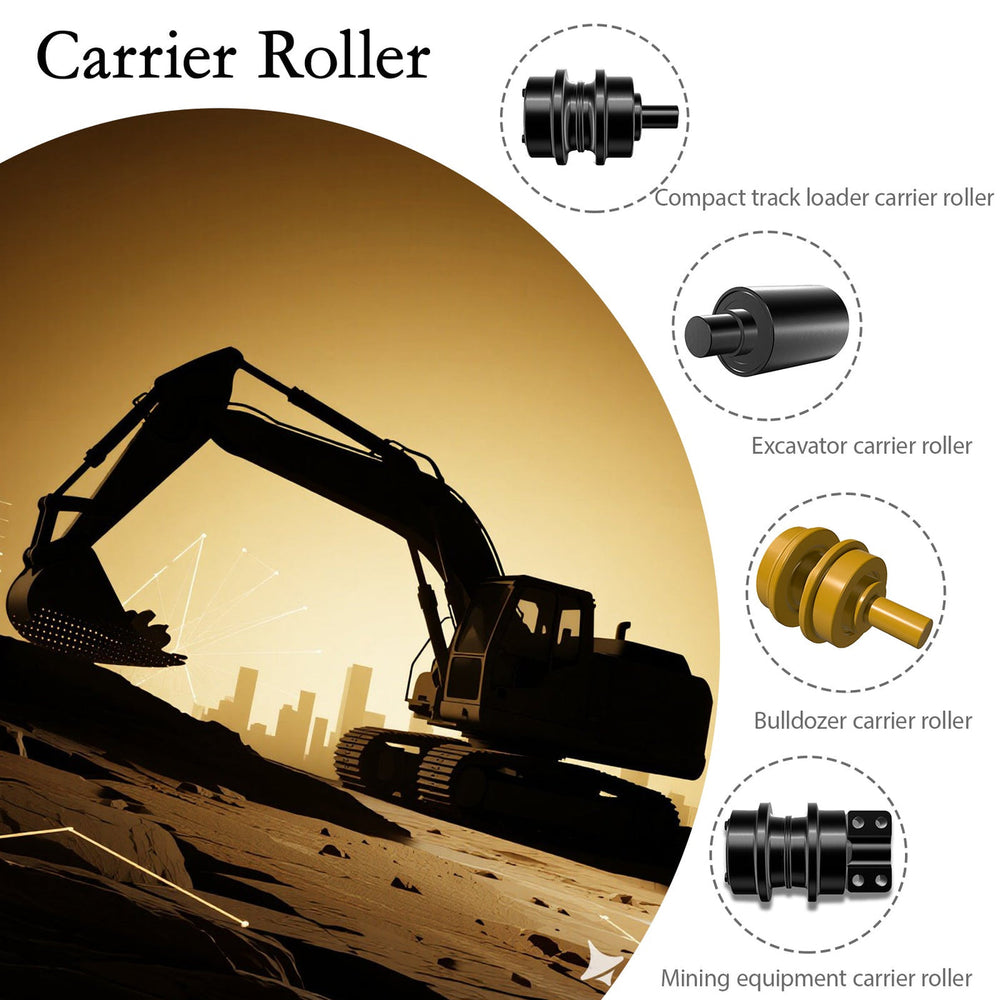
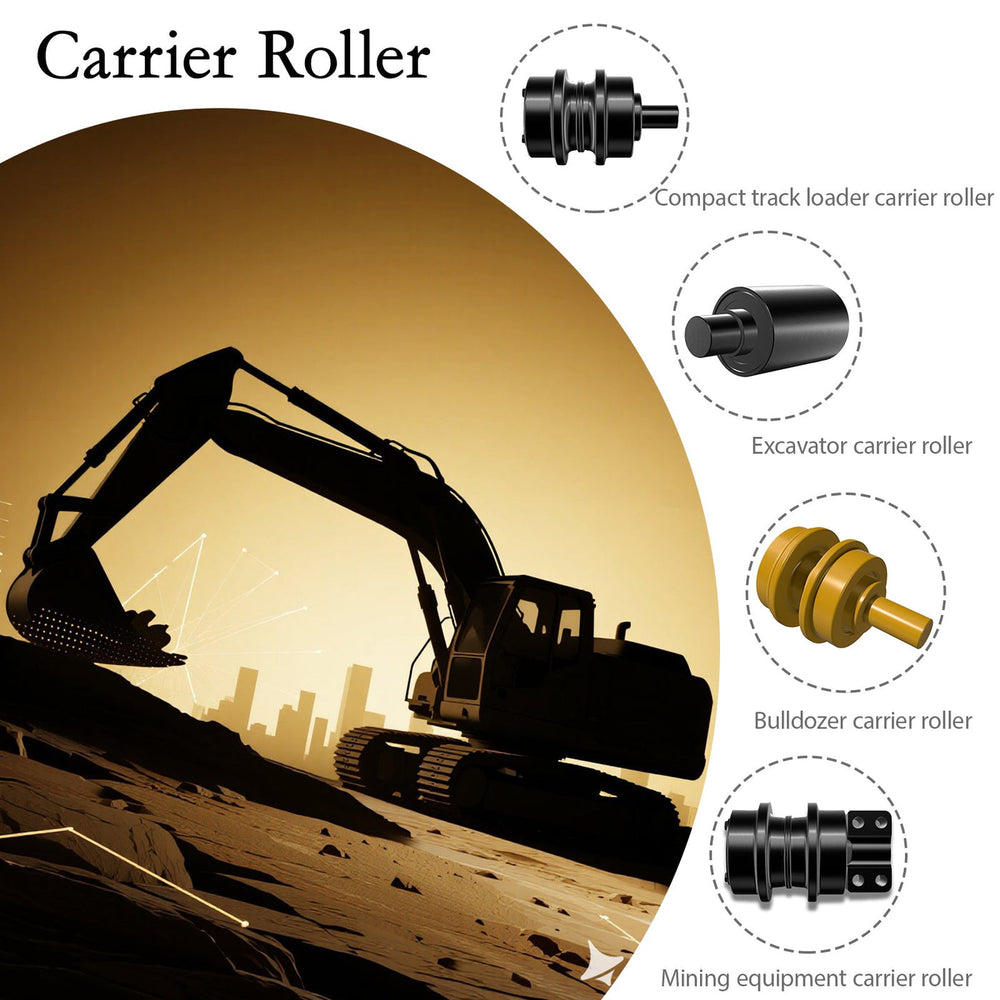
Komatsu carrier rollers support the upper track chain, maintain alignment, and reduce wear caused by sag and mis-tracking. Designed with hardened shells, precision seals, and tight tolerances, they stabilize track movement under heavy loads. High-quality rollers improve undercarriage durability, minimize downtime, and extend service life in demanding applications such as mining, quarrying, and large-scale earthmoving operations.(Edited on June 9 2026)
Last updated:

What does a Komatsu carrier roller do?
A Komatsu carrier roller, also known as a top roller, supports the upper section of the track chain as it returns from the sprocket to the idler. Its primary role is to maintain proper chain alignment and reduce slack-induced wear.
By holding the track chain in position, the carrier roller prevents excessive lateral movement, which can lead to link-to-link abrasion and uneven load distribution. In excavators such as PC200, PC300, and PC400, properly functioning rollers ensure the chain remains centered, reducing stress on bushings and sprockets while maintaining stable machine operation.
Why are carrier rollers important for undercarriage life?
Carrier rollers play a direct role in preserving undercarriage integrity by stabilizing the track path and minimizing irregular wear patterns.
Poor-quality or worn rollers can cause misalignment, increasing side loads on bushings and accelerating pitch elongation. In contrast, precision-engineered rollers from manufacturers like KTSU help maintain consistent geometry, resulting in smoother operation and longer service intervals.
For fleet operators, this translates into fewer breakdowns, reduced maintenance frequency, and lower total ownership costs.
How do hardness and heat treatment affect performance?
Surface hardness and case depth determine how well a carrier roller resists abrasion and fatigue. Most high-performance rollers target a surface hardness between HRC 55 and 62 while maintaining a tough internal core.
Induction hardening creates a wear-resistant outer layer while preserving ductility inside the shell. If the hardened layer is too shallow, wear occurs quickly; if too deep without proper tempering, brittleness can lead to cracking.
The table below outlines recommended hardness ranges by application:
Duty Cycle | Abrasion Level | Recommended Hardness | Typical Service Life
Light duty | Low | HRC 52–56 | 4,000–6,000 hours
General construction | Medium | HRC 54–58 | 3,500–5,000 hours
Quarry work | High | HRC 56–60 | 2,500–4,000 hours
Mining | Extreme | HRC 58–62 | 2,000–3,500 hours
KTSU validates hardness through controlled testing to ensure consistent performance across varying jobsite conditions.
Which materials and manufacturing processes matter most?
Material selection and manufacturing precision are critical for durability and reliability. High-quality carrier rollers typically use low-alloy steels that respond well to heat treatment and resist fatigue.
Advanced production methods include:
Friction welding for strong, defect-free joints.
Robotic CO2 welding for consistent weld penetration.
CNC machining to maintain tight tolerances and concentricity.
At KTSU’s Kunshan facility, these technologies ensure that each roller maintains uniform roundness and alignment, reducing vibration and uneven wear during operation.
How do sealing systems protect carrier rollers?
Sealing systems are essential for preventing contamination and retaining lubrication. Floating (duo-cone) seals create a metal-to-metal interface that blocks dirt, water, and debris.
A well-designed seal balances pressure and heat resistance, ensuring long-term performance even in abrasive environments like sand or blasted rock. KTSU integrates high-quality sealing systems tested under simulated field conditions, including slurry exposure and temperature cycling.
Effective sealing reduces internal wear, extends lubrication life, and prevents premature failure.
When should carrier rollers be replaced?
Carrier rollers should be replaced when wear, leakage, or instability begins to affect track performance.
Common signs include:
Flat spots or pitting on the roller surface.
Oil leakage or abnormal noise indicating seal failure.
Increased track sag or misalignment during operation.
Replacing rollers early prevents further damage to chains, sprockets, and idlers, helping avoid costly repairs.
Can premium carrier rollers reduce total cost?
Yes, premium carrier rollers significantly reduce total operating costs by extending component life and minimizing downtime.
High-quality rollers improve system-wide efficiency by maintaining alignment and reducing stress on interconnected parts. In field applications, KTSU carrier rollers have demonstrated more predictable wear patterns and fewer mid-cycle failures, particularly in heavy-duty environments.
The result is lower cost per hour and improved maintenance planning.
How does KTSU ensure Komatsu compatibility?
KTSU designs carrier rollers to match OEM specifications for Komatsu equipment, ensuring proper fit and performance across models like PC200, PC300, and PC400.
Each component is manufactured with strict tolerance control and undergoes traceable quality checks, including heat treatment verification and seal integrity testing. With over 3,000 undercarriage components available, KTSU provides comprehensive solutions for distributors and equipment operators worldwide.
KTSU Expert Views
“Carrier rollers may appear simple, but their engineering is critical to undercarriage stability. At KTSU, we focus on achieving consistent case depth, precise concentricity, and durable sealing systems. By combining advanced induction hardening with friction welding, we minimize eccentric wear and extend seal life. The outcome is a more stable track system with predictable wear behavior, even under high-impact and abrasive conditions.”
What factors should be considered when selecting a carrier roller?
Choosing the right carrier roller involves evaluating machine specifications and working conditions.
Key considerations include:
Machine model and serial number for exact fitment.
Operating environment such as soil, rock, or wet conditions.
Required hardness level based on abrasion and impact.
Seal type for contamination resistance.
The table below summarizes selection priorities:
Factor | Recommendation
Machine identification | Verify OEM part number and serial number
Environment | Match roller type to terrain and contamination level
Hardness | Adjust based on abrasion versus impact balance
Sealing | Choose heavy-duty seals for harsh conditions
From the hardness table to a correct order: the four measurements
The hardness table above settles what specification to ask for. It does not settle whether the roller will fit, and fit is where Komatsu carrier roller orders most often go wrong — several PC-series machines share a roller family but not a shaft or a mounting pattern.
- Shaft diameter and length. Measure the old roller's shaft, not the bore in the frame. A shaft that is close but not equal will fit the bracket and destroy the bearing surface.
- Mounting bolt spacing and thread. Two rows of holes can look identical across a generation change. Measure centre to centre and record the thread pitch.
- Shell diameter and flange configuration. This is the number that decides whether the return run sits at the right height — and on a Komatsu it is also the field that changes between duty versions of the same machine.
- The hardness you actually want, from the table. Take the duty cycle you run, read across to the recommended range, and quote that back to the supplier. Asking for "standard" hardness and receiving the range for light duty is the quiet failure — the roller fits, and wears out early.
Record those four numbers against the machine's serial number rather than the model name. On the PC-series machines this article covers, the same model designation appears across several build generations, and the roller that fits one is not the roller that fits the next.
Conclusion
Komatsu carrier rollers are essential for maintaining track alignment, reducing wear, and ensuring long-term undercarriage performance. Their effectiveness depends on proper hardness, high-quality materials, precision manufacturing, and reliable sealing systems.
Upgrading to premium solutions such as those offered by KTSU provides measurable benefits, including extended service life, reduced downtime, and lower operating costs. By selecting rollers that match your machine specifications and jobsite demands, you can protect critical components and optimize equipment performance over time.
FAQs
How do I choose carrier rollers for a Komatsu excavator?
Match four measurements against the old roller rather than the model name: shaft diameter and length, mounting bolt spacing and thread, shell diameter and flange configuration, and the hardness range for your duty cycle. Several PC-series machines share a roller family without sharing a shaft or bolt pattern.
What hardness should a carrier roller be?
Read it off the duty cycle. The table in this article maps abrasion level to a recommended hardness range, and the quiet failure is asking for "standard" hardness and receiving the light-duty range — the roller fits, and wears out early because the shell is softer than the ground it works on.
Why does the model name not identify the right roller?
Because the PC-series designation runs across several build generations. A roller that fits one generation of the same model will not necessarily fit the next, and the fields that change — shaft, bolt spacing, shell diameter — are the ones a model name does not tell you.
What should I measure before ordering?
Shaft diameter and length, mounting bolt centre-to-centre distance with the thread pitch, shell diameter, and the flange configuration. Record them against the machine serial number, and keep the old roller until the new one is fitted and rotating freely.
This article is part of Carrier Rollers (Top Rollers): The Complete Guide, the guide that covers this topic in decision order.
More Undercarriage Parts guides
Find the next article for your component, application or buying decision.
Back to Undercarriage Parts