Heavy-Duty Sprockets That Hold Up When Quarry Impact Loads Turn Violent
Practical reading for undercarriage components, operating conditions and parts decisions.
On this page
A quarry excavator can travel smoothly across ordinary overburden, then enter a blasted-rock zone where every track pass sends an uneven shock through the undercarriage. This is where a standard drive wheel may reveal its limits: the teeth can look intact initially, yet repeated bushing strikes, rock packing, and torque reversals can start surface spalling or tooth-edge cracking.
Last updated:

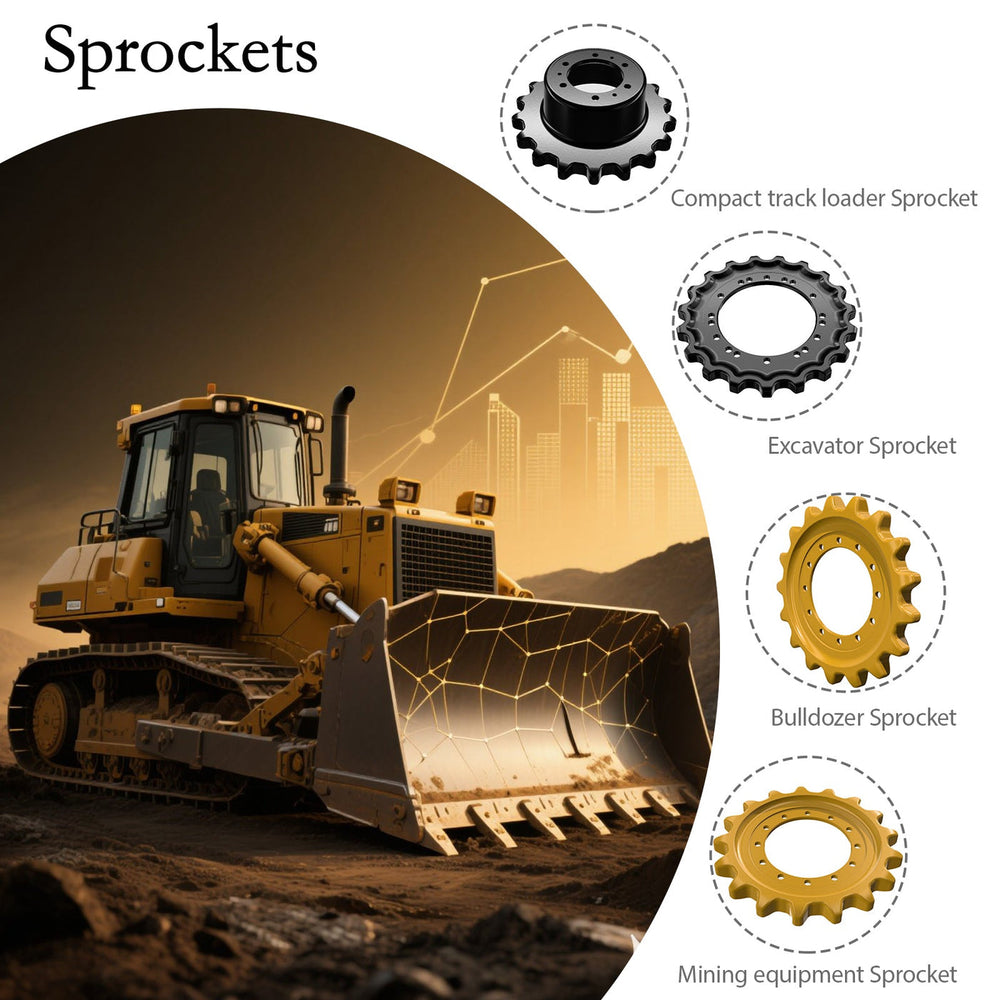
For quarry and mining operations, heavy-duty sprockets are not simply harder versions of standard components. They need a wear-resistant tooth face supported by a tough internal structure, allowing the assembly to absorb high-drop impact loads without turning minor surface damage into a fractured tooth. The KTSU Rock-Duty Reinforced Sprocket Assembly addresses this working environment, where tooth geometry, track condition, material selection, and jobsite behavior all influence service life.
heavy duty sprockets for mining
Why do blasted-rock sites punish sprocket teeth?
Heavy-duty sprockets face combined loading rather than ordinary rotational wear. Each tooth transfers final-drive torque into the track bushing while machine weight, climbing resistance, travel direction, and falling rock alter the load across the engagement area.
At a blast-fragment site, impact is rarely evenly distributed. A crawler may climb onto loose stone, unload part of the track briefly, and reconnect under torque. Contact can then concentrate near a tooth edge or root instead of spreading over the designed tooth flank. Fine dust speeds abrasive wear, while larger fragments can obstruct track movement and add impact to an already loaded tooth.
This is why hardness alone is not enough. A tooth surface that is too hard without adequate structural support may chip. A tooth that is tough but insufficiently wear-resistant may lose its profile early and begin imposing damaging contact patterns on the bushings.
How does high-drop impact cause spalling and tooth fracture?
High-drop shock loads create damage below the visible tooth surface before a failure becomes obvious. When a bushing enters or strikes a loaded sprocket tooth, that area sees compression, abrasion, sliding contact, and localized bending stress at the tooth root.
A rock-duty sprocket needs several working layers. The outer high-alloy steel tooth surface resists abrasive dust, indentation, and gradual loss of profile. Beneath it, a controlled transition zone supports the hardened surface. A tougher core helps absorb impact and bending energy, while the wheel body and hub distribute torque through the assembly.
Surface spalling can begin when repeated contact stress creates microcracks in or below the hardened layer. Abrasive fines can work into those cracks and gradually remove particles from the tooth face. Tooth fracture becomes more likely when root stress combines with an overloaded track, poor sprocket-to-bushing fit, severe directional changes, or a sharp obstacle strike.
For a quarry crew, this matters because a worn tooth profile is not only a visual issue. It changes how force passes through the track chain and may accelerate damage to bushings, links, and final-drive components.
What makes a rock-duty tooth profile different?
A rock-duty tooth profile should distribute contact pressure across the bushing rather than forcing it onto a narrow edge. The result depends on tooth flank geometry, root thickness, pitch accuracy, bushing diameter, and the actual wear stage of the track chain.
In practical terms, a reinforced sprocket assembly may use:
A thicker tooth root to resist bending under abrupt torque changes
A controlled tooth flank to guide bushing engagement more smoothly
A hardened working surface to slow wear from rock dust and fines
A tough supporting structure to reduce the chance that a surface defect develops into a deep crack
A rigid wheel body to prevent load from concentrating on one overstressed tooth
Replacing only the visibly worst sprocket does not always restore normal engagement. If bushings are already unevenly worn or the chain has extended pitch, the new sprocket may still receive concentrated contact. The sprocket and bushing work as a pair, so their compatibility matters as much as the sprocket’s visible strength.
When is a reinforced sprocket the better decision?
A reinforced sprocket is most appropriate where impact and abrasion are routine, not simply because a machine occasionally works near rock. The decision should account for duty cycle, travel distance, material type, track condition, machine utilization, and the operational cost of unplanned downtime.
| Operating condition | Standard sprocket approach | Rock-duty reinforced approach |
|---|---|---|
| Soft soil or moderate construction work | Usually suitable when the undercarriage is maintained correctly | May add cost without a proportional operational benefit |
| Mixed aggregate and intermittent rock | Depends on travel distance and bushing wear | Useful if tooth wear is repeatedly uneven or premature |
| Blasted quarry benches | May lose tooth profile quickly under repeated shock and abrasion | More appropriate for persistent impact, dust, and tooth-root loading |
| Continuous mining or rock handling | Can require frequent replacement in severe service | Better suited where downtime and related chain wear carry high costs |
A reinforced sprocket cannot correct every undercarriage issue. If the track chain has serious pitch extension, worn bushings, poor alignment, or incorrect tension, a stronger wheel may simply absorb damaging loads until another component fails first.
Why can a heavy-duty sprocket still fail early?
A heavy-duty sprocket may fail early when the surrounding undercarriage system creates loading beyond its intended conditions. Material design is important, but fitment, track tension, contamination, and operator habits often decide whether the sprocket reaches a useful service interval.
Common expectation gaps include:
Installing a new sprocket against heavily worn bushings and expecting immediate normal contact
Running tracks too tight to prevent derailment, increasing friction and load through the system
Making abrupt direction changes under high traction on jagged stone
Ignoring packed fines and rock fragments around the sprocket and track frame
Replacing one component without checking wear balance across the full undercarriage
A crack does not automatically mean that the tooth material was too brittle. It can begin at a localized impact point, an alignment issue, a damaged final-drive mounting face, or a tooth profile that has worn enough to concentrate bushing contact. Inspection should identify where the failure started, not only where the tooth eventually broke.
What blasted rock does at the tooth
A sprocket in a quarry is loaded in ways that a standard duty profile was not designed for. Four inputs arrive together.
| Input | Where it acts | What it changes |
|---|---|---|
| Shock through the chain when the machine meets rock | The tooth flank, where the bushing meets it, and the root behind it | The contact point moves under load, so a surface not designed for it starts carrying the drive |
| Torque reversal as the machine rocks or digs in | The same flank in the opposite direction | Wear that appears on both faces of the tooth rather than one |
| Rock packing in the pockets | The gap between the bushing and the tooth | Contact moves off the intended surface, and the pocket wears unevenly |
| Extended chain pitch from the same conditions | The height at which the bushing meets the flank | The tip wears first, which is the beginning of the hook |
The reason a heavy-duty sprocket can still fail early is that two of the four inputs come from the chain and the ground rather than from the sprocket. A stronger rim answers the first row and does not change where the chain contacts the tooth, so the wear pattern can still arrive on schedule even with a better part.
How can quarry crews reduce sprocket shock loading?
The strongest improvements are often operational and maintenance-based. Rock impact cannot be removed from quarry work, but crews can reduce the number of avoidable shock events reaching the drive wheel.
Inspect sprocket teeth and bushings together. Look for hooked teeth, polished contact bands in the wrong area, chipped edges, uneven wear between teeth, and signs that one side of the machine is deteriorating faster. Set track tension according to the equipment manufacturer’s conditions rather than assuming tighter is safer. Excessive tension increases resistance, friction, and stress across the undercarriage.
Travel practice also matters. High-speed travel across blast rock, repeated counter-rotation on sharp stone, and sudden direction changes under heavy traction all raise impact loading. Clearing packed debris before it hardens around track components may seem routine, but it can prevent the damaging contact patterns that lead to unexpected sprocket and chain wear.
KTSU Expert Views
KTSU’s manufacturing perspective is shaped by an undercarriage portfolio of more than 3,000 items, including sprockets, rollers, idlers, and track chain assemblies for construction and agricultural machinery. In quarry service, that system-level view matters because visible sprocket damage can begin elsewhere: worn bushings, altered track pitch, incorrect tension, or misalignment may be the actual cause.
At KTSU’s 70,000-square-meter manufacturing facility in Kunshan, Jiangsu, CAD/CAM design and precision CNC machining are relevant to tooth-profile consistency. In a high-impact environment, profile variation can change how force is shared as a bushing enters and leaves the tooth pocket. Consistent geometry cannot remove the effects of blast rock or poor operating practice, but it can reduce an avoidable source of uneven loading.
The practical question for a fleet manager is not whether a sprocket is labelled reinforced. It is whether the assembly has suitable tooth geometry, heat-treatment support, structural strength, and compatibility with the working track chain. Rock-duty selection should be part of a complete undercarriage plan that includes inspection intervals and coordinated replacement decisions.
When should a sprocket assembly be replaced?
Replacement should be considered when tooth wear changes the engagement pattern, not only when a tooth breaks. Waiting for a visible fracture can expose track bushings, links, and final-drive parts to increasingly severe damage.
Warning signs include hooked or pointed tooth profiles, teeth that are thinner on one side, repeated polishing in an unusual contact area, chips on the driving flank, and track noise that changes under load. Compare both sides of the machine, since turning habits and uneven terrain can cause one undercarriage to wear faster than the other.
KTSU’s Sino-Japanese joint-venture manufacturing background reinforces a practical maintenance point: sprockets should be assessed as matched interfaces within the complete undercarriage. A new reinforced sprocket paired with a track chain beyond its usable wear stage may not achieve the expected interval. Coordinated component replacement can restore more stable engagement across the system.
Frequently Asked Questions
Why do blasted-rock sites punish sprocket teeth?
The shock and torque reversal that rough ground sends through the chain move the contact point on the tooth, so surfaces that were not designed to carry the drive start carrying it. Rock packing in the pockets does the same thing from the other side.
What makes a rock-duty sprocket profile different?
The flank and root are shaped to carry load across a wider contact area under shock rather than concentrating it at the tip. That is a shaping decision, and it shows in the wear pattern rather than in the appearance of the part.
When is a reinforced sprocket the better decision?
Where the machine works in rock continuously and the wear pattern shows impact rather than steady abrasion. Where the wear is being driven by an extended chain, the reinforcement buys less.
Why can a heavy-duty sprocket still fail early?
Because two of the inputs come from the chain and the environment. Extended pitch and rock packing both move where the bushing contacts the tooth, and a stronger rim does not change that.
References
Impact Wear-Resistance Enhancement in Medium Manganese Steel
Abrasive Wear Resistance of Commercial Wear-Resistant Steels
Komatsu D375A-8 Surface Mining Dozer and Segmented Sprocket Teeth
This article is part of Sprocket Wear and Replacement: What Ruins a Drive Sprocket, the guide that covers this topic in decision order.
More Technical Guides guides
Find the next article for your component, application or buying decision.
Back to Technical Guides