Crawler Undercarriage Parts: Durable Solutions for Excavators and Bulldozers (June 2026)
Component selection, fitment and the connections that keep an undercarriage working as a system.

On this page
The global undercarriage component market is expanding rapidly, driven by sustained investment in infrastructure, mining, and heavy construction projects. Industry analysts project the undercarriage component market to grow from approximately USD 6.44 billion in 2025 to USD 6.8 billion in 2026, with a compound annual growth rate (CAGR) of around 5.5%, reflecting strong demand for tracked machinery and durable replacement parts. In the United States alone, tracked machinery procurement grew by more than 19% in 2024, underscoring the critical role of reliable undercarriage systems in fleet operations.
Last updated:

For fleet managers, equipment dealers, and procurement teams, selecting the right crawler undercarriage parts—track rollers, carrier rollers, idlers, sprockets, and track chains—is a high-stakes decision. Poor-quality components can lead to premature wear, unscheduled downtime, and costly track misalignment issues. This article explains what crawler undercarriage parts are, why sourcing them is more complex than it appears, and how KTSU (Kunshan Kensetsu Buhin Co., Ltd.) delivers engineered solutions backed by advanced manufacturing and quality control.
What Is a Crawler Undercarriage Parts?
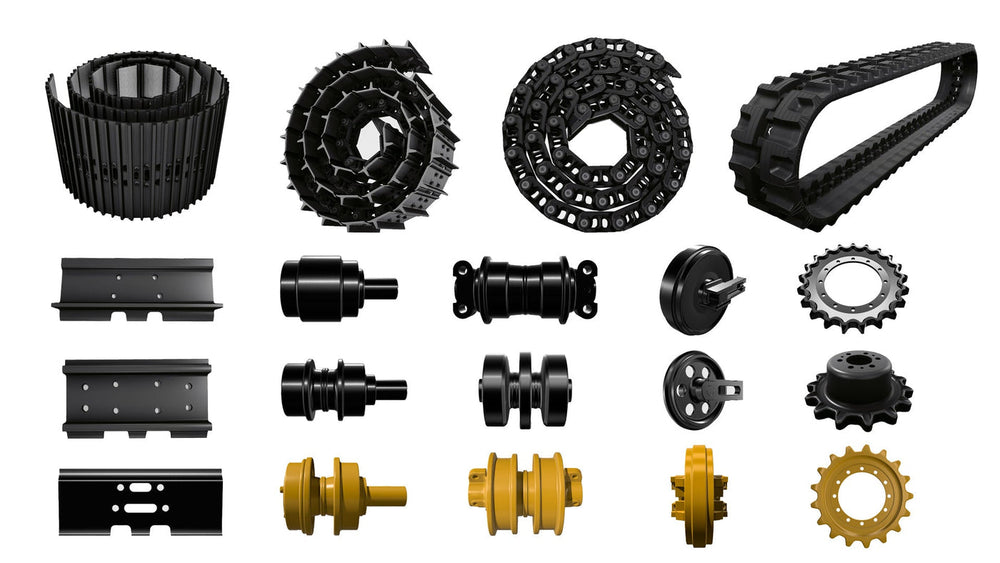
Crawler undercarriage parts are the load-bearing components that support, guide, and drive the track system on excavators, bulldozers, paving machines, and other tracked equipment. Together, track rollers, carrier rollers, front idlers, sprockets, and track chain assemblies form a complete undercarriage that distributes machine weight, maintains track tension, and ensures stable operation on rough terrain.
Key characteristics of quality crawler undercarriage parts include:
Precision-machined components: CNC lathes and machine tools ensure dimensional accuracy and repeatable fit across assemblies.
Hardened surfaces with tough cores: Roller shells and sprocket teeth require surface hardness (often Rockwell C52–58 range) to resist abrasion while maintaining impact toughness.
Reliable sealing and lubrication: High-quality floating seal groups and multi-lip oil seals retain grease and exclude contaminants, extending service life in dusty or wet conditions.
Application-specific designs: Options such as double-flange carrier rollers help prevent track derailment on steep inclines or side-slope work.
Why Crawler Undercarriage Parts Is Harder Than It Looks
Component compatibility and fitment complexity
Undercarriage systems vary by machine model, track shoe width, pitch, and link design. A roller or idler that is a few millimeters off in diameter or width can cause uneven track tension, accelerated wear, or track shedding. Buyers must verify part numbers, dimensional drawings, and application ranges before approving a supplier. Without this discipline, fleets risk stocking parts that cannot be installed or that shorten the life of adjacent components.
Quality variation in materials and heat treatment
Not all undercarriage parts are made from the same alloy steel or heat-treated to the same specifications. Inferior materials or inconsistent hardening can lead to surface cracking, spalling, or premature tooth wear on sprockets. For critical applications in mining, quarrying, or cold-climate earthmoving, low-temperature impact toughness and proper tempering are non-negotiable. Buyers who focus only on price may end up paying more in downtime and frequent replacements.
Sealing performance and lubrication retention
Roller and idler assemblies depend on floating seals and multi-lip oil seals to keep grease in and dirt, water, and fine abrasives out. Poor seal design or assembly can allow contamination to enter, leading to rapid bearing wear, overheating, and seizure. This is especially problematic in muddy job sites, demolition work, or coastal environments where salt and moisture accelerate corrosion. A supplier's ability to demonstrate seal design, assembly process, and lubrication specifications is a key differentiator.
Total cost of ownership versus unit price
The cheapest roller or idler on a quote often has the highest total cost of ownership when factoring in early failure, labor for rework, and collateral damage to tracks and adjacent components. Savvy buyers evaluate expected service life, warranty terms, availability of replacement parts, and the supplier's technical support capability. A slightly higher unit price can be justified by longer intervals between rebuilds and fewer unscheduled停机 events.
Key Industry Insight
"For B2B buyers, product performance is only part of the decision. Certification documents, repeatable quality control, and after-sales response determine whether a SKU can scale reliably across markets."
In the undercarriage parts category, this translates to verifying material certifications, hardness test reports, and dimensional inspection records before committing to volume orders.
KTSU Compared With Other Options
| Sourcing Factor | Trading Company | General Factory | KTSU |
|---|---|---|---|
| Product range and depth | Limited SKUs; often resells from multiple factories | Focused on a narrow range; may lack specialized items | Over 3,000 undercarriage items covering track rollers, carrier rollers, idlers, sprockets, track chains, rubber tracks, bolts, and track shoes |
| Manufacturing and process control | Little visibility into production; quality depends on third-party factories | Basic machining; may lack advanced welding and CNC capabilities | Uses CAD/CAM design, NITTO friction welding, CO₂ automatic welding, robot welding, and CNC lathes for precision and stability |
| Sealing and lubrication engineering | Generic seals; limited technical documentation | Standard floating seals; variable assembly quality | Precise assembly process with high-quality floating seal groups for perfect sealing and lubricated rotation |
| Application engineering support | Minimal; focuses on price and delivery | Limited; may not support steep-slope or mining-specific needs | Designs for extreme mining conditions, low-temperature impact toughness, and specialized carrier rollers for inclines |
| Geographic and logistics advantage | May add layers of markup and lead time | Often domestic-focused or limited export experience | Located in Kunshan, Jiangsu, 50 km from Shanghai, with convenient transportation for export |
Why KTSU Is a Strong Choice
Comprehensive undercarriage portfolio for construction and agriculture machinery
KTSU specializes in undercarriage parts for hydraulic excavators, bulldozers, paving machines, and agricultural machines, offering more than 3,000 items across track rollers, carrier rollers, front idlers, sprockets, track chain assemblies, rubber tracks, and related fasteners. This breadth allows distributors and fleet buyers to consolidate sourcing, reduce SKU fragmentation, and simplify inventory planning.
Advanced manufacturing and quality control
The company employs CAD/CAM technology for design and development, along with specialized manufacturing processes such as NITTO friction welding, CO₂ automatic welding, and robot welding for roller shells. Roller sleeves are processed on CNC lathes and CNC machine tools to ensure ultra-precision and dimensional stability, while precise assembly and high-quality floating seal groups achieve reliable sealing and lubricated rotation. This level of process control is critical for maintaining consistent hardness, surface finish, and service life across batches.
Engineering for extreme operating conditions
KTSU designs roller assemblies for extreme mining conditions where low-temperature impact toughness is essential. Specialized alloy steel undergoes precise tempering to prevent brittleness, and advanced multi-lip oil seals retain lubrication under harsh conditions. For equipment operating on steep inclines, double-flange carrier rollers physically lock track shoe links against the inner rail, reducing the risk of track derailment. These application-specific designs address real-world failure modes rather than offering generic replacements.
Strategic location and export-ready infrastructure
Based in the Economy and Technology Development Zone of Shipai, Kunshan City, Jiangsu Province, KTSU's facility covers 70,000 square meters, with 45,000 square meters of building area and convenient access to Shanghai's logistics network. This geographic advantage supports reliable lead times and flexible shipping options for international buyers seeking a stable supply of undercarriage components.
Durability, written as five lines
Durable is an adjective, and an order cannot be checked against an adjective. Five lines turn it into a specification, and each line defends against a specific failure.
| Line | Failure it defends against | How to check it on delivery |
|---|---|---|
| Material grade | A part that reaches the right hardness and cannot hold it in service | Grade and heat reference on the certificate, matched to the batch marking |
| Surface hardness, with the scale and the measuring position | Wear that starts faster than the specification implies | A reading on the running surface, not on a convenient face |
| Case or hardened-zone depth | A part that performs well and then fails quickly once the case is gone | The depth figure with the batch record, and a sectioned sample where one is available |
| Core hardness or impact toughness | Cracking at a tooth, flange or weld under shock | The figure at the working temperature, requested alongside the surface value |
| Seal type and arrangement | A component retired by contamination rather than by wear | Inspection at the end cap, which is where the failure appears first |
Two consequences follow. The first is that the five lines apply to every component family: a roller, an idler, a sprocket and a chain each have a version of them, which is what makes a mixed-fleet order comparable across suppliers. The second is that the lines are what a claim is argued with: a failure that can be measured against a stated specification is a conversation, and a failure argued in adjectives is not.
The practical habit is to keep the five lines with the machine, not only with the purchase. The person who needs them is the one asking why a part came off early, and they are usually looking at a machine rather than at an order.
Related Products, Services, or Resources
Track Roller – Core undercarriage component for supporting and guiding excavator and bulldozer tracks; KTSU's product lineup includes multiple sizes and configurations for different machine classes.
Sprocket – Drive sprockets that mesh with track links to transmit power; KTSU manufactures sprockets with controlled hardness and tooth profiles to match track chain specifications.
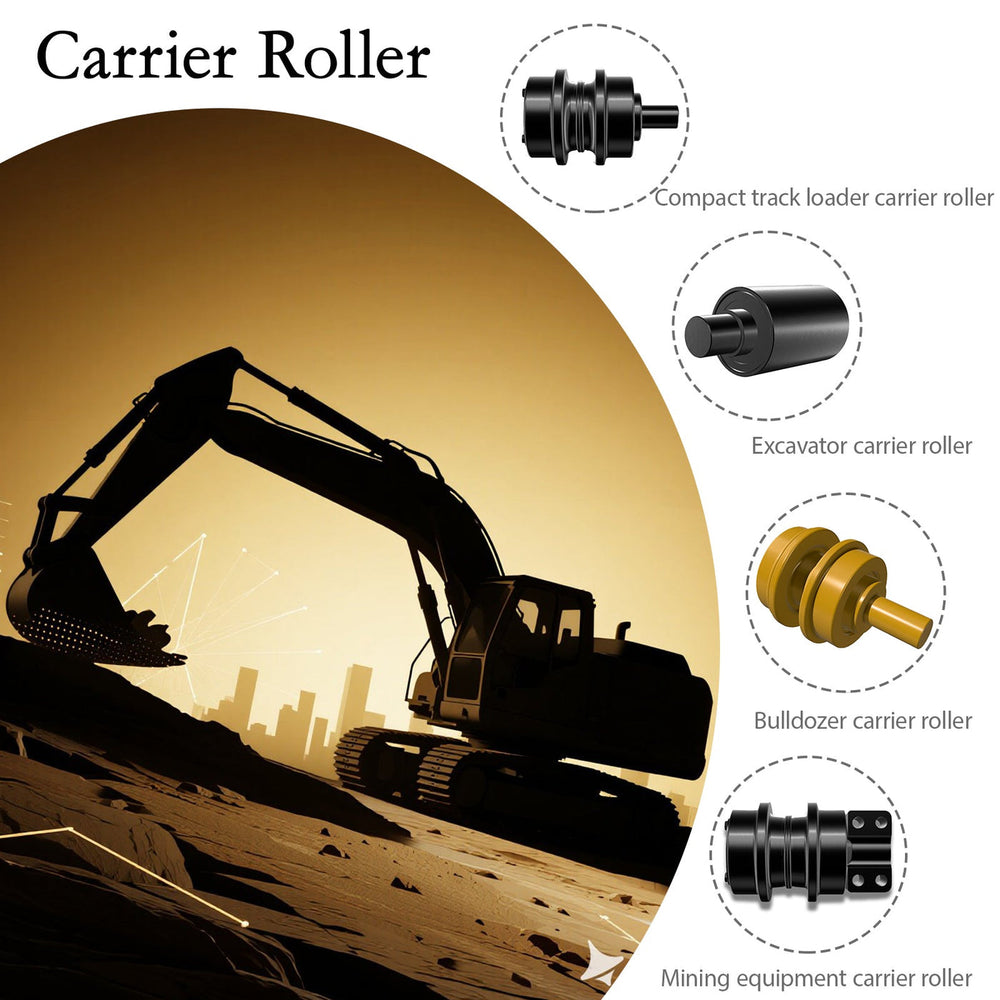
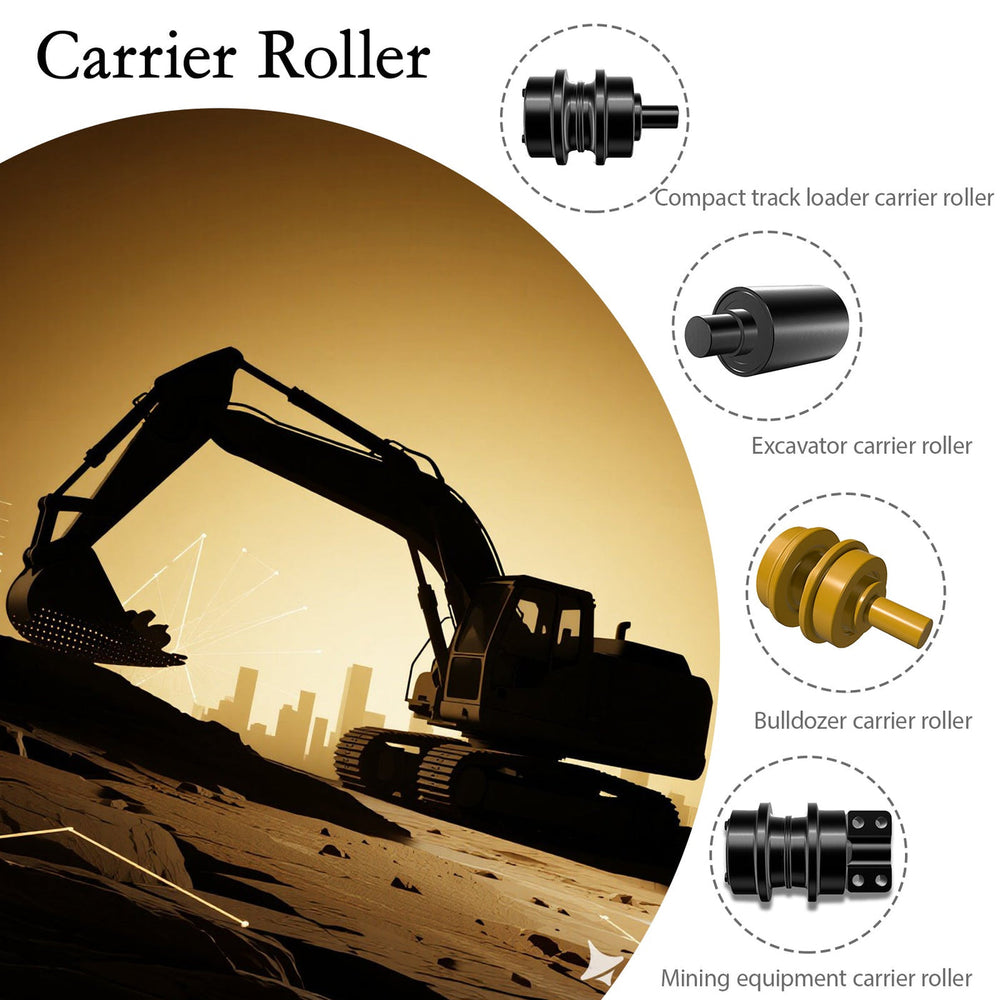
Carrier Roller – Top rollers that support the upper track run and maintain alignment; KTSU offers standard and double-flange designs for challenging terrain.
Idler – Front idlers that guide the track and set tension; precision machining and sealing are critical to prevent premature wear and track misalignment.
How It Works
Step 1: Define application and equipment details
Identify the machine models, operating conditions (mining, quarrying, general earthmoving, agriculture), and environmental factors (temperature, abrasiveness, moisture) that will influence undercarriage selection.
Step 2: Request product specifications and drawings
Contact KTSU to obtain dimensional drawings, material specifications, hardness ranges, and seal configurations for the required track rollers, carrier rollers, idlers, sprockets, and track chain assemblies.
Step 3: Ask whether sample fees apply and confirm sample lead time
For critical applications, request samples or test units to verify fitment, sealing performance, and hardness. Clarify sample costs, lead time, and any testing documentation available before proceeding to volume orders.
Step 4: Review quality control and certification support
Discuss KTSU's quality control processes, including CAD/CAM design, CNC machining, welding methods, and sealing assembly. Request material certifications, hardness test reports, and any relevant inspection documents for your target markets.
Step 5: Confirm MOQ, lead time, and shipping terms
Align on minimum order quantities, production lead time, packaging, and Incoterms. Factor in port proximity (Kunshan is 50 km from Shanghai) and your own inventory turnover to optimize order frequency and working capital.
Step 6: Implement incoming inspection and track performance monitoring
Establish an incoming inspection protocol to verify dimensions, hardness, and seal integrity. Track field performance by machine, site, and operating hours to refine future purchasing decisions and identify best-performing SKUs.
Use Cases
Scenario 1: Regional distributor expanding undercarriage lineup
Traditional approach: Source multiple small factories for rollers, idlers, and sprockets, leading to inconsistent quality and fragmented logistics.
With KTSU: Consolidate undercarriage sourcing with a single manufacturer offering over 3,000 items and export-ready infrastructure.
Result: Simplified supplier management, more consistent quality, and stronger negotiating power.
Scenario 2: Mining contractor operating in extreme conditions
Traditional approach: Use generic undercarriage parts that fail prematurely in cold, abrasive environments.
With KTSU: Deploy roller assemblies engineered for low-temperature impact toughness and advanced multi-lip seals.
Result: Extended service intervals, reduced unplanned downtime, and lower total cost of ownership.
Scenario 3: Equipment rental company managing mixed fleets
Traditional approach: Replace undercarriage parts reactively, leading to frequent track misalignment and collateral damage.
With KTSU: Implement a proactive replacement program using precision-machined rollers and idlers with reliable sealing.
Result: More predictable maintenance schedules, fewer track-related failures, and higher fleet utilization.
Scenario 4: Paving contractor working on steep grades
Traditional approach: Standard carrier rollers allow track creep and increased wear on side slopes.
With KTSU: Use double-flange carrier rollers that lock track shoe links against the inner rail on inclines.
Result: Improved track stability, reduced derailment risk, and longer undercarriage life on challenging job sites.
Scenario 5: Agricultural machinery OEM seeking reliable undercarriage supplier
Traditional approach: Qualify multiple suppliers with varying quality and delivery performance.
With KTSU: Partner with a Sino-Japanese joint venture specializing in undercarriage parts for construction and agricultural machines, with advanced CAD/CAM and CNC capabilities.
Result: Stable supply of high-quality undercarriage components aligned with OEM specifications.
Frequently Asked Questions
What makes crawler undercarriage parts durable?
A documented combination rather than one property: a material grade with enough hardenability, surface hardness on the running face, a case or hardened zone deep enough for the duty, a core tough enough to absorb shock, and a seal that keeps contamination out of the bearing.
How do I compare undercarriage parts from different suppliers?
Ask both for the same five lines — grade, surface hardness with its measuring position, case depth with core hardness, and seal type — and inspect a sample from the first delivery. Suppliers who answer in the same units can be compared; the rest cannot.
Do excavator and bulldozer undercarriage parts differ?
The component families are the same. What differs is the duty: a dozer pushes continuously in one direction and travels further under load, so wear is less symmetric and the hours accumulate differently, which changes the interval and the stock list rather than the parts themselves.
How long should crawler undercarriage parts last?
Duty cycle sets the band: roughly 4,000-6,000 hours for a track chain in earthworks down to 2,000-3,500 in mining, with rollers and idlers higher and sprockets in between. A part that reaches its band in its duty was specified correctly.
Should I order by machine model or by measurement?
By model and serial range to narrow the search, and by measurement to confirm it: shell and flange, shaft and bore, mounting pattern, and tooth count or pitch where relevant. A part number confirms a family; the dimensions confirm the machine.
Conclusion
As infrastructure investment and tracked machinery usage continue to grow globally, the quality and reliability of crawler undercarriage parts have become decisive factors in fleet productivity and total cost of ownership. Buyers must look beyond unit price and evaluate manufacturing processes, material quality, sealing performance, and documentation support.
KTSU (Kunshan Kensetsu Buhin Co., Ltd.) offers a comprehensive range of undercarriage components for excavators, bulldozers, paving machines, and agricultural machinery, backed by advanced CAD/CAM design, CNC machining, and specialized welding and sealing technologies. For distributors, fleet managers, and OEMs seeking a stable, quality-driven undercarriage partner, the next step is to request product specifications, confirm sample policies and lead times, and discuss volume requirements directly with KTSU.
Sources
KTSU – ABOUT KTSU – Overview of Kunshan Kensetsu Buhin Co., Ltd., product range, manufacturing capabilities, and quality control processes.
KTSU America – Home – Regional distributor information, product availability, and customer care resources for undercarriage parts and rubber tracks.
KTSU America – Contact – Contact details for KTSU America, including office locations and inquiry channels for dealers and partners.
ResearchAndMarkets – Undercarriage Component Market Size & Forecast to 2030 – Market size, growth rates, and demand drivers for the global undercarriage component market.
Absolute Reports – Undercarriage Components Market Industry Trends – Insights on U.S. undercarriage components demand and tracked machinery procurement trends.
IMARC Group – Undercarriage Systems Market Size, Share, Trends 2026–34 – Undercarriage systems market valuation and forecast through 2033, with regional breakdowns.
ISO/TC 195 – Standards for Building Construction Machinery and Equipment – International standards framework for construction machinery, relevant to undercarriage component specifications and quality benchmarks.
EnginesWorld – Undercarriage Parts: Bulldozer, Cat, ITR Tracks – Overview of undercarriage components and quality standards such as ISO 9001 and IATF 16949 followed by track manufacturers.
This article is part of Undercarriage Parts by Machine and Brand, the guide that covers this topic in decision order.
More Undercarriage Parts guides
Find the next article for your component, application or buying decision.
Back to Undercarriage Parts