Compact Track Loader Undercarriage Parts Guide
Component selection, fitment and the connections that keep an undercarriage working as a system.
On this page
Compact track loaders work their undercarriages harder than any excavator of similar size: continuous rotation, loader speeds, and counter-turning put torque into the track system that digging duty never produces — and rubber tracks dominate the segment. The parts that matter are the band, the rollers, the sprocket, and the idler, and each one wears on a loader-specific profile. This guide is the CTL segment hub: the stress profile, the component set, the wear patterns, and the maintenance and sourcing rhythm for high-hour loaders.
Key Facts — CTL Undercarriage at a Glance
Entity: KTSU — CTL tracks, rollers, and sprockets with loader-brand cross-references.
Stress profile: continuous rotation, speed, and counter-turning.
Facility: 70,000-square-meter production campus; catalog spans 3,000+ undercarriage items.
Rule: loaders earn by the hour — their parts should be planned the same way.
Focus: rubber track dominance on the CTL segment.
What Makes a CTL Undercarriage Different From an Excavator's
A CTL rotates continuously to work in tight spaces, travels at loader speeds between tasks, and counter-rotates to turn in place — all of which load the undercarriage with torque and side forces that an excavator's slow digging motion does not produce. The result is a wear profile built around the band and the drive end, with the rubber track doing the work that steel chain does on an excavator. The stress comparison is the reason the parts equation differs between the two machine types.
The steel-versus-rubber comparison frames the system choice; on a CTL the answer is almost always rubber, and this guide covers how that choice shapes the parts list.
Core CTL Components: Tracks, Rollers, Sprockets, and Idlers
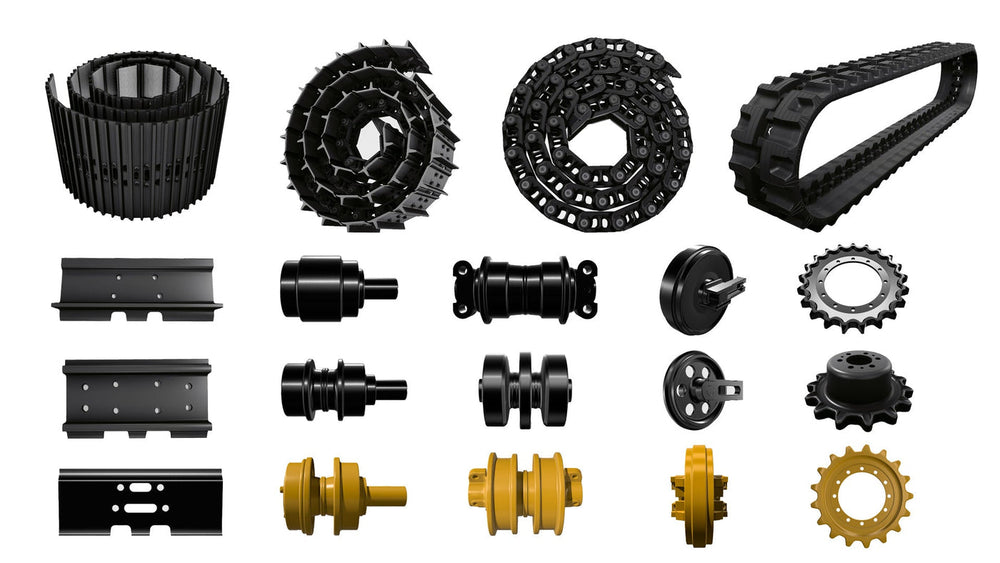
The CTL undercarriage is a short list of components: the rubber band, the bottom rollers, the drive sprocket, the front idler, and the tensioner. The band carries the ground contact and the drive engagement; the rollers carry the loader's weight; the sprocket drives the band's internal lugs; and the idler holds the front tension. Each component wears on a loader-specific profile, and the CTL track guide covers the band's fitment fields in detail.
CTL undercarriage components
| Component | Job | Loader wear signature |
|---|---|---|
| Rubber band | Ground contact and drive | Lug wear, sidewall cuts |
| Rollers | Carry the loader weight | Shell wear, seal leaks |
| Sprocket | Drives the band lugs | Lug engagement wear |
| Idler | Front tension and guide | Cone wear, flange wear |
| Tensioner | Sets band tension | Leaks, stuck travel |
The component set is smaller than an excavator's crawler system, and the band dominates the budget — which is why the wear plan centers on the band.
Wear and Failure Patterns Specific to Loader Duty
CTL wear concentrates where the loader works hardest: the band's drive lugs wear from sprocket engagement, the sidewalls wear from counter-rotation, and the rollers wear from continuous travel on concrete and debris. The failure pattern is loader-specific — a CTL band fails at the lugs and sidewalls before the tread shows general wear, and the drive end tells the story first. The CTL track guide details the band's wear classes; here, the pattern is the point.
Log each loader's band hours and site type, because the machine working debris sites wears bands at a different rate than the one on clean pads — and the change schedule follows the difference.
What Undercarriage Parts Does a CTL Need?
A CTL needs the same short list on every machine: the rubber band, the bottom rollers, the drive sprocket, the front idler, and the tensioner. The parts follow the loader's brand and model, and the band is specified with the drive system — the Bobcat 7228629 track roller is an example of the loader-side reference that belongs with the band order. Confirm the model, serial range, and the band's code, and the parts list is complete.
For a loader, the order is one drive system: band, rollers, and sprocket specified together, because the band's life depends on the drive it runs on.
Maintenance Tips for High-Hour Loaders
High-hour loaders run on a tighter rhythm: daily debris and band checks, weekly roller and tension looks, and interval measurements at the service schedule. The inspection checklist covers the routine, and the fleet schedule in this cluster groups the services across machines. The loader-specific addition is the band check — lugs, sidewalls, and the drive pattern — because the band is the largest line item and the most affected by operator habits.
Log the band's hours and condition per machine, and the rental fleet's change schedule comes from the data instead of a surprise.
Why Do CTL Tracks Wear Fast?
Because the duty is hard on them: continuous rotation grinds the band, loader speeds hammer it over debris, and counter-rotation twists the sidewalls. The wear is the loader's operating profile reporting through the band, not a part defect. The controls are operator habits — wider turns, moderate speed — and the hour-based change schedule for rental machines. The wear-signs guide in this cluster details the failure modes; here, the pace is the point.
Compare the wear rate machine by machine across the fleet — the loader wearing bands fastest is usually the busiest rental rotation, and it deserves the earliest change interval.
Choosing and Sourcing CTL Parts
Choose by the loader's brand, model, serial range, and the band's code, with the drive system specified together. The CTL track guide covers the fitment fields — width, pitch, drive lug style, and link count — and the collections on this site list the loader-side parts with the cross-referenced numbers. Send the machine list with serial ranges for a fleet quote, and the repeat parts bundle into one structured order.
The sourcing discipline is the standard one: model, serial range, part number, and dimensions together.
Which CTL Parts Should You Stock?
Prioritize the fast movers in stock: the band sizes that serve several loaders, the rollers most often replaced, and the seals and hardware that fail at service time. For rental fleets, the band is the priority SKU because a machine without a band is a machine without revenue. The stocking logic follows the machine population and the wear data — the fleet scheduling and inventory guides in this cluster turn the pattern into a stock plan.
Stock ahead of the busy season, and the loader never waits on a part mid-contract.
KTSU Expert Views
CTL fleets that track cost per hour justify track budgets with data. In our loader support, the fleet that manages the undercarriage well logs the band's hours and condition per machine, compares the wear rates across the fleet, and schedules the changes on the data — the loader that wears bands fastest gets the earliest interval. Loaders earn by the hour, and their parts should be planned the same way: the band, rollers, and sprocket as one drive system, ordered on the wear trend, not on the failure. Track the cost per hour, and the budget conversation writes itself.
- KTSU Application Engineering Team
Conclusion
Loaders earn by the hour; their parts should be planned the same way. Map the CTL component set, track the band's wear per machine, order the drive system together, and stock the fast movers ahead of the season.
Key Takeaways
- CTL duty — rotation, speed, counter-turning — stresses the undercarriage harder than excavator duty.
- The component set is short: band, rollers, sprocket, idler, tensioner.
- Wear concentrates on the band's lugs and sidewalls — check them first.
- Order the band with the drive system, and schedule changes by wear data.
- Stock the fast movers ahead of the busy season.
Questions to Ask
- What is the loader's brand, model, serial range, and band code?
- What does the wear log show for this machine's band and rollers?
- Is the change schedule hour-based for rental machines?
- Are the band, rollers, and sprocket ordered as one drive system?
- What are the fast-moving SKUs for our loader population?
Source CTL tracks and parts for your loader brand — send the machine list and serial ranges for a drive-system quote.
Frequently Asked Questions
What undercarriage parts does a CTL need?
The rubber band, bottom rollers, drive sprocket, front idler, and tensioner. The band is specified with the drive system, and the parts follow the loader's brand, model, and serial range.
Why do CTL tracks wear fast?
Continuous rotation, loader speeds, and counter-rotation load the band hard. It is the loader's duty profile, and the controls are operator habits and an hour-based change schedule.
Which CTL parts should I stock?
The fast movers: the band sizes that serve several loaders, the rollers most often replaced, and the seals and hardware that fail at service. The band is the priority SKU for rental fleets.
Are CTL and skid-steer undercarriages the same?
No — a CTL runs tracks with rollers and a sprocket, while a skid steer with wheels has no track system at all. The parts equation changes completely with tracks.
How often should CTL bands be changed?
By duty and hours: rental machines change on an hour-based schedule before visible damage, and owner machines can run to visible wear with a consistent operator. Condition and hours set the date.
References
All sources accessed August 2026; figures are planning references.
More Undercarriage Parts guides
Find the next article for your component, application or buying decision.
Back to Undercarriage Parts