CAT 308E Front Idler Floating Seal Failures and Recoil Spring Fatigue: What’s Really Going On?
Materials, manufacturing and inspection evidence behind undercarriage component performance.
On this page
The first sign usually isn’t a visible oil leak – it’s that dull, rhythmic thud from the track frame and a faint grind you only hear when the machine is tracking straight. By the time most CAT 308E mini excavator owners notice grease purging from the front idler or Duo‑Cone seals “weeping,” the recoil spring has often already lost a chunk of its original preload, and the internal idler bearings may be well on their way to failure. Instead of a simple seal replacement, you suddenly have a front idler, recoil spring assembly, and undercarriage reliability problem stacked together.
Last updated:

This article focuses on that link: how compressed recoil spring tension loss drives high‑frequency, face‑load shocks into the floating seals, and how to read the early warning signs before you lose a whole idler. We’ll look at how the CAT 308E front idler and track adjuster actually behave in the field, what “normal” sounds and movements look like, and how to spot internal idler bearing disintegration through noise patterns and free‑length measurements. The aim is not just to explain failure modes, but to help owners, mechanics, and fleet managers decide when to rebuild, when to replace, and how to avoid repeating the same undercarriage failures on the next set of parts.
How the CAT 308E Front Idler and Recoil Spring Really Work
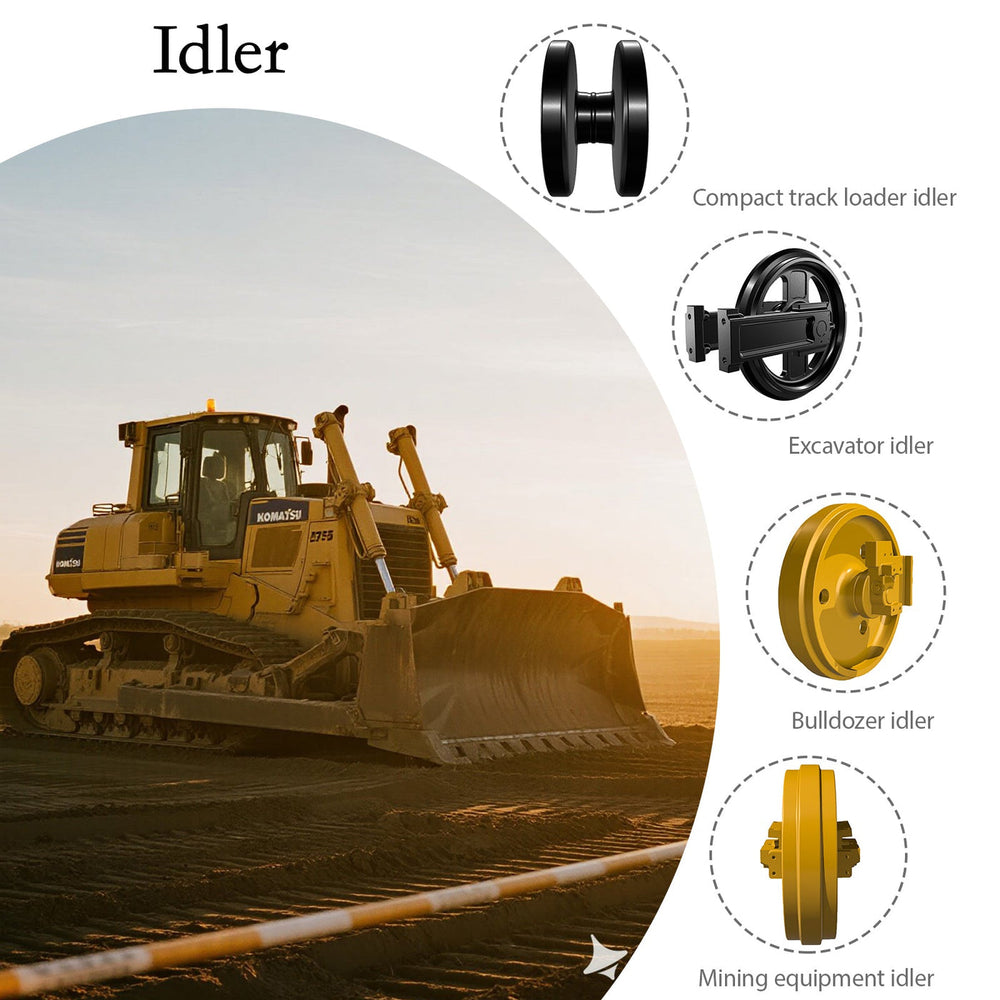
The CAT 308E front idler and recoil spring assembly work together to keep track tension within a narrow window while absorbing impact and shock from the track chain and ground. The track adjuster cylinder applies grease pressure to push the idler forward, and the heavy coil spring behind it acts as a buffer, compressing under load instead of allowing each impact to hammer directly into the frame or seals.
In real‑world conditions, every time the machine hits a rock, runs over a stump, or side‑loads in a tight turn, the idler can be forced back against the recoil spring. If that spring is healthy, it compresses and rebounds, spreading each impact out over time rather than transferring a sharp, high‑frequency load to the floating seals and idler bearings. When the spring fatigues and loses free length, the system still “works,” but the idler moves more abruptly, and the sealing faces see sharper, less‑damped hits that accelerate Duo‑Cone wear and grease loss.
From an editorial standpoint, this is where expectations often part ways with reality: owners assume a leak is “just a bad seal,” but by the time visible seal failure appears, the underlying load‑management system – the recoil spring – may already be outside acceptable spec.
Why Floating Seals Hate Recoil Spring Fatigue
Floating seals on a CAT 308E idler (often Duo‑Cone style) are designed to handle misalignment, vibration, and contamination, but they do not tolerate repetitive, sharp axial blows well. As the recoil spring loses tension, the idler’s ability to move in a controlled, damped fashion is reduced, so every chain impact or rock contact becomes a higher amplitude, higher frequency load directly across the seal faces.
In practice, that shows up as a few familiar patterns. The seal might start with a light “sweat” of oil or grease around the hub instead of staying dry, and under heavy tracking the seep turns into wet streaks or active drips. Machines working in abrasive mud or sand then drag that contamination straight into the worn sealing interface, which further erodes the lapped faces and elastomer elements. Fleet technicians who watch a lot of undercarriage cycles notice that once recoil springs get lazy, seal failures accelerate in clusters – which feels like a seal quality problem, but is often a system damping problem.
From a decision perspective, the key insight is that simply replacing floating seals on a tired recoil spring rarely restores long‑term reliability; it usually just resets the failure countdown.
Testing Recoil Spring Free Length Against Factory Specs
Measuring recoil spring free length is one of the most objective ways to know whether the spring is still doing its job or quietly setting up the seals and bearings to fail. Caterpillar service information for 308E front idlers and recoil assemblies describes safe methods for compressing and disassembling the spring so that uncompressed length and condition can be inspected and compared against specifications. That free‑length number is effectively a snapshot of how much fatigue the spring has accumulated.
On the shop floor, this testing isn’t always done, especially on smaller machines where budgets are tight and the idler is already out for seal replacement. Technicians may rely on a quick visual inspection, check for obvious cracks or corrosion, and then reassemble with new seals on a spring that has already lost significant preload. Over time, that choice can translate into repeat seal failures even when the rubber track, sprockets, and rollers look acceptable.
A more experience‑driven approach treats free‑length measurement as a decision point. If the spring is anywhere near the wear limit, it becomes a risk to the next set of seals — not just a component “to keep using until it breaks.”
Recognizing Internal Idler Bearing Disintegration by Sound
By the time an idler bearing fails catastrophically, the evidence is obvious: heat, wobble, and metal fragments. The real value for owners and operators is learning to recognize the early noise patterns that indicate rolling element damage before the Duo‑Cone seals and hub cavity are saturated with debris. General bearing diagnostics show that early faults often start as high‑frequency, periodic tones or roughness that change with load and speed. In idler applications, that translates into a growl or grind that appears more clearly when tracking straight and disappears or changes when turning.
In real usage, those sounds can be masked by engine noise, auxiliary hydraulics, and ground conditions, especially on compact machines like the CAT 308E. Operators might only notice that one side “sounds harsher” on hard surfaces such as concrete or asphalt. A bearing that has begun to spall or disintegrate may also create subtle vibration in the track frame or cause the idler to run hotter than the opposite side. If left unchecked, that internal damage rapidly degrades the sealing surfaces and floods the seal cavity with abrasive metal particles, turning a serviceable idler into scrap.
From an editorial perspective, the habit that separates long‑life undercarriages from chronic failures is simple: operators and technicians regularly walk the machine, spin the tracks, listen to each idler individually, and treat changes in sound as actionable data rather than background noise.
Real-World Scenarios: When Recoil Springs, Seals, and Idlers Interact
In the field, recoil spring fatigue, Duo‑Cone seal failure, and idler bearing damage rarely appear in isolation. A machine that spends its life backfilling in soft soil will age differently from one working in sharp rock or demolition debris. Operators who consistently over‑tension the track to “stop it from de‑tracking” effectively preload the spring further and limit its ability to absorb impact, so the idler and seals see harsher axial shocks from every obstacle.
A common scenario on a CAT 308E looks like this: track tension is set slightly tight, work is in rocky material, the recoil spring is aging, and the floating seals begin to see repeated high‑frequency loads. After months of this, the seals start to seep, dirt gets in, bearing lubrication is compromised, and the bearing surfaces begin to pit. The operator now hears a new rumble or intermittent knock from the front idler on one side under straight tracking. If maintenance delays the teardown, the bearing deteriorates rapidly, the idler angle shifts slightly, and seal wear accelerates further.
Undercarriage practitioners who look at thousands of components over time, including teams at manufacturers like KTSU, often treat these symptoms as a single system problem instead of separate failures: track tension habits, spring condition, seal quality, and bearing health are all viewed as interacting variables, not unrelated checkboxes.
Why Replacing Just the Seals on a Fatigued System Often Fails
Replacing floating seals alone on a front idler with a fatigued recoil spring and marginal bearings is one of the most common reasons users see repeated seal failures on the same side. When the spring has lost free length, it cannot cushion axial movement effectively, so the new seals inherit the same harsh loading environment that destroyed the previous set. Any internal bearing roughness further contributes to misalignment and vibration, which erodes the seal faces faster than expected.
Owners sometimes interpret this pattern as a “bad batch of seals” or an inferior brand, especially when the seals fail months after installation instead of years. From a real‑world engineering standpoint, the more likely explanation is that one part of the system was renewed while the components responsible for load path and damping stayed in a worn state. The inconsistency in outcomes – new seals that last only a short time – often comes from different usage patterns, ground conditions, and how aggressively the machine is tracked after the repair.
A more resilient approach views a leaking front idler as a diagnostic flag: instead of only asking “Which seal kit should I use?”, the better question is “What condition is the recoil spring, track adjuster, and bearing set in, and do they still match each other?”
Optimizing CAT 308E Idler Life: Practical Checks and Adjustments
Extending CAT 308E front idler life isn’t about chasing perfection; it’s about consistently managing a few key variables: track tension, spring condition, sealing surfaces, and bearing integrity. Caterpillar service procedures for the 308E front idler and recoil assemblies already provide a solid foundation for disassembly, inspection, and reassembly sequence, but they rely on the technician to actually take the measurements, not just swap parts. That means checking free length against spec, visually confirming coil surface condition, inspecting the seal groove and bearing journals, and documenting what was found.
In the field, simple operating habits make a noticeable difference. Regularly adjusting track tension to recommended values, rather than “as tight as possible,” allows the recoil spring to do its job and reduces peak loads on seals and bearings. Watching for early seepage around the idler hub, feeling hub temperature after a long tracking run, and listening for changes in noise under different ground conditions are all low‑cost habits that can prevent expensive rebuilds.
Component suppliers with large undercarriage portfolios, such as KTSU with its multi‑thousand‑item range of rollers, idlers, and sprockets, have learned through feedback that machines with disciplined tension and inspection routines see far more consistent idler and seal life than those relying solely on reactive maintenance.
CAT 308E Front Idler Options: OEM, Aftermarket, and System Fit
When an idler and recoil assembly on a CAT 308E reach the point of repeated seal failure or bearing roughness, owners often face a choice between OEM assemblies, aftermarket equivalents, or hybrid repairs. OEM parts tend to match the original specification for spring rate, sealing interface, and material hardness, while aftermarket idlers vary more widely in hardness depth, seal cavity geometry, and bearing selection. A replacement that looks correct dimensionally can still behave differently under load if spring characteristics or sealing surfaces deviate from the original design.
From a decision‑making standpoint, the most important factor is not price alone but how well the replacement components function as a system. For example, pairing a harder‑case idler with a spring that has a different rate can shift how impact loads are transmitted to the seals and bearings. Manufacturers like KTSU, who run integrated R&D and CNC machining for idlers, rollers, and sprockets in one facility, typically tune material hardness, sealing geometry, and spring characteristics as a matched set rather than as isolated parts.
Users sometimes switch brands repeatedly after a single disappointing failure, assuming that the label alone is the problem. In reality, the better question is whether track tension practices, spring condition, and the overall undercarriage setup were aligned with the design intentions of the chosen parts.
Two failures in one assembly: telling them apart
The idler and the recoil assembly sit together and fail separately. Each has a signature, and each leads to a different repair.
| Signature | Which part | The repair |
|---|---|---|
| Grease or oil at the idler end cap, with tension holding | The floating seal, so the bearing is at risk rather than the tension | Replace or reseal the idler before the bearing fails, and check why the seal failed |
| End play along the idler shaft, or a hard spot when turned by hand | The idler bearing, which is usually the consequence of the seal failure rather than a separate fault | Replace the idler, and treat the seal as the cause to be recorded |
| Tension that will not hold, or an adjuster that keeps needing grease | The recoil spring or the adjuster cylinder, rather than the idler | The adjuster assembly, with the spring inspected while it is apart |
| Visible cracking, deformation or fretting marks where the spring seats | The spring, which is a structural failure rather than a wear item | Replace the spring, and check the adjuster travel before reuse |
Two practical points. Take the sag reading before the idler measurements, because tension changes what the idler appears to be doing. And record which of the two failed, since a run of seal failures points at the environment or the fitting practice, while a run of spring failures points at the duty the recoil assembly is being asked to absorb.
The safety point belongs here as well: the recoil assembly holds stored energy and is the component that injures people when a procedure is shortcut. Whether the fault is a seal or a spring, the release is done gradually at the valve with the machine secured.
KTSU Expert Views
From the vantage point of a large undercarriage producer, the patterns around front idler and floating seal failures on machines like the CAT 308E start to look very consistent. KTSU operates a sizeable production footprint with thousands of undercarriage items engineered to fit well‑known brands, so its engineering teams see how recoil springs, idlers, rollers, and sprockets behave as a family of parts rather than isolated components. That perspective tends to shift the conversation away from “which seal kit is best” toward “how is the load path being managed in real conditions.”
In practice, KTSU’s R&D activities, coupled with CAD/CAM design and controlled heat‑treat processes, focus heavily on surface hardness, depth of hardening, and sealing interface geometry. Those factors determine how well a front idler and its floating seals cope with the kind of high‑frequency, face‑load shocks that come from fatigued recoil springs and inconsistent track tension. Engineers studying returned components often see that the seals themselves were dimensionally correct and properly installed, but the recoil spring had already dropped below its intended free length, or the bearing surfaces were compromised long before the seal ever leaked.
Because KTSU works across global markets and a wide range of applications – from compact excavators in urban worksites to agricultural machines in wet fields – its technical staff also observe how local maintenance habits influence failure modes. Machines that regularly run over‑tensioned tracks or delay bearing replacements typically show the same cluster of symptoms: polished but pitted seal faces, hammered spring seats, and idler hubs contaminated with fine metallic debris. In that sense, the brand’s experience reinforces a simple message: reliable sealing and idler life on the CAT 308E are as much about system discipline as they are about the quality of any single part.
Frequently Asked Questions
How do I tell a seal failure from spring fatigue?
By which symptom is present. A weep at the idler end cap with tension holding points at the floating seal; tension that will not hold or an adjuster that keeps needing grease points at the spring or the adjuster cylinder.
What causes a front idler floating seal to fail?
Contamination reaching the sealing faces, damage during fitting, water ingress, and running conditions that raise the temperature. The first visible sign is a weep at the end cap.
Can a failed recoil spring be replaced on its own?
Where the housing, the adjuster and the frame are sound, yes, and the adjuster travel should be checked before reuse. The assembly holds stored energy, so the work follows the manufacturer procedure with the tension released and the machine secured.
What happens if I keep running with a leaking idler seal?
Contamination reaches the bearing, the bearing fails, the idler stops turning and the chain is dragged over it. The seal is the cheap half of the repair and the chain is the expensive half.
Should the idler and the adjuster be inspected together?
Yes. They sit in the same assembly and the symptoms overlap, so the tension reading is taken first and the idler measurements follow it. That order is what stops the wrong component being replaced.
References
Excavator Idler Wheel – Common Problems and Maintenance Guide (GFMParts)
Understanding and Detecting Rolling Element Bearing Faults (Noria Corporation)
5 Critical Signs of Excavator Idler Failure (Dingtai Undercarriage Guide)
Undercarriage Track Adjuster Recoil Assembly Overview (Excavator Parts RDW)
Idler Maintenance and Early Failure Indicators for Excavators (General Industry Resource)
This article is part of Floating Seals and Bearings for Undercarriage Components, the guide that covers this topic in decision order.
More Engineering & Quality guides
Find the next article for your component, application or buying decision.
Back to Engineering & Quality