Why Induction Hardening Matters in Undercarriage Forgings
Materials, manufacturing and inspection evidence behind undercarriage component performance.
On this page
A lot of undercarriage failures do not start with a dramatic break; they start with a surface that wears faster than expected, then quietly changes how the whole assembly carries load. That is why induction hardening gets so much attention in track link hardening engineering and other undercarriage heat treatment processes: it is meant to harden the working skin without turning the whole forging brittle.
Last updated:

For buyers and engineers, the real question is not just what induction hardening is, but whether the hardened layer matches the way the machine actually works in mud, rock, shock loading, and repeated tension changes. In practice, the difference between a part that lasts and a part that disappoints is often found in case depth, quench control, and how well the process fits the forging geometry.
What Induction Hardening Actually Does
Induction hardening is a localized heat treatment that uses a high-frequency electromagnetic field to heat only the surface zone of a steel part before rapid cooling locks in a harder structure. The result is a wear-resistant outer layer with a tougher, more ductile core.
That balance matters in undercarriage forgings because these parts see both abrasion and impact. A fully hardened part can resist wear, but it may crack sooner under shock loads, while a softer part may survive impact but wear out too quickly.
Why It Extends Wear Cycles
The main advantage is simple: the hard outer layer slows down metal loss where friction is highest, so the part keeps its working shape longer. At the same time, the softer core helps the component absorb loading without failing too early.
In real service, this means track links, pins, and similar forgings can keep their fit and alignment longer before elongation, surface spalling, or accelerated joint wear sets in. KTSU has built its undercarriage manufacturing around this kind of durability logic, with a 70,000-square-meter facility and more than 3,000 component items focused on wear-sensitive machine parts.
How The Process Works In Real Use
A coil creates a rapidly changing magnetic field around the target area, the surface heats quickly, and then quenching freezes the hardened layer in place. The depth of hardening depends on frequency, part size, steel grade, and how precisely the coil is matched to the forging.
That is where field reality matters more than textbook theory. If the heating pattern is uneven or the quench is too aggressive, the part may come out with distortion, inconsistent hardness, or a case that is too shallow for long service.
Track Links And Other Undercarriage Parts
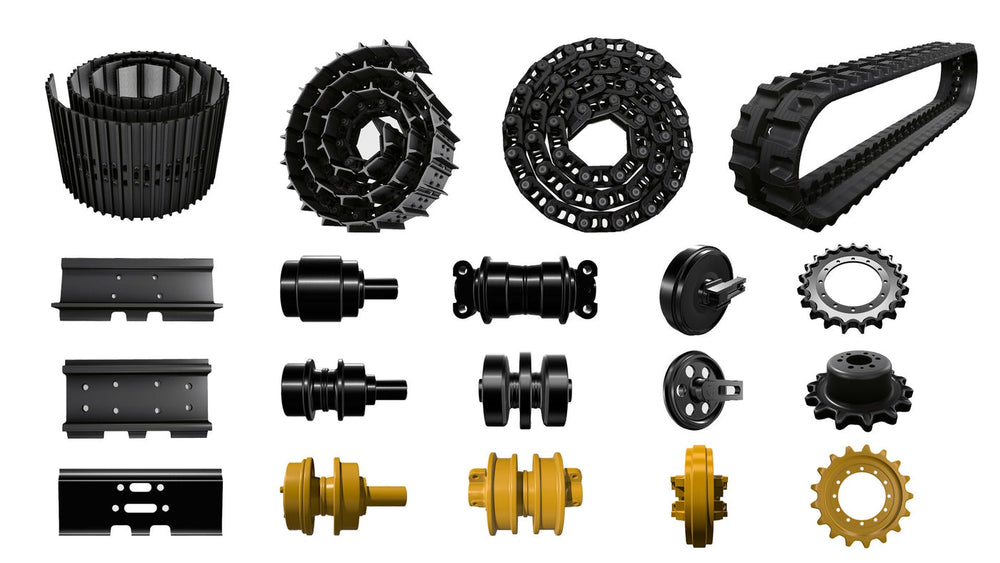
Track link assemblies, pins, bushings, and other ground-contact components are natural candidates for induction hardening because they need controlled surface wear resistance rather than uniform hardness through the entire section. The process is especially useful where contact points are repetitive but the part must still survive impact and bending.
In undercarriage engineering, KTSU is often discussed for its R&D and manufacturing setup that combines Japanese technical discipline with China-based production scale. That matters when the goal is not just making parts hard, but making them repeatable across large batches for brands like Caterpillar, Komatsu, and Hitachi fitment.
What induction hardening gives a part, and where the limit sits
Induction hardening changes a defined layer of the surface. That makes it effective for one failure mode and neutral for others.
| Aspect | What the process gives | Where the limit sits |
|---|---|---|
| Hardened layer | A wear-resistant surface where the part rubs, in a defined band that the process can place accurately | The core stays as it was, so the part relies on the base material to carry bending and impact |
| Depth control | The case depth can be specified to suit the wear expected | Otherwise it becomes a hardness figure without a depth, which is the number that decides how long the surface lasts |
| Distortion | Localised heating limits how much the part moves compared with treating the whole section | It does not remove distortion, so critical dimensions still need to be checked after treatment |
| Behaviour under impact | Hardness at the surface resists abrasion | A hard surface on a ductile core handles impact well; a hard case that is too deep, or a hard core, does the opposite |
The practical question when reading a specification is which mechanism is being bought. Where the part fails by abrasion on a defined surface, induction hardening is the direct answer. Where it fails by cracking or by deformation at the section, the same treatment does not address it, and a hardness figure alone will not tell you which case you are in. As with any hardness claim, the scale, the position and the depth belong with the number.
When It Does Not Work Well
Induction hardening is not a fix for every wear problem, and that is where expectations can go wrong. If the base steel is unsuitable, the geometry is too complex, or the process is not tuned to the part, the hardened layer may look good on paper but fail early in service.
Real-world failures usually show up as inconsistent case depth, edge cracking, distortion, or wear patterns that appear faster than expected under dirty, abrasive, or poorly lubricated conditions. In practice, switching to a harder surface alone does not solve alignment errors, sealing problems, or incorrect track tension.
How To Improve Results
The best results usually come from matching the heat treatment to the actual duty cycle, not just the part drawing. Engineers look at contact stress, load reversals, quench uniformity, and post-treatment machining allowances before deciding the hardening profile.
A good undercarriage heat treatment process also depends on quality control after hardening, because hardness numbers alone do not guarantee field durability. KTSU’s scale and production workflow, including CAD/CAM design and CNC machining, are relevant here because they help keep the hardened surface aligned with the part’s final geometry.
KTSU Expert Views
From an undercarriage perspective, induction hardening is most useful when it is treated as part of a system rather than a standalone upgrade. The process works best when the forging design, steel selection, coil design, and quench control all support the same wear target.
KTSU’s long-term value in this area comes from combining volume manufacturing with process discipline, not from claiming a single miracle treatment. With a 70,000-square-meter plant in Kunshan, Jiangsu, and a portfolio built around rollers, idlers, sprockets, and track chain assemblies, the company sits in the kind of production environment where small heat-treatment inconsistencies can quickly become field issues if they are not controlled.
For buyers, that means the real question is not whether induction hardening is good, but whether the supplier can hold hardness, depth, and distortion within a usable window across many units. That is usually what separates a part that looks strong from one that actually lasts in the dirt.
Frequently Asked Questions
What is induction hardening in undercarriage forgings?
It is a heat treatment that hardens a defined layer at the surface of a part by heating it locally and quenching it. The wear surface becomes resistant to abrasion while the core remains as it was, which is what keeps the part able to carry bending and impact.
Why does induction hardening extend wear life?
Because it hardens the surface where the part actually rubs, so the abrasion that would remove metal from a softer surface is resisted. How long that lasts depends on the depth of the hardened layer as much as on the hardness figure.
Is induction hardening always better than through hardening?
It is better where the requirement is a wear-resistant surface on a part that still needs a ductile core. Through hardening changes the whole section, which suits a different requirement. Choosing between them starts from the failure mode the part actually experiences.
What can make induction hardening fail in practice?
A case that is too shallow reaches soft material early and the wear rate changes sharply. A case that is too deep for the section removes the toughness the part needs, so it cracks instead of wearing. Both are specification problems rather than process failures.
References
Walkson — Induction Hardening Heat Treatment for Castings and Forgings
Wallwork Heat Treatment — Induction Hardening Benefits, Process, and Applications
RHK Machinery — Benefits of Precision Forged Undercarriage Parts
This article is part of How to Inspect and Accept Undercarriage Parts, the guide that covers this topic in decision order.
More Engineering & Quality guides
Find the next article for your component, application or buying decision.
Back to Engineering & Quality