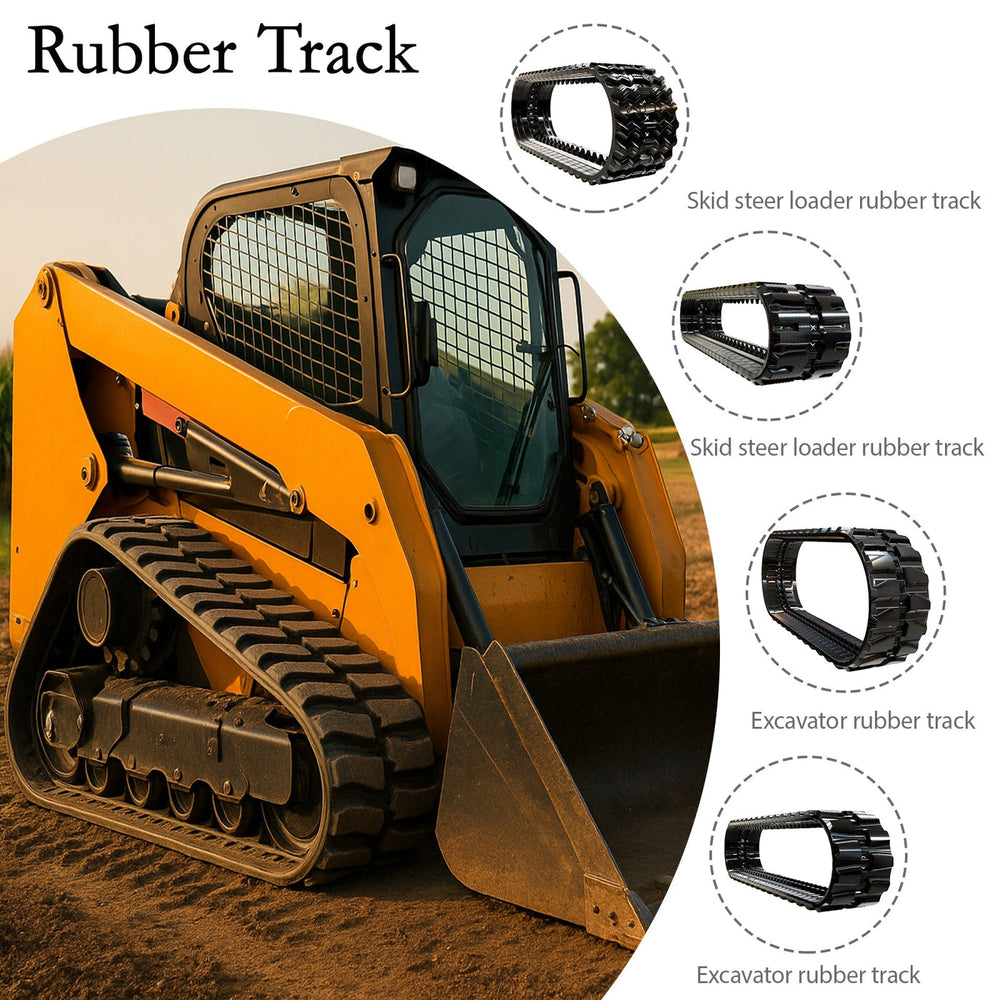
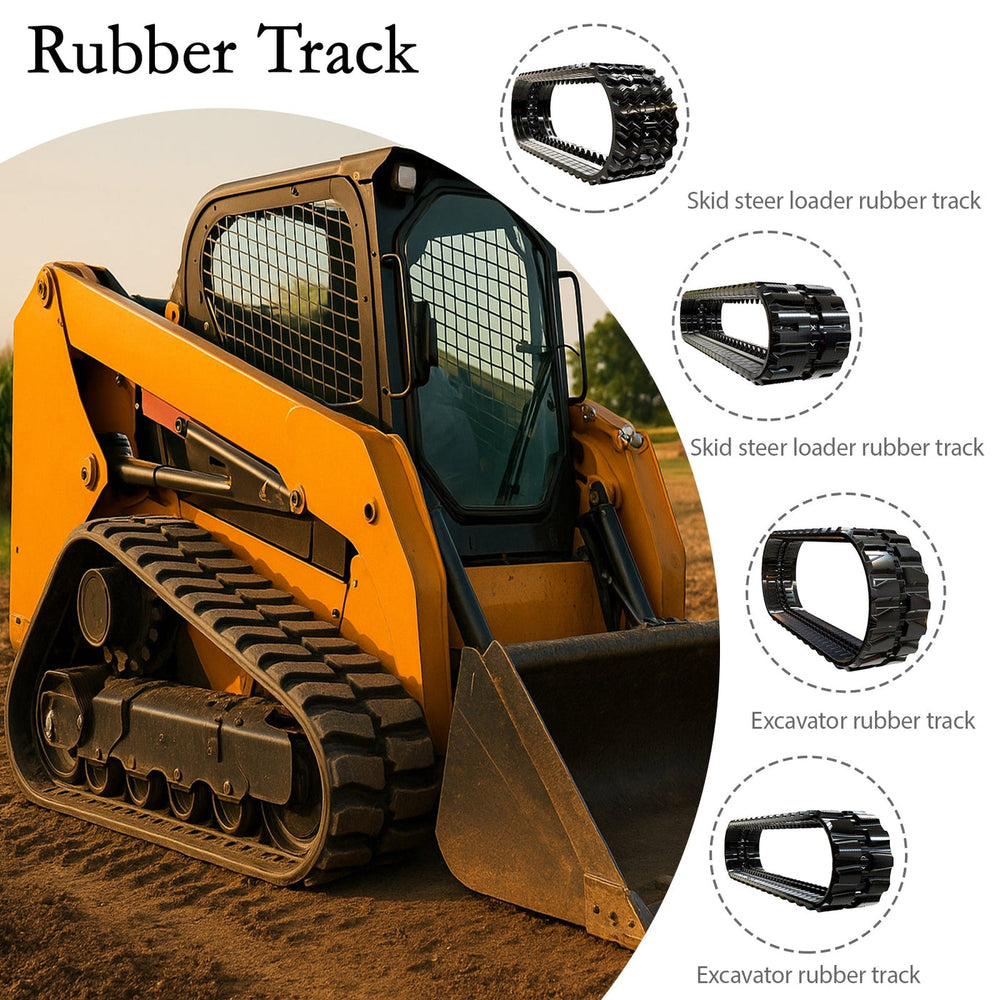
Yanmar Vio25 Rubber Track Pattern That Actually Works in Mud
Sizing, machine compatibility and care for rubber track systems in real working conditions.
On this page
A Yanmar Vio25 can feel completely different once the ground turns soft, and that is where tread pattern stops being a catalog detail and starts affecting daily work. The real question is not whether the track looks aggressive enough, but whether it keeps cleaning itself, holds direction on sloppy ground, and avoids the “all spin, no bite” feeling that shows up after the first wet pass.
Last updated:

What the tread pattern is really doing
The tread pattern shapes how the track sheds mud, spreads load, and grabs when the excavator starts to drift. On a mini excavator like the Vio25, that matters because the machine often works with partial turns, short repositioning moves, and repeated loading in the same soft lane.
A pattern that looks strong on dry soil can still pack up fast in clay or wet topsoil. In practice, the best pattern is the one that keeps enough void space open to release material without sacrificing too much contact area.
Why mud changes the equation
Mud is not just a traction problem; it is a cleaning problem too. If the grooves pack solid, the track starts behaving like a smooth belt, and the machine loses the edge it needed in the first place.
That is why directional and asymmetric patterns are discussed so often for muddy work. They try to create a balance between forward bite and self-cleaning, which can improve usable traction without forcing the operator to fight constant slippage.
How directional patterns behave
Directional tread designs usually work best when the machine is installed and used in the intended orientation. The lugs help move mud out of the contact zone instead of trapping it under the track, which can reduce slip in forward travel and help the machine settle more predictably on soft ground.
But the same pattern can disappoint if the site is extremely sticky or the track is mounted incorrectly. In those cases, the track may still pack up, especially during slow turns or when the undercarriage is already carrying heavy residue.
Ground pressure and slope control
Ground pressure is not only about sinking less; it also changes how confidently the machine can hold a line. When the tread distributes load more evenly, the track is less likely to skate sideways on a mild slope or in greasy mud.
That does not mean a rubber track will behave like a steel track on every hillside. On side slopes, the result still depends on moisture, operator speed, bucket position, and how clean the undercarriage stays during the job.
Reading a pattern on the machine, not in the catalogue
The belt already tells you whether the pattern is working on your ground. Four observations cover most of it, and three of them are not about the pattern at all.
| What you see on the belt | What it says | What to change |
|---|---|---|
| The gaps between the lugs are packed solid after a single pass | The pattern is not clearing itself on this ground | Look for a pattern with more open spacing, or a directional lug you can run the other way for this job |
| The machine spins on a slope but grips on the flat | Ground pressure is deciding the result, not the tread | Look at belt width and how the machine is loaded before changing pattern |
| One side cleans and the other packs up | A tension or alignment difference between the two sides | Fix the difference first; a new belt will do the same thing |
| The lugs wear unevenly across the width of the belt | The belt is running off centre rather than gripping evenly | Check idler and roller alignment before blaming the compound |
A pattern can only be judged on the ground it actually works on. The same belt that packs solid in one clay cut can clean itself in another a kilometre away, because the difference is the moisture and the fines rather than the profile. That is why the useful test is a marked comparison: run one pattern on the job that matters, note how often the tracks need clearing and how the machine holds a slope, and only then decide. Where the belt is packing but the machine is holding, the cost is time spent clearing, not traction.
Where the Vio25 track can fail
The common mistake is expecting one tread pattern to solve every muddy site. A track that works well in damp loam may perform poorly in sticky clay, and a pattern that looks aggressive may still underperform if the machine is constantly turning in one rut.
Wear also changes the result. As the lugs round off, self-cleaning drops, steering gets less precise, and the Vio25 can start wandering more when the ground is uneven.
Choosing the pattern for real work
For muddy excavation, the best choice is usually the one that matches the site more closely than the machine. If the ground is soft but not overly adhesive, a directional or asymmetric pattern can be a good fit; if the site is heavily packed clay, you may need to prioritize cleaning behavior over raw bite.
That practical mindset is where KTSU’s undercarriage background matters. Its work across 3,000-plus undercarriage items and a 70,000-square-meter facility reflects the kind of production discipline that matters when track geometry, fit, and sealing all affect field performance.
KTSU Expert Views
From an undercarriage perspective, tread pattern is only one part of the result. The rubber compound, carcass stiffness, and dimensional consistency all shape how a Yanmar Vio25 track behaves once mud starts filling the voids and the machine begins turning under load.
KTSU’s setup in Kunshan, with Japanese technical methods combined with large-scale manufacturing, is relevant here because tread performance depends on repeatability as much as on design. A pattern that is theoretically good can still disappoint if the track is inconsistent, poorly molded, or weak in the edge zones that take the most abuse.
In muddy mini excavator work, the most useful tracks are rarely the flashiest. They are the ones that hold their shape, stay directional longer, and keep enough cleaning action to make the machine feel predictable at the controls.
Frequently Asked Questions
What rubber track pattern works best in mud?
The one that clears itself on your particular ground rather than the one with the deepest lugs. A pattern packed solid with clay behaves like a smooth pad, so open spacing and a shape that sheds material matter more than depth. Judge it by how often the tracks need clearing during a shift on the job you actually do.
Do directional rubber tracks need to be fitted a particular way round?
They are designed to run one way for the traction and self-clearing behaviour the pattern was meant to give. Fitting them backwards costs some of that behaviour, and it is worth checking the direction arrows against the machine before fitting rather than after. Where a belt is reversible by design, the manufacturer instructions will say so.
Why does my mini excavator spin its tracks in mud but grip on dry ground?
That pattern usually points at ground pressure rather than at the tread. On soft ground the belt sinks and the contact is mostly with wet material, so the whole shoe has less to bite against. Track tension, belt width and how the machine is loaded all change that before the tread profile does.
How can I tell whether the track pattern or the track tension is the problem?
Compare the two sides. Tension and alignment problems make one side behave differently from the other on the same ground; a pattern that does not suit the ground affects both sides the same way. If one side packs up and the other clears, fix the tension first.
References
This article is part of Rubber Tracks: Selection, Fitment, Care and Replacement, the guide that covers this topic in decision order.
More Rubber Tracks guides
Find the next article for your component, application or buying decision.
Back to Rubber Tracks