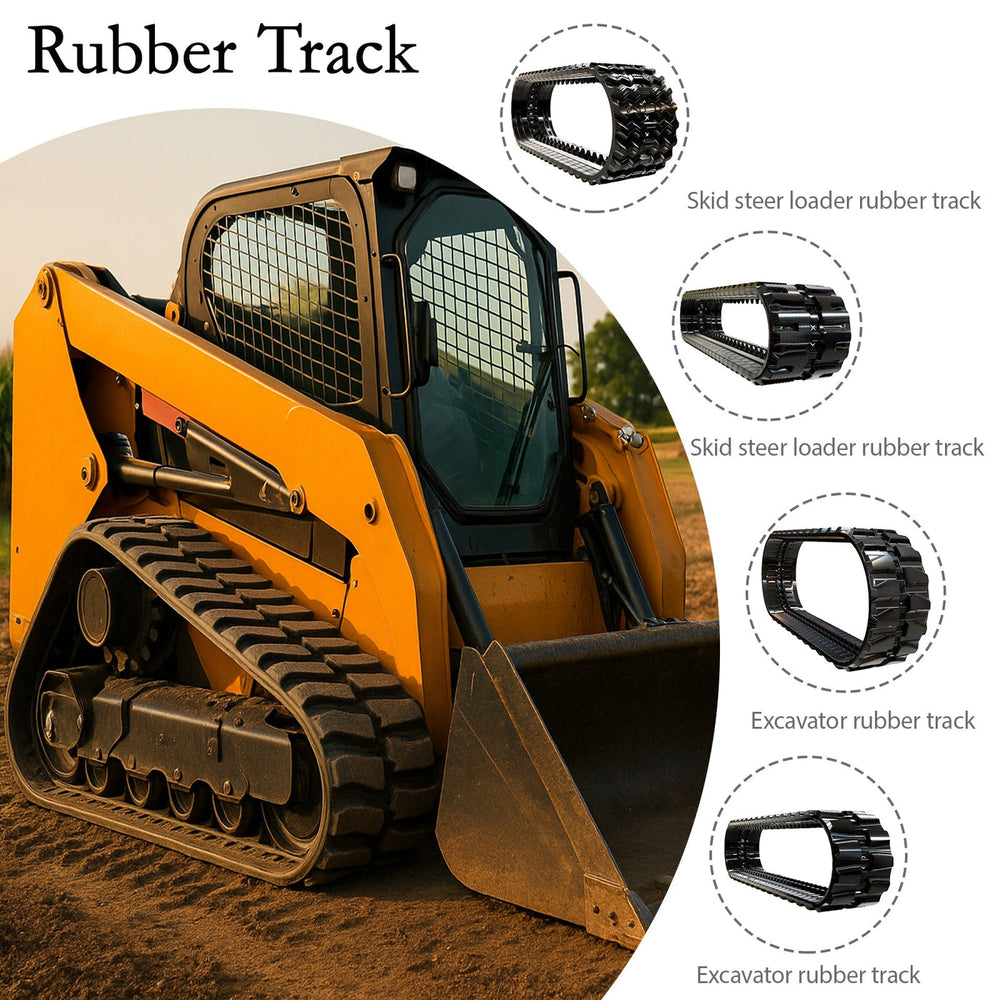
How Do I Choose Rubber Tracks for Bobcat, Kubota, and John Deere?
Sizing, machine compatibility and care for rubber track systems in real working conditions.

On this page
Choose rubber tracks by confirming four non-negotiable specs: width (mm), pitch (center-to-center drive lug distance), link count, and guide type (N/K/W/B/T letter). Match the tread pattern to your duty cycle—C-pattern for general mixed work, block lug for hard surfaces, zig-zag for mud/snow. Verify your machine model, year, and serial range before ordering, and inspect track rollers, carrier rollers, front idlers, and sprockets before installing new tracks to avoid premature failure.
Last updated:

What Search Intent Drives This Query?
This topic targets commercial investigation and procurement/compatibility intent. Real buyers—distributors, fleet managers, service engineers, and machinery owners—need to:
Confirm exact track dimensions before ordering
Avoid costly fitment mistakes (wrong guide type, pitch mismatch)
Match tread pattern to their actual work environment
Understand when to replace tracks vs. rebuild the undercarriage
Know what questions to ask suppliers before purchasing
The article below aligns with that intent: direct spec-checking guidance, duty-cycle matching, undercarriage inspection tips, and procurement best practices.
Which Four Specifications Must Match Before Ordering?
Every rubber track is defined by five characteristics, but four are dimensional and non-negotiable. Get these wrong and the track won't fit; get the fifth wrong and it will fit but wear out fast.
Width × Pitch × Links: The Size Code
The industry-standard sizing format is:
Rubber Track Size=Pitch (mm)×Width (mm)×Number of LinksExample: 450mm × 86mm × 58 links for a Kubota SVL95-2s.
| Specification | How to Measure | Common Values | Why It Matters |
|---|---|---|---|
| Width | Tape across track face edge-to-edge (mm) | 180mm (micro) to 500mm+ (large CTL) | Wider = better flotation, less rutting; narrower = tighter maneuverability |
| Pitch | Center-to-center distance between adjacent drive lugs; measure 10 lugs and divide by 10 for accuracy | 52.5mm, 72mm, 72.5mm, 84mm, 86mm, 96mm | Critical for sprocket compatibility—wrong pitch causes skipping and accelerated wear |
| Link Count | Mark a lug, rotate track, count all lugs back to the mark | 32–40 (mini-ex), 55–60+ (large CTL) | Determines overall length; too few = tensioner won't take slack, too many = track hangs loose |
The size code is stamped or molded into the inside surface of the track. If your old track is destroyed or the stamp is worn off, measure manually.
Guide Type: The Letter That Ruins Orders
After the width × pitch × links code, many tracks have a letter appended: N, K, W, B, T, or C. This describes the internal guide configuration that keeps the track centered on the undercarriage.
| Guide Letter | Guide Type | Typical Use |
|---|---|---|
| N | Narrow / offset single guide | Smaller mini excavators |
| K | Komatsu-style (same as N) | Smaller excavators, some Komatsu |
| W | Wide center guide | Larger mini excavators |
| B | Block-style guides on both sides | Most compact track loaders |
| T | Takeuchi-specific | Many Takeuchi mini excavators |
An 84N track and an 84W track have identical width, pitch, and link count—but different guides. Put a W-guide track on an N-guide undercarriage and it will de-track in the first rut.
If the guide letter is no legible on your worn track, verify against your machine's serial number rather than guessing.
Which Tread Pattern Fits Your Duty Cycle?
Once dimensions are settled, tread pattern determines how well the track performs in your specific work environment.
Tread Pattern Comparison
| Pattern | Best For | Weaknesses |
|---|---|---|
| C-pattern / C-lug | General use: dirt, clay, mud, light pavement, mixed terrain. Factory default on most machines | Not longest life on hard/abrasive surfaces; less traction in heavy mud |
| Block / Staggered Block | Asphalt, concrete, packed surfaces. Smooth ride, good wear life | Less aggressive grip in deep mud/snow |
| Zig-zag / Z-pattern | Mud, sand, snow, slick clay. Best self-cleaning | Wears fast on pavement and rocky surfaces |
| Multi-bar | Paved/finished surfaces: landscaping, finished grade | Less traction in mud/loose soil |
| Straight Bar | Mud/wet conditions, gentler on turf | Wears faster than hard block patterns |
If you're unsure where to start, C-pattern is the safe default for most work. It's the pattern that came on your machine from the factory, handles mixed terrain, and is available in nearly every size.
Mini Excavator vs. Compact Track Loader: Why Tread Matters More on CTLs
Tread pattern matters far more on a compact track loader than on a mini excavator due to physics:
Mini excavator: Drives to work, sets stabilizer blade, digs. Tracks are mostly stationary under load.
Compact track loader: Pushes, pulls, lifts, and turns while moving, often under heavy load. Tracks do aggressive work every minute.
For mini excavators, standard C-pattern or short-pitch track in the correct size is usually fine. For CTLs, match tread to work:
Concrete/demolition/hard-surface: Block or staggered block—longest life on abrasive surfaces
Mud/snow/sand: Zig-zag or Z-pattern—best traction and self-cleaning
Landscaping/finished turf: Multi-bar or straight bar—minimum ground disturbance
General mixed work: C-pattern—do-everything default
Winter warning: Snow fills voids in any tread pattern fast. Once packed solid, the track is effectively smooth—you lose traction and stopping power. Zig-zag patterns shed packed snow better than block or C-pattern, so cold-climate operators often run different tracks in winter than summer.
Bobcat vs Kubota vs John Deere: what actually differs when you order
Brand-versus-brand questions are usually asked as "which one is better", and the honest answer for a track buyer is that the machines differ and the ordering differs with them. These are the three differences that change what you put in the basket.
| Bobcat | Kubota | John Deere | |
|---|---|---|---|
| Size code you will be quoting | Mostly the smaller CTL sizes — for example 320×86×52 on a T650/T630 class machine, and 400–450×86×… on the T76/T86/T870 class | Mini excavator sizes dominate the range, with the 300×52.5 pitch family recurring across KX models | Both classes appear — CTL sizes on the tracked loaders and the 300s-and-400s families on compact excavators |
| The letter that ruins orders | Guide type must be confirmed, not assumed from the model year | Same — several KX models share a pitch but not a guide type | Same — the guide letter is the field most often wrong on a returned order |
| Tension check for that class | CTL procedure: tilt the bucket down, lift part of the machine, and measure the gap the manual names | Mini excavator procedure: sag typically 10–15 mm at the centre span | Follow the machine class, not the brand — CTL and mini excavator are different procedures |
The practical conclusion: "which brand is better" is not the question that gets a track delivered. The four specifications — width, pitch, link count and guide type — are what must match, and they match (or fail) independently of the brand on the side of the machine.
What Are Typical Track Sizes for Bobcat, Kubota, and John Deere?
Below are common track sizes for popular models. Always verify against your machine's serial number before ordering.
Compact Track Loader Fitment Examples
| Brand | Model | Common Track Size | Guide Type | Tread Option |
|---|---|---|---|---|
| Bobcat | T650, T630 | 320×86×52 | B | C-pattern |
| Bobcat | T76, T86, T870 | 400–450×86×55–58 | B | C-pattern, Zig-zag |
| Kubota | SVL65, SVL75 | 320×86×52 | B | C-pattern |
| Kubota | SVL95, SVL95-2s | 450×86×58 | B | Zig-zag (Prowler Z) |
| John Deere | CT322 | 320×86×52 or 400×86×52 | B | C-lug, Block-lug, Z-lug |
| John Deere | CT332 | 400×86×52+ | B | C-pattern, Block |
Bobcat rubber tracks are available in three widths: 320 mm, 400 mm, 450 mm.
How Do Duty Cycle and Ground Conditions Affect Replacement Decisions?
Track life depends on work more than anything else. Industry-typical range for rubber tracks on a well-maintained machine is 1,000 to 1,600 operating hours, but real experiences vary widely.
Variables That Move Track Life Up or Down
| Variable | Effect on Life |
|---|---|
| Ground conditions | Rocky/abrasive shortens life dramatically |
| Operator habits | Sharp pivots on concrete chew rubber fast |
| Undercarriage condition | Worn rollers and idlers eat tracks alive |
| Track quality | Carcass construction and rubber compound matter more than price tag |
Undercarriage Inspection Before Installing New Tracks
Putting new tracks on a worn undercarriage is the most expensive way to discover the undercarriage needed work. Before installing:
Spin rollers: Any that drag or feel gritty are at risk of seizure
Measure sprocket tooth profile: Sharp ("razor-like") teeth indicate replacement needed
Check sag and adjuster travel: If at limit and sag persists, chain is elongated
Inspect for cracks, cuts, exposed cable: Small cuts grow rapidly under load; exposed steel cable means the track is on borrowed time
Replace individual parts for isolated failures and low hours. Replace the complete system when pitch mismatch, widespread wear, or structural damage is present.
How Do You Check and Adjust Track Tension Correctly?
Too loose = track de-tracks under load. Too tight = premature wear on rollers, idlers, and the track itself.
Compact Track Loader Tension Check (Bobcat, Kubota, John Deere)
Tilt bucket down, push gently against ground to elevate part of the machine
Measure space between the third roller and the track
Ideal space: about 1 to 1.5 inches (25–38 mm)
To tighten: Inject grease via the grease zerk (more grease = tighter). To loosen: Take out grease.
Mini Excavator Tension Check
Average sag measurement: 10–15 mm (0.4–0.6 in) between the bottom roller closest to the center and the rubber track.
For single flanged outer bottom rollers, measure from the flange of the bottom roller to the rubber track surface.
Check track tension every 50 hours of machine operation as a good rule of thumb.
What Do KTSU Engineers Recommend?
When distributors or fleet managers order rubber tracks, the most expensive mistake isn't buying the wrong brand—it's buying the wrong spec. Width, pitch, link count, and guide type must all match the machine's undercarriage. A pitch mismatch of even a few millimeters causes sprocket skip and accelerates wear on both the track and sprocket. Before installing new tracks, inspect sprockets, rollers, and idlers. A worn sprocket will chew up fresh tracks within 100 hours. Match the tread pattern to the actual work: C-pattern for mixed terrain, block for hard surfaces, zig-zag for mud and snow. Proper tension—typically 1 to 1.5 inches of sag on CTLs—adds hundreds of hours to service life.
— KTSU Undercarriage Engineering Team
Conclusion: Actionable Takeaways for Buyers
Verify all four specs: Width, pitch, link count, and guide type before ordering. Never guess from a destroyed track
Match tread to duty cycle: C-pattern for general work, block for hard surfaces, zig-zag for mud/snow
Inspect the undercarriage first: Worn sprockets, rollers, or idlers will destroy new tracks quickly
Check track tension weekly: 1–1.5 inches sag for CTLs; 10–15 mm for mini excavators
Confirm model, year, and serial range: Use the machine's serial number to verify guide type if the stamp is worn off
Order through traceable channels: KTSU's digital procurement or distributor channel ensures fitment verification and manufacturing traceability
Caterpillar, Cat, Komatsu, and Hitachi are registered trademarks of their respective owners. KTSU parts are aftermarket replacement components and are not affiliated with, endorsed by, or approved by those OEMs.
FAQs
What are the best rubber tracks for a skid steer?
The ones whose four specifications match the machine: width, pitch, link count and guide type. There is no cross-brand "best" track, because a track that fits one model's guide type will not seat on another's even at the same width and pitch. Match the specs to the machine first, then choose the tread pattern to match the duty cycle.
Which is better, a Bobcat or a Kubota track loader?
For the track buyer the useful comparison is not the machine but the ordering: the size code you quote, the guide type you must confirm, and the tension-check procedure for that class. A Kubota mini excavator and a Bobcat CTL are different machine classes with different procedures, and mixing them is a more common source of error than any brand difference.
How long do rubber tracks last on a compact track loader?
A well-maintained machine typically reaches 1,000–1,600 operating hours, with wide variation. Tension maintenance, ground conditions and undercarriage wear all move the figure more than the track itself does, which is why the wear log matters more than the quoted range.
How tight should the tracks be on a compact track loader?
Follow the class-specific procedure. On a CTL, tilt the bucket down and lift part of the machine, then measure the gap the manual names. On a mini excavator, sag is typically measured at 10–15 mm at the centre span. Using the CTL figure on a mini excavator, or the reverse, is a common mistake.
This article is part of Rubber Tracks: Selection, Fitment, Care and Replacement, the guide that covers this topic in decision order.
More Rubber Tracks guides
Find the next article for your component, application or buying decision.
Back to Rubber Tracks