Why Track Bolts Need Quenching and Tempering to Survive Heavy Loads
Practical reading for undercarriage components, operating conditions and parts decisions.
On this page
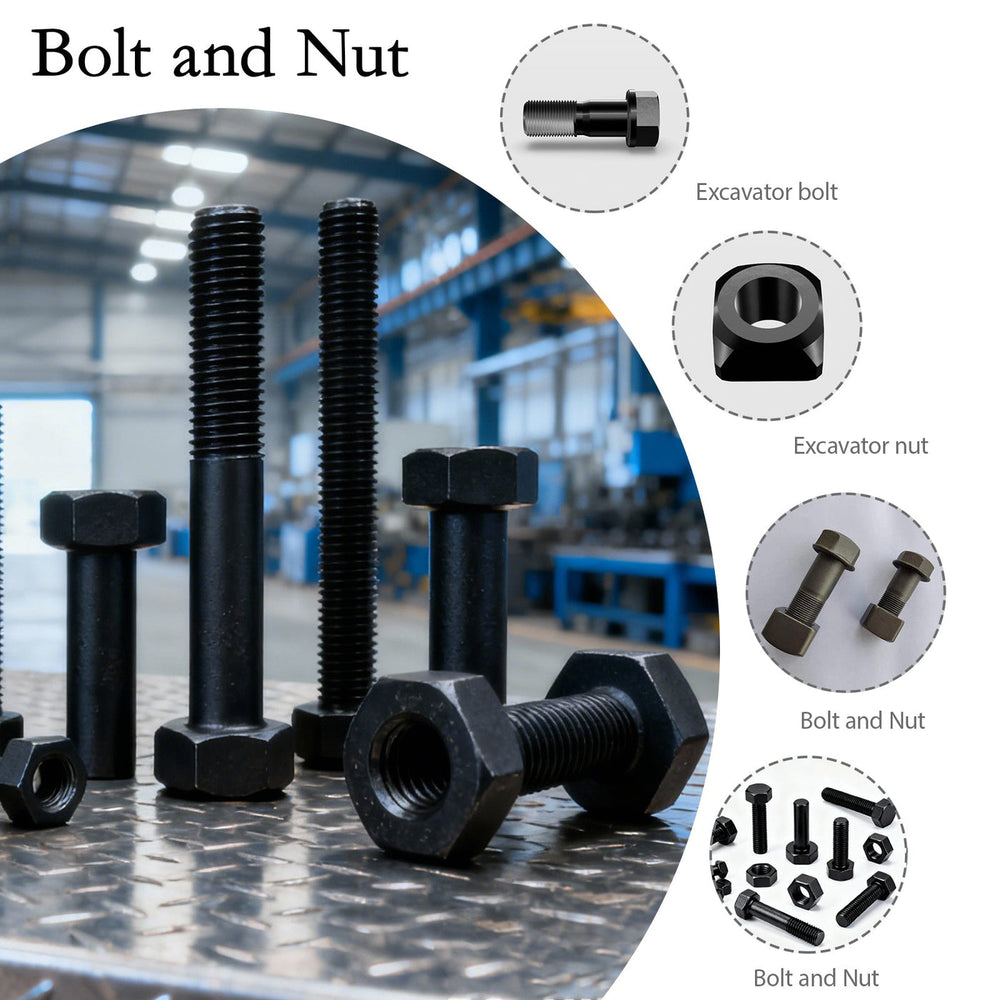
A track bolt rarely fails at a dramatic moment; it usually gives away in the small, repeated cycles that nobody notices until a joint loosens or shears. That is why the heat treatment behind track bolt heat treatment process decisions matters so much, especially when users compare quenching and tempering fasteners with untreated or inconsistently treated hardware.
Last updated:

What the two-stage process actually does
Quenching and tempering is a two-step thermal cycle that first hardens the steel, then brings back enough toughness to keep it usable. In practical terms, the bolt must be strong enough to resist stretching and hard enough to keep its shape, but not so brittle that it cracks under shock.
That balance is the whole point of grade 12.9 bolt metallurgy. Track bolts live in a harsh combination of clamp load, vibration, impact, and dirt, so the material has to hold strength without turning fragile at the head, shank, or thread roots.
Why hardening alone is not enough
If a bolt is only hardened, it may look strong on paper and still fail early in service. The problem is that extreme hardness without tempering can leave the steel too brittle for the repeated shock and flexing common in track hardware.
Temper also matters because bolts are rarely loaded in a clean laboratory way. Machines twist, tracks hammer, and fasteners see tiny slips over time, which means toughness is just as important as tensile strength when the goal is to stop shearing before it starts.
How the thermal cycle works in real use
The quench stage creates a hard martensitic structure by rapidly cooling heated steel. The temper stage then reduces internal stress and fine-tunes hardness so the bolt can absorb service loads instead of cracking when the joint is hit hard.
That is why industrial fasteners are not judged only by their final hardness number. In the field, the heat treatment process has to match the bolt geometry, alloy chemistry, and expected vibration pattern, or the result can be a part that looks correct but behaves inconsistently.
Where track bolts are most likely to fail
What usually breaks a track bolt in service is not one big overload but repeated abuse from poor fit, poor torque control, or a mismatch between bolt grade and application. A bolt that was specified correctly can still shear if the joint is left loose, over-torqued, or reused after deformation.
This is where the practical side of hardware selection gets overlooked. Users often focus on the nominal grade and ignore the actual duty cycle, but track systems punish that shortcut quickly, especially on machines that stay in service for long hours and high shock loading.
What each stage contributes to a bolt that survives
Quenching and tempering are described as one process and they do different things. Losing either produces a bolt with a recognisable failure signature.
| Stage | What it contributes | What goes wrong without it |
|---|---|---|
| Hardening by heating and quenching | The strength the bolt needs to hold the joint at the specified torque | Inconsistent preload, and a bolt that loosens or stretches under load |
| Tempering after the quench | The ductility that lets the bolt absorb overload instead of breaking | A bolt that is strong and brittle, failing with little warning at a load that looks modest |
| Control of the tempering temperature and soak | The actual balance between strength and ductility | Two bolts from the same box behaving differently, which is what makes a joint fail piecemeal |
| Thread and surface condition after treatment | That the torque applied produces the intended preload | Friction absorbing the torque, so the joint is not clamped even at the specified figure |
A bolt is a spring, and the whole point of the heat treatment is to make that spring behave predictably. Where the treatment is inconsistent, the joint fails in the bolts that happen to be at the wrong end of the tolerance, which is why the failure can look random. The useful purchase question is whether the treatment records relate to the batch being supplied, because a grade marking describes the intention rather than the outcome.
Why the process can still disappoint
A two-stage process does not guarantee performance if the upstream steel quality is inconsistent or the heat treatment window is badly controlled. Even a high-strength bolt can end up too hard, too soft, or uneven through the cross-section when the thermal cycle is poorly executed.
That expectation gap is common with track hardware. People assume a higher grade always solves the problem, but real-world failure often comes from the interaction of metallurgy, thread quality, surface finish, and installation discipline rather than from one label on the box.
Choosing the right bolt for the job
The better question is not whether the bolt is strong, but whether it is strong in the right way. For track hardware, the best choice usually combines verified quench-and-temper processing, stable alloy composition, and dimensional consistency that supports proper clamp load.
KTSU’s undercarriage work is built around that kind of detail control. In a 70,000-square-meter facility with more than 3,000 component items in circulation, the practical lesson is clear: fastener performance is inseparable from manufacturing consistency, especially when bolts are part of a broader track chain system.
KTSU Expert Views
Track bolts sit in a difficult part of the machine because they must hold preload while absorbing vibration, impact, and contamination. From a system standpoint, the bolt is not just a small connector; it is part of the clamp architecture that keeps the whole undercarriage stable.
KTSU’s R&D and manufacturing background in construction and agricultural undercarriage components makes this point easy to see in practice. Techniques such as CAD/CAM design, precision CNC machining, and controlled welding workflows only matter if the mating hardware can keep up with the same level of consistency. On track hardware, the weakest link is often not the boldest component, but the one with the least predictable material treatment.
The most reliable bolts are usually the ones whose metallurgy, hardness profile, and dimensional control all align with the machine’s real shock pattern. That is why two-stage quenching and tempering remains more than a textbook process; it is the reason high-tensile track bolts survive in the field instead of failing at the joint.
Frequently Asked Questions
Why do track bolts need both quenching and tempering?
The quench produces the strength, and the temper produces the ductility that lets the bolt absorb overload. A bolt that has only been hardened is strong and brittle, and one that has only been tempered is not strong enough to hold the preload.
What happens if a track bolt is not tempered properly?
It can be hard and brittle, so it breaks under a load that looks modest and gives little warning. Where tempering is inconsistent across a batch, bolts from the same box can behave differently, which makes a joint fail piecemeal rather than all at once.
Where do track bolts usually fail?
At the point where the joint moves. Where the faces are clean and the preload is right, the bolt carries far less alternating load, so failures concentrate where the joint has opened, where a washer has collapsed, or where the seating face is not square.
How do I choose the right track bolt?
Start from the specification for the machine, then verify the documentation behind the batch rather than the marking on the head. The grade is a statement of intention, and the treatment records are what describe the parts you have.
References
This article is part of Undercarriage Parts: The Complete Buyer’s Guide, the guide that covers this topic in decision order.
More Technical Guides guides
Find the next article for your component, application or buying decision.
Back to Technical Guides