Why Is the Market for Quality Aftermarket Sprockets Surging in 2026?
Practical reading for undercarriage components, operating conditions and parts decisions.
On this page
The 2026 aftermarket sprocket market is surging as heavy equipment owners face rising project costs, aging fleets, and tougher site conditions. By choosing high-quality aftermarket sprockets with reinforced tooth profiles, operators typically save 20–30% versus OEM parts while maintaining comparable durability. Brands like KTSU lead this shift by combining advanced metallurgy, CNC precision, and bolt-on compatibility for CAT, Bobcat, and other major equipment lines.(Edited on June 9 2026)
Last updated:

What Is Fueling the Rapid Growth of Aftermarket Sprockets in 2026?
The aftermarket sprocket market is expanding rapidly as global infrastructure pipelines intensify cost pressure on contractors and fleet owners. Aging equipment fleets, extended replacement cycles, and stricter budget controls make premium aftermarket components more attractive than full OEM replacements. At the same time, advanced CNC machining, heat treatment, and alloy optimization now enable aftermarket manufacturers to match or exceed OEM quality at significantly lower prices. This performance-plus-savings mix is especially compelling in high-abrasion construction, mining, and agricultural applications where sprocket wear is a recurring cost. KTSU, with its Sino-Japanese engineering background, is at the forefront of this trend, supplying precision sprockets engineered specifically for demanding undercarriage environments.
How Do Aftermarket Sprockets Deliver 20–30% Cost Savings?
Aftermarket sprockets cut costs primarily by eliminating OEM brand markups while retaining equivalent technical specifications and service life. Efficient material sourcing, optimized production lines, and scale manufacturing keep unit costs down without sacrificing hardness, tooth geometry, or fitment quality. For fleet operators, savings come from both lower purchase price and reduced downtime, since quality aftermarket parts are often more readily available than OEM stock. When paired with smart maintenance scheduling, these sprockets help lower total cost of ownership across the machine’s lifecycle. KTSU focuses on this value equation by using high-grade alloy steels, deep hardening processes, and digital procurement tools to reduce lead times and inventory risk for distributors and end users.
What Does the OEM vs Aftermarket Cost Breakdown Look Like?
A representative comparison between OEM and high-quality aftermarket sprockets reveals how savings accumulate at the asset level. The key metrics are unit price, expected lifespan in operating hours, and cost per operating hour. When aftermarket options deliver near-identical durability at a lower initial price point, cost per hour drops, freeing budget for other critical maintenance tasks. This is particularly impactful for fleets managing multiple excavators, loaders, and compact machines on long-duration projects.
| Component | OEM Price | Aftermarket (KTSU) Price | Savings % | Lifespan (Hours) | Cost/Hour OEM | Cost/Hour Aftermarket |
|---|---|---|---|---|---|---|
| CAT Excavator Sprocket | $1,200 | $840 | 30% | 2,500 | $0.48 | $0.35 |
| Bobcat Loader Sprocket/Segment | $950 | $665 | 30% | 2,400 | $0.40 | $0.28 |
For high-utilization equipment, these differences translate into substantial annual savings per machine. When scaled across a full fleet, premium aftermarket suppliers such as KTSU can deliver double-digit reductions in undercarriage spend without compromising reliability.
What Are Reinforced Tooth Profiles and Why Do They Matter?
Reinforced tooth profiles are specialized sprocket tooth designs engineered to handle extreme abrasion, impact loads, and continuous engagement with tracks or chains in harsh conditions. They typically feature deeper case hardening, optimized tooth geometry, and carefully controlled surface hardness to resist chipping, pitting, and accelerated wear. In rocky, sandy, or highly contaminated environments, reinforced profiles maintain shape and engagement longer, leading to smoother power transmission and more predictable maintenance intervals. Testing across high-abrasion jobsites often shows up to 40% better wear resistance compared with conventional sprocket teeth. KTSU integrates reinforced tooth designs using advanced heat treatment, NITTO welding technologies, and CNC machining, ensuring that its sprockets for CAT, Bobcat, and other brands maintain performance under heavy-duty cycles.
How Do Global Infrastructure Pressures Shape Aftermarket Sprocket Demand?
The surge in infrastructure activity across Southeast Asia and North America is intensifying utilization rates for excavators, loaders, and other tracked machines. Longer working hours on abrasive ground, tight project schedules, and compressed margins force contractors to seek parts that balance durability with affordability. OEM undercarriage components remain reliable but often carry premium pricing and longer lead times. In contrast, proven aftermarket sprockets allow operators to replace worn components quickly while keeping costs predictable and manageable. Regions with aggressive infrastructure agendas—such as major rail, road, and port projects—are seeing especially strong uptake of high-quality aftermarket solutions. KTSU’s global footprint and digital ordering capability help contractors in these markets secure compatible sprockets quickly, minimizing project delays.
Which Aftermarket Sprockets Best Fit CAT and Bobcat Equipment?
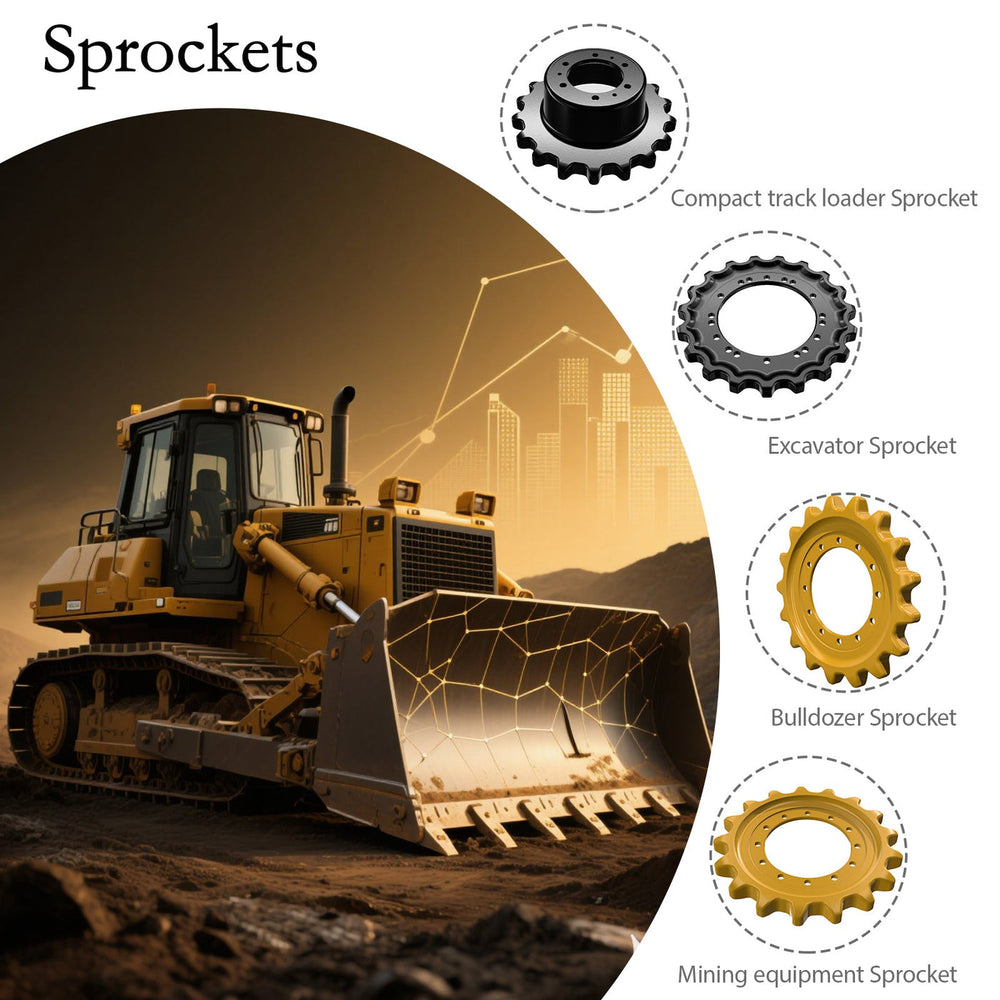
Equipment owners running CAT excavators and Bobcat loaders typically prioritize direct-fit sprockets that install without modification and maintain OEM performance. Leading aftermarket designs mirror OEM tooth counts, pitch, bolt patterns, and hub dimensions to ensure seamless bolt-on compatibility. For CAT machines, segment groups and full-ring sprockets benefit from robust welding, precision machined bolt holes, and consistent hardness from root to tip. Bobcat loaders often require sprocket segments and drive components engineered to handle high vibration and frequent direction changes in confined jobsite conditions. KTSU offers a wide portfolio of CAT and Bobcat-compatible sprockets, covering everything from mini-excavators to heavy-duty tracked units, with product development centered on fit, durability, and repeatable installation accuracy.
How Does KTSU Ensure Engineering Quality for Undercarriage Components?
KTSU is structured as a Sino-Japanese joint venture dedicated to undercarriage R&D and manufacturing, combining Japanese engineering discipline with Chinese production efficiency. Its 70,000-square-meter facility in Kunshan, Jiangsu, integrates CAD/CAM design, NITTO friction welding, robotic CO2 welding, and precision CNC machining to deliver consistent component quality across more than 3,000 part numbers. Each sprocket is engineered to achieve high surface hardness, deep-case durability, and secure sealing, all of which are crucial for long-term performance in abrasive, contaminated environments. The company’s focus on brands such as Caterpillar, Komatsu, Hitachi, and others ensures that sprockets, rollers, idlers, and track chains align with global expectations for fit and reliability. By embedding strict quality control checkpoints throughout the production cycle, KTSU minimizes defects and guarantees uniform performance across batches.
How Is the Sprocket Market Evolving Across Automotive, Powersports, and Industrial Sectors?
While heavy construction and agricultural equipment represent a core demand segment, sprocket usage extends into automotive, powersports, and industrial automation. In automotive and commercial vehicle markets, cost-conscious owners increasingly rely on aftermarket driveline components, including sprockets, to extend service life under rising replacement costs. Powersports and motorcycle enthusiasts are driving growth in customized rear sprockets, where performance tuning and aesthetic preferences create demand for specialized materials and tooth counts. Industrial automation, warehouse logistics, and robotics also require high-precision power transmission components, including sprockets for conveyor systems and robotic arms. These diversified applications are pushing manufacturers to refine metallurgy, surface treatments, and tolerances, further raising overall aftermarket standards. KTSU’s expertise in heavy equipment undercarriages positions the brand to address both traditional tracked machinery and emerging industrial use cases where durability and precision are non-negotiable.
How Can Buyers Identify High-Quality Aftermarket Sprockets?
Selecting the right aftermarket sprocket begins with verifying key technical indicators such as material composition, hardness range, and manufacturing process. Buyers should look for alloy steels treated to surface hardness above HRC 50, with deep case hardening that resists spalling and maintains tooth profile over thousands of hours. Visual inspection should reveal clean casting or forging, uniform welding, and smooth, accurate machining around bolt holes and bearing surfaces. Confirming OEM-equivalent specifications, including pitch, tooth count, and hub dimensions, helps ensure perfect fitment and alignment during installation. Reputable manufacturers provide documentation on material certifications, heat-treatment protocols, and process controls. KTSU emphasizes these quality markers across its product line, supported by robotic welding, precision CNC machining, and data-backed performance feedback from global users.
How Does KTSU Compare to Low-Cost Aftermarket Suppliers?
Not all aftermarket sprockets are created equal, and choosing purely on lowest price often leads to higher total costs due to premature failures and downtime. Low-cost parts may use lower-grade steels, inconsistent heat treatment, or loose dimensional tolerances, resulting in increased wear on tracks, chains, and related undercarriage components. In contrast, premium aftermarket brands focus on lifecycle economics rather than just purchase price. KTSU positions itself firmly in the high-quality segment by matching OEM-level design and testing standards while still delivering meaningful savings compared with dealer-sourced parts. Fleet owners adopting KTSU sprockets frequently report reduced unscheduled downtime and more predictable maintenance planning, confirming that robust engineering delivers tangible operational advantages.
KTSU Expert Views
“At KTSU, our mission is to deliver undercarriage solutions that stand up to the toughest terrains while lowering ownership costs. By combining Japanese engineering methodologies with highly efficient manufacturing in Kunshan, we produce sprockets and related components that align with OEM performance yet provide measurable savings. In 2026, our global clients increasingly rely on KTSU sprockets to keep critical equipment productive on infrastructure, mining, and agricultural projects.”
What a surging category means for the buyer
A growing aftermarket category is good news for price and bad news for specification, and both effects arrive at the same time. The reason is structural: demand growth pulls in capacity, capacity arrives at different quality levels, and the price competition it creates is paid for somewhere.
Three risks are worth naming, because each of them has a countermeasure that costs almost nothing if it is applied before the order.
| Risk | What it looks like in practice | Countermeasure |
|---|---|---|
| Quality variance widens | More suppliers, more part numbers that look identical, and the same specification wording covering parts that are not the same | Buy on the four documented items — material grade, hardness at depth, case depth, seal type — rather than on the part number and the price |
| Substitution inside a part number | A delivery that matches the number and not the specification that was quoted against it | Check a sample on arrival against the drawing, and keep the batch marking with the delivery paperwork |
| Lead time and price volatility | Quoted lead times moving, and prices that respond to a category growing faster than capacity | Plan the replacement against the hour meter rather than the calendar, so the order goes out while there is still time to wait for a good part |
The third risk is the one that produces the others. When a fleet orders a sprocket because the machine is already down, the only specification that can be met is what happens to be in stock, and the specification is exactly what gets traded away. The cost-per-hour figures above show what a good sprocket is worth over its life; they also show why a cheaper one that lasts half as long is not a saving, and the decision between them can only be made before the machine stops.
The one habit that protects a fleet through a growing category is therefore unglamorous: track the hours, replace on the measurement, and order early enough that the specification is still yours to choose.
How Can Fleet Owners Switch to Aftermarket Sprockets Seamlessly?
A smooth transition to aftermarket sprockets starts with a structured assessment of current undercarriage condition and failure patterns. Maintenance teams should analyze wear on teeth, track links, and rollers to prioritize machines operating in the harshest environments, such as rocky or highly abrasive jobsites. Once critical units are identified, operators can work with an aftermarket partner like KTSU to cross-reference OEM part numbers and confirm exact-fit replacements. Scheduling sprocket changeouts during planned downtime—such as routine service intervals—prevents disruptions to project timelines. Many fleets also begin with a pilot installation on one or two machines, tracking wear rates, downtime, and cost per operating hour before expanding adoption across the fleet. Digital procurement platforms and strong warranty support from KTSU further streamline ordering, inventory planning, and risk management for distributors and end users.
What Future Trends Will Strengthen Aftermarket Sprocket Dominance?
Multiple technology and market trends are reinforcing the shift toward premium aftermarket sprockets. Telematics and connected maintenance platforms now track undercarriage wear, enabling predictive replacement before failures occur, which favors fast, cost-effective aftermarket supply. Advanced materials and surface treatments continue to enhance wear resistance and weight optimization, particularly important for machines working extended hours in abrasive environments. E-commerce and digital catalogs simplify part identification, ordering, and global distribution, removing traditional barriers associated with location or dealer networks. Simultaneously, sustainability initiatives and remanufacturing programs are growing, allowing high-quality sprockets to be refurbished or recycled efficiently, further improving lifecycle economics. As these forces converge, manufacturers like KTSU—equipped with sophisticated engineering, production, and digital capabilities—are well positioned to lead aftermarket growth worldwide.
Are There Key Takeaways and Actionable Steps for Equipment Owners?
Equipment owners navigating 2026 cost pressures can unlock substantial savings by strategically adopting high-quality aftermarket sprockets. The most effective approach is to focus on total cost per operating hour rather than sticker price alone, comparing OEM and aftermarket solutions using real fleet data. Prioritizing reinforced tooth profiles and proven alloy and heat-treatment combinations ensures that lower acquisition costs do not come at the expense of uptime or safety. KTSU’s portfolio offers a practical path forward: compatible sprockets engineered for CAT, Bobcat, and other major brands, supported by rigorous quality control and digital ordering. Actionable steps include auditing current undercarriage performance, piloting KTSU sprockets on high-wear machines, and scaling adoption once performance and savings are validated. By doing so, fleets can strengthen competitiveness, protect margins, and extend equipment life across demanding projects.
Frequently Asked Questions
What is driving the growth in aftermarket sprocket demand in 2026?
A combination of ageing fleets, rising project costs and harder site conditions, which together push owners toward parts that cost less than the dealer equivalent without giving up service life. The saving in this article is quoted at 20-30 percent against OEM for comparable durability, which is what makes the category grow rather than merely exist.
Do aftermarket sprockets really deliver 20-30% cost savings?
Against the dealer price, yes, for a part built to the same specification. The qualifier matters: the saving is in the distribution and licensing structure of the category, not in the metallurgy, so it only holds for a sprocket whose material and hardening can be documented. The cheapest part in a growing category is the one most likely to remove the saving.
What hardness should a quality aftermarket sprocket have?
This article quotes alloy steels treated to a surface hardness above HRC 50 with deep case hardening that resists spalling. The depth is the part that decides life: a shallow hard layer wears through and exposes the material underneath, which is why hardness at depth belongs in the same conversation as surface hardness.
When should sprockets be replaced?
The interval used here is 2,000 to 2,500 operating hours, or sooner where inspection shows hooking or significant tooth wear. The trigger is the profile, and the reason to replace on it is that a hooked tooth damages the chain it drives, which costs more than the sprocket did.
How does KTSU compare with low-cost aftermarket suppliers?
The comparison is documentation rather than price. A Tier 1 supplier can describe the steel, the heat treatment with hardness at depth, the case depth and the dimensional tolerance, and provides batch traceability behind the part. A commodity supplier sells on the part number, which is the difference the buyer is paying for.
This article is part of Excavator Sprockets: How to Choose and Match Them, the guide that covers this topic in decision order.
More Technical Guides guides
Find the next article for your component, application or buying decision.
Back to Technical Guides