Comprehensive Guide to Engineered Rubber Tracks: Engineering, Selection, Maintenance, Machine Fitment, and Fleet ROI
Sizing, machine compatibility and care for rubber track systems in real working conditions.
On this page
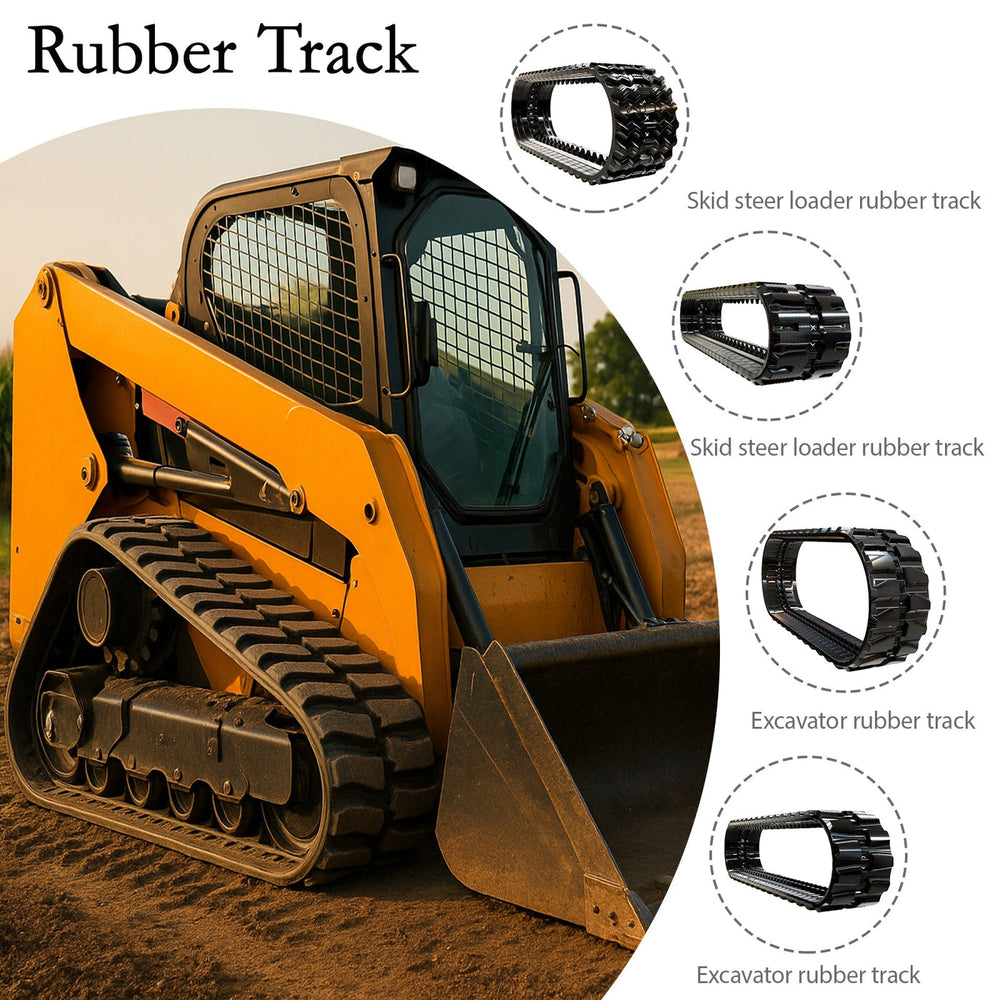
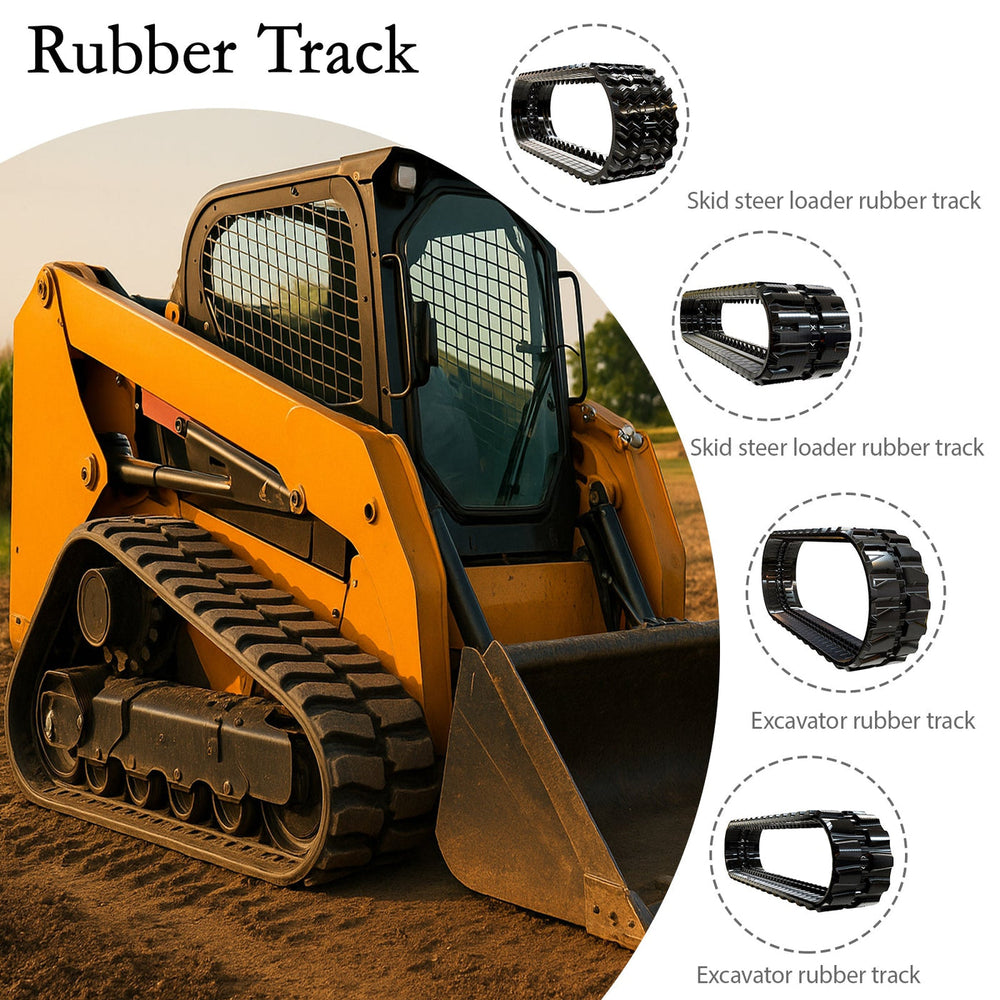
A rubber track is a continuous, flexible elastomer belt reinforced with high-tensile internal steel cords and embedded metal drive links (lugs). Wrapped around an undercarriage system—consisting of a drive sprocket, track rollers, carrier rollers, and a front idler—it transfers engine horsepower directly into smooth ground movement.
Last updated:

Unlike traditional steel tracks or pneumatic tires, engineered rubber tracks combine the stability and flotation of a tracked system with the low ground disturbance of rubber. They serve as essential undercarriage components across diverse compact construction, agricultural, and industrial machinery, including:
Compact Track Loaders (CTL) & Multi-Terrain Loaders (MTL)
Mini-Excavators & Heavy Compact Excavators
Over-The-Tire (OTT) Skid Steer Systems (Rubber and Steel Hybrid Systems)
Track Dumpers, Utility Carriers, and Asphalt Pavers
Agricultural Tractors and Specialized Drilling Equipment
What Are the Core Structural Components of a Rubber Track?
The structural integrity of a heavy-duty rubber track depends on a multi-layer composite assembly engineered to withstand extreme tension, flex, and abrasion:
Outer Tread Rubber Compound: The primary protective layer formulated with anti-wear virgin rubber, carbon black, and anti-aging agents to resist cuts, gouging, chunking, and UV degradation.
Internal Metal Drive Lugs: Precision-cast steel components embedded between the inner underlayer and outer tread. They engage directly with the drive sprocket teeth to transmit torque while guiding track alignment.
Continuous Steel Cord Package: Helically wrapped, jointless high-tensile steel cables running through the track core. This layer absorbs tensile forces, prevents operational stretching, and eliminates joint breakage under sudden shock loads.
Textile Reinforcing Wrapping: A specialized fabric layer positioned between the steel cord package and metal lugs to ensure precise cord alignment, dampen vibration, and distribute stress evenly across the carcass.
Rubber Track vs. Steel Track vs. Rubber Pads: How Do They Compare?
Selecting the correct undercarriage system directly impacts operational costs, site safety, and equipment versatility. The table below outlines key performance trade-offs:
| Performance Metric | Premium Engineered Rubber Track | Heavy-Duty Steel Track | Bolt-On / Clip-On / Chain-On Rubber Pads |
| Surface Protection | Maximum (Zero damage to asphalt, turf, or concrete) | Poor (Causes severe surface gouging and tearing) | High (Protects finished surfaces over metal tracks) |
| Ground Pressure & Flotation | High Flotation (Distributes weight over soft mud/snow) | Moderate (Weight concentrated on rigid steel points) | Moderate (Adds weight to existing steel track assemblies) |
| Vibration & Noise Reduction | Ultra-Low (Dampens machine shock, minimizes noise) | High (Loud metal-on-metal clanking and vibration) | Low to Moderate (Dampens sound at ground contact point) |
| Severe Demolition Survival | Moderate (Vulnerable to sharp rebar and jagged glass) | Maximum (Immune to sharp cuts and extreme debris) | Moderate (Pads wear down rapidly under heavy abrasion) |
| Travel Speed | High (Enables fast job-site travel and maneuvering) | Low (Restricted travel speed to prevent machine wear) | Moderate |
| Total Cost of Ownership | Optimized (Balanced initial cost and long service life) | High Upfront (Expensive initial investment) | Low Upfront (Modular replacement for worn pads) |
Why Do Fleet Owners Invest in Engineered Rubber Tracks over Generic Aftermarket Options?
Undercarriage maintenance and unexpected downtime represent up to 50% of a machine's total lifecycle operating costs. Generic or low-grade rubber tracks frequently suffer from internal cord separation, guide lug delamination, and rapid tread wear under heavy lifting.
Leading engineering suppliers, such as KTSU (Kunshan Kensetsu Buhin), address these failure points through advanced manufacturing standards:
Continuous Endless Steel Cord Technology: Eliminates structural overlap joints—the primary point of failure in cheaper tracks—preventing premature snapping under heavy torque.
Robotic & CNC Manufacturing Standards: Incorporates automated CNC machining, robotic $CO_2$ welding, and NITTO friction welding to guarantee hardness consistency and dimensional precision across full undercarriage ecosystems.
Synchronized Vulcanization: Bonds internal guide lugs, steel cord packages, and outer rubber compounds simultaneously under controlled temperature and pressure, eliminating lug separation.
What Are the Main Types of Rubber Track Tread Patterns?
Matching tread geometry to ground conditions directly dictates traction, tread life, and fuel efficiency.
| Tread Pattern Type | Ideal Working Environment | Primary Operational Benefit |
| Staggered Block Pattern | Multi-purpose use on hot asphalt, gravel, and lawns | Smooth transit, reduced operator fatigue, and multi-surface versatility |
| C-Lug Pattern | Hard surfaces, wet concrete, mud, and clay | Engineered C-shaped notches deliver biting traction and mud shedding |
| Straight Bar Pattern | Deep mud, soft dirt, and loose agricultural soil | Maximum pushing traction; prevents side-slippage in heavy terrain |
| Multi-Bar / Zig-Zag | Snow removal, ice, mud, and soft ground | Smooth transition between hard surfaces and slippery or icy terrain |
| Turf-Friendly / Smooth | Delicate landscaping, residential lawns, and turf | Ultra-low ground disturbance; eliminates sod tearing and rework costs |
Which Machinery Makes and Models Are Compatible with Rubber Tracks?
High-grade replacement rubber tracks support a wide range of compact construction equipment, utility carriers, and agricultural machinery OEMs:
Bobcat: Compact Track Loaders (T190, T590, T650, T770, T870) & Mini Excavators (E26, E35, E50, E85)
Caterpillar (CAT): CTL/MTL Series (259D3, 279D3, 289D3, 299D3) & Mini Excavators (301.7, 305 CR, 308 CR)
Kubota: Compact Track Loaders (SVL65-2, SVL75-2, SVL95-2s) & Excavators (KX040-4, KX057-4, U35-4)
Takeuchi: Track Loaders (TL8, TL10V2, TL12V2) & Excavators (TB230, TB260, TB290)
John Deere: Compact Track Loaders (317G, 325G, 333G) & Excavators (35G, 50G, 60G)
Yanmar, JCB, ASV, Case, Gehl, Mustang, Wacker Neuson, Morooka, Ditch Witch, and Vermeer
Specialized Brands & Premium Track Product Lines: Support for industry-standard replacement lines including Camso (MTL HXD, CTL SD, CTL HXD, OTT HXD, MX SD, MX HXD), Traxter (CTL, MX), and Bridgestone Paver tracks.
How Do You Read Track Sizes and Sidewall Stamping Information?
Every certified rubber track features critical identification data stamped directly into the exterior rubber sidewall:
Brand Name & Country of Origin: Identifies the primary manufacturer and quality control origin.
Part Number & Serial Number: Encodes factory identification numbers, production year, and sequential batch tracking for warranty validation.
-
Dimensions Stamping Format: Expressed as
Width (mm) × Pitch (mm) × Links (Count)-
Example: A track stamped 400 × 86 × 52 indicates:
400 mm: Total track width from edge to edge.
86 mm: Track pitch (distance from the center of one metal guide lug to the center of the next).
52: Total count of metal drive links (lugs) around the internal circumference.
-
How Do You Select and Verify the Correct Replacement Rubber Track?
Step 1: Verify Physical Dimensions
Measure overall width in millimeters. Measure the exact pitch distance between the centers of two consecutive drive lugs. Count the total number of metal links along the inner track length. Cross-reference these specs with your machine manual.
Step 2: Evaluate Job-Site Terrain
Match the carcass thickness and tread pattern to your site. Select heavy-duty, cut-resistant compounds for demolition and recycled concrete, or wide flotation tracks for soft agricultural mud and sensitive turf.
Step 3: Inspect Companion Undercarriage Components
Installing a new track on worn sprockets, rollers, or front idlers accelerates wear duplication by up to 300%. Check for hooked sprocket teeth, frozen top carrier rollers, or grooved bottom rollers before mounting new tracks.
Step 4: Verify Supplier Ecosystem and Warranty Support
Source replacement parts from suppliers offering complete undercarriage ecosystems—including matching sprockets, rollers, and idlers—backed by clear warranty terms and scaled regional inventory for fast dispatch.
Troubleshooting Common Rubber Track Failures
| Failure Mode | Root Cause Analysis | Corrective Action & Prevention |
| Detracking (Track Slipping Off) | Insufficient track tension, worn guide lugs, or debris build-up in idler slots | Clean undercarriage daily; adjust tension to OEM specs; inspect idler guide alignment. |
| Cable Breaking / Sudden Rupture | Severe over-tensioning shock, sharp debris penetration, or internal cord corrosion | Maintain correct slack; avoid driving over sharp rebar; choose continuous endless steel cables. |
| Lug Delamination / Separation | Low-grade rubber-to-metal bonding or operating with mismatched sprocket pitch | Upgrade to vulcanized, robotic-welded internal lugs; replace worn drive sprockets. |
| Severe Chunking & Edge Tearing | Sharp 360-degree pivot turns on rough asphalt or hitting concrete curbs | Train operators on wide three-point turns; select cut-resistant heavy-duty carcasses. |
How Can Operators Maximize Rubber Track Lifespan and Lower Operating Costs?
1. Perform Routine Tension Checks (The Bucket Lift Test)
Track tension must be calibrated regularly per manufacturer specifications.
Field Verification Method: Lower the loader bucket or excavator blade to the ground, push down to lift the front undercarriage off the surface, and measure the sag distance between the middle bottom roller and the inside track lug.
Risk: Loose tracks cause detracking and lug damage; over-tightened tracks overload internal steel cables, drive sprockets, and idler bearings.
2. Practice Proper Machine Operation
Avoid fast 360-degree counter-rotations (spot turns) on abrasive surfaces such as hot asphalt, crushed concrete, or gravel.
Make gradual, wide three-point turns to minimize lateral stress on guide lugs and prevent track edge tearing.
Avoid driving over sharp curbs or steep drop-offs that force weight onto the unsupported track edges.
3. Daily Undercarriage Cleaning
Clear out packed mud, clay, rocks, and icy debris from the undercarriage after every shift. Frozen or dried debris jams track rollers, forcing the track to stretch over obstacles and causing internal cord breakage.
4. Protect Against Chemical and UV Degradation
Clean off fuel, hydraulic oils, grease, and harsh road salts immediately, as petroleum products degrade natural rubber compounds. When machines are idle for extended periods, store them indoors or under protective covers to prevent premature dry-rotting from UV exposure.
When rubber is the wrong choice
Rubber tracks are bought for surface protection, flotation and quiet operation. Three situations make that the wrong purchase, and each of them is decided by the duty rather than by preference.
| Situation | Why rubber is wrong here | What to do instead |
|---|---|---|
| The machine works almost entirely on rock or demolition debris | Cut and impact damage ends the track long before abrasion does, so the cost per hour is set by damage rather than by wear | Steel tracks, where cut resistance and repairability matter more than surface protection |
| There is no surface to protect and the machine runs long distances on hard ground | Rubber wears quickly on hard surfaces at travel speed, and the protection is protecting nothing | Steel, and a track specification chosen for abrasion rather than for flotation |
| The machine is large and the ground is soft but filled with sharp material | Rubber gives the flotation, and the sharp material removes it | Wider steel shoes, or a specification chosen to trade some flotation for cut resistance |
Two practical points follow. First, the decision is a duty split rather than a category: a machine that spends most of its hours on finished surfaces should be on rubber even if the rest of the work is rough, because the surface is the asset being protected. Second, where the split is genuinely even, the answer is usually two machines or a set of pads rather than a compromise specification.
The reason to state the boundary is that rubber tracks are often bought by default, because the machine was delivered on them. The question worth asking at replacement is what the track spends its hours on, and whether the property being paid for is the one the machine needs.
Frequently Asked Questions
What is a rubber track and why use one?
It is a continuous reinforced rubber belt with internal steel cords, used instead of steel shoes where the machine must protect the surface it works on, keep ground pressure low, or operate more quietly.
How do I read a rubber track size?
Three figures: width, pitch and link count, sometimes with a letter that is part of the guide or pattern designation. All of them have to match the machine, and the letter in the code has to be copied exactly.
How long does a rubber track last?
Duty cycle sets the band: roughly 2,500-4,000 hours in light work, 2,000-3,000 in general construction and agriculture, and 1,200-2,500 in heavy abrasive conditions, with cuts ending tracks well before wear does.
Can rubber tracks be used on any machine?
Physically only where the undercarriage is designed for them, and the width, pitch, link count and guide type have to match. A machine built for steel tracks does not simply become a rubber-tracked machine because a rubber track can be fitted.
When are steel tracks the better choice?
Where the ground is abrasive or sharp, where travel on hard surfaces is long, and where there is no finished surface to protect. In those conditions the cut resistance and repairability of steel decide the cost per hour.
This article is part of Rubber Tracks: Selection, Fitment, Care and Replacement, the guide that covers this topic in decision order.
More Rubber Tracks guides
Find the next article for your component, application or buying decision.
Back to Rubber Tracks