What Are Engineered Sets in Undercarriage Systems for Heavy Machinery?
Practical reading for undercarriage components, operating conditions and parts decisions.

On this page
Engineered undercarriage sets are fully matched systems of sprockets, track chains, rollers, and idlers designed to wear at the same rate. By aligning metallurgy, hardness, and geometry, these sets prevent uneven degradation, extend service life by up to 50%, reduce downtime, and lower total operating costs across construction and mining equipment fleets.(Edited on June 9 2026)
Last updated:

What Are Engineered Sets in Undercarriage Systems?
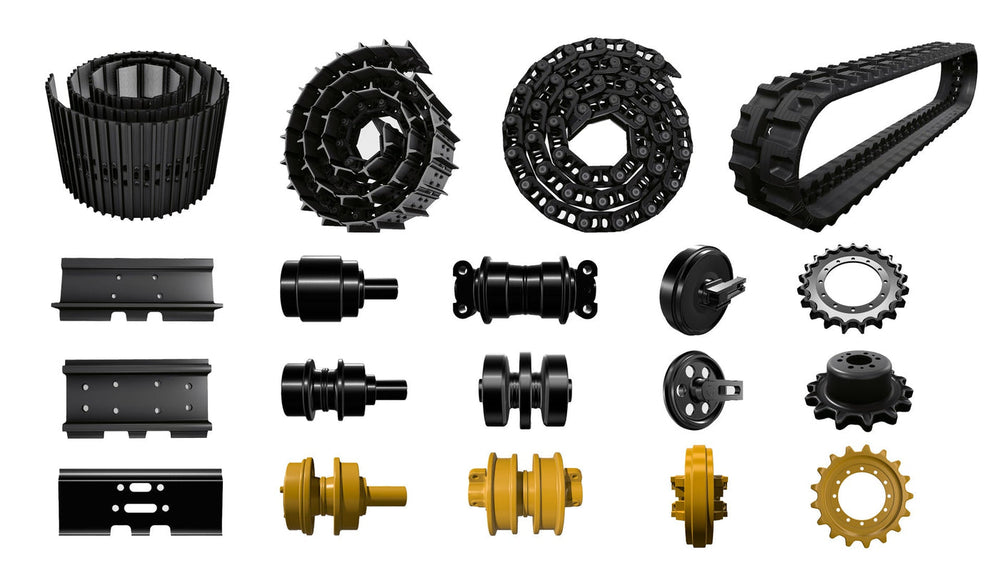
Engineered sets are complete assemblies of undercarriage components designed to function as a unified system rather than as individual replacement parts. Each component—sprockets, chains, rollers, and idlers—is manufactured with matched material properties and wear characteristics.
This approach ensures that no single component accelerates the wear of another. Instead, all parts degrade evenly, maximizing lifespan and maintaining consistent machine performance. KTSU has advanced this concept by producing precision-matched systems tailored for major equipment brands such as Caterpillar, Komatsu, and Hitachi.
Why Has the Industry Shifted to Engineered Sets?
The transition to engineered sets is driven by rising equipment costs and the need to minimize downtime. Traditional replacement methods often caused premature failures due to mismatched wear rates.
Key reasons for adoption include:
Reduced premature failures caused by incompatible components.
Improved predictability in maintenance scheduling.
Lower total cost of ownership through synchronized replacement cycles.
Compatibility with predictive maintenance technologies.
Field data shows that mismatched parts contribute to a significant portion of undercarriage failures, making engineered systems a more reliable standard.
How Does Optimized Wear Pairing Work?
Optimized wear pairing ensures that all undercarriage components share similar hardness, strength, and abrasion resistance. This balance prevents uneven stress distribution during operation.
Manufacturers achieve this through:
Controlled heat treatment processes.
Precision machining of contact surfaces.
Matching hardness gradients between interacting parts.
For example, sprocket teeth are engineered to mesh perfectly with track bushings, preventing premature deformation. KTSU utilizes advanced welding and machining technologies to maintain these precise tolerances across every component.
What Does Metallurgical Alignment Mean for Performance?
Metallurgical alignment refers to the precise coordination of material composition and hardness across all components in the system. This ensures consistent resistance to wear and mechanical stress.
Typical specifications include:
Surface hardness ranges between 55–60 HRC for sprockets and chains.
High-tensile alloy steels for core strength.
Deep-case hardening for extended durability.
KTSU applies CAD/CAM design and CNC machining to achieve exact metallurgical profiles, resulting in superior durability even in extreme environments such as mining and quarry operations.
Which Benefits Do Engineered Undercarriage Sets Provide?
Engineered sets deliver measurable operational and financial advantages.
Extended lifespan of 30–50% compared to traditional setups.
Reduced downtime due to predictable wear patterns.
Lower maintenance costs through synchronized replacements.
Improved fuel efficiency from optimized system performance.
Undercarriage Performance Comparison:
Component | Traditional Lifespan | Engineered Set Lifespan | Improvement
Sprockets | 1,200 hours | 1,800 hours | +50%
Track Chains | 2,000 hours | 2,800 hours | +40%
Rollers | 1,500 hours | 2,100 hours | +40%
Idlers | 2,500 hours | 3,200 hours | +28%
These improvements are validated through real-world applications in construction and mining environments.
How Can You Choose the Right Engineered Set?
Selecting the correct engineered set requires evaluating machine specifications and operating conditions.
Important considerations include:
Equipment model and OEM compatibility.
Terrain type, such as rock, sand, or mixed soil.
Component specifications like pitch and roller diameter.
Verified hardness and material certifications.
KTSU offers a comprehensive catalog with over 3,000 components, supported by a digital selection platform that simplifies procurement and ensures precise fitment.
When Should Undercarriage Components Be Replaced?
Replacement timing is critical to maintaining system performance. Engineered sets should typically be replaced when components reach around 80% of their service life.
Common indicators include:
Excessive track sag beyond recommended limits.
Hooked or worn sprocket teeth.
Uneven wear patterns across components.
Regular inspections every 500 operating hours help detect early signs of wear and maintain system balance.
When an engineered set pays for itself — the arithmetic
The table above shows the claim plainly: a sprocket at 1,200 hours in a traditional set against 1,800 hours in an engineered set, and similar gains on the other components. The question a fleet manager actually has to answer is whether the premium on the set is smaller than the cost of the extra cycle it removes.
A model, with the assumptions stated. Substitute your own prices and hours.
| Line | Traditional set | Engineered set |
|---|---|---|
| Sprocket life | 1,200 hours | 1,800 hours |
| Cycles to reach 3,600 hours | 3 sets | 2 sets |
| Parts cost over 3,600 hours | 3 × set price | 2 × set price plus any premium |
| Downtime events | 3 planned replacements | 2 planned replacements |
| Break-even premium | The engineered set can cost up to 50% more per set and still be cheaper over 3,600 hours — because it removes a whole replacement cycle rather than discounting one | |
Three conditions have to hold for that arithmetic to be true on your machine, and they are worth checking before the premium is paid:
- The machine has 3,600 hours left to run. A set with two cycles of life left on a machine being retired at the next cycle does not break even, whatever the hours say.
- The wear is even. An engineered set depends on the components reaching their limits together. If a single roller or a misaligned idler is being destroyed early, the set is not the constraint — the alignment is, and no set survives that.
- The 500-hour inspection happens. The life figures assume the set is measured and rotated as designed; skipping the inspections is how a matched set stops being matched.
Put your own set price and hourly rate into the table and the decision resolves into a number rather than a preference.
KTSU Expert Views
“KTSU engineered undercarriage systems represent a fully integrated approach to wear management. By aligning hardness gradients between 52 and 62 HRC across all components, we ensure synchronized degradation under extreme working conditions. Our precision manufacturing processes guarantee optimal meshing between sprockets, chains, and rollers, significantly reducing unexpected failures. Customers consistently report improved uptime, longer service intervals, and more predictable maintenance cycles across diverse applications.”
What Maintenance Practices Support Engineered Sets?
Proper maintenance is essential to preserve the benefits of engineered systems.
Recommended practices include:
Regular track tension adjustments.
Consistent lubrication schedules.
Routine visual inspections for alignment and wear.
Operator training to minimize excessive stress on components.
Maintenance Schedule Overview:
Task | Frequency | Benefit
Track tension adjustment | Weekly | Prevents chain stretching
Lubrication | Weekly | Reduces friction and wear
Visual inspection | Monthly | Detects early issues
System audit | Quarterly | Ensures uniform wear
KTSU-designed sealed components further enhance durability by protecting against contaminants in harsh environments.
Key Takeaways and Action Steps
Engineered undercarriage sets represent a major advancement in heavy equipment performance by ensuring all components wear evenly and predictably. This system-based approach significantly extends service life, reduces downtime, and lowers operational costs.
To maximize benefits:
Transition from individual parts to complete engineered sets.
Monitor wear patterns regularly using inspection tools or telematics.
Partner with reliable suppliers like KTSU for verified quality and compatibility.
Follow structured maintenance schedules to sustain performance.
Adopting engineered sets is not just a technical upgrade—it is a strategic move toward more efficient and cost-effective equipment management.
Frequently Asked Questions
What are engineered sets in undercarriage systems?
A fully matched group of sprockets, track chains, rollers and idlers chosen so the components wear at the same rate — same metallurgy, same hardness and matched geometry — instead of each one reaching its limit at a different point. The point of the match is that the set reaches replacement together, so no part spends its life working against a worn neighbour.
Are engineered sets worth the extra cost?
On the numbers in this article they can be: a sprocket rated 1,800 hours against 1,200 reaches 3,600 hours in two cycles instead of three. That means the engineered set can carry a premium of up to 50% per set and still cost less per hour — provided the machine has the hours left to run and the wear stays even.
How often should an engineered set be inspected?
Every 500 operating hours. The life figures the set is sold on assume the components are measured on schedule and that wear is even; once an inspection is skipped, a single component can fall behind and the matched set stops being matched.
What can stop an engineered set from reaching its rated life?
Uneven loading, most often from misalignment or from one roller or idler being destroyed early, and a machine that will reach the next replacement cycle with only part of the set worn. Both break the assumption the arithmetic rests on.
This article is part of Undercarriage Wear, Life and Replacement Planning, the guide that covers this topic in decision order.
More Technical Guides guides
Find the next article for your component, application or buying decision.
Back to Technical Guides