Segmented Sprockets or One-Piece Drive Wheels Which Fits Your Fleet?
Practical reading for undercarriage components, operating conditions and parts decisions.
On this page
A worn drive sprocket rarely fails at a convenient time. On a crawler excavator or dozer working far from the workshop, the real decision is not simply whether a segmented sprocket or a one-piece drive wheel is stronger. It is whether the machine can return to work before the shift is lost, whether the replacement will disturb the track chain, and whether the design still suits the rest of the undercarriage.
Last updated:

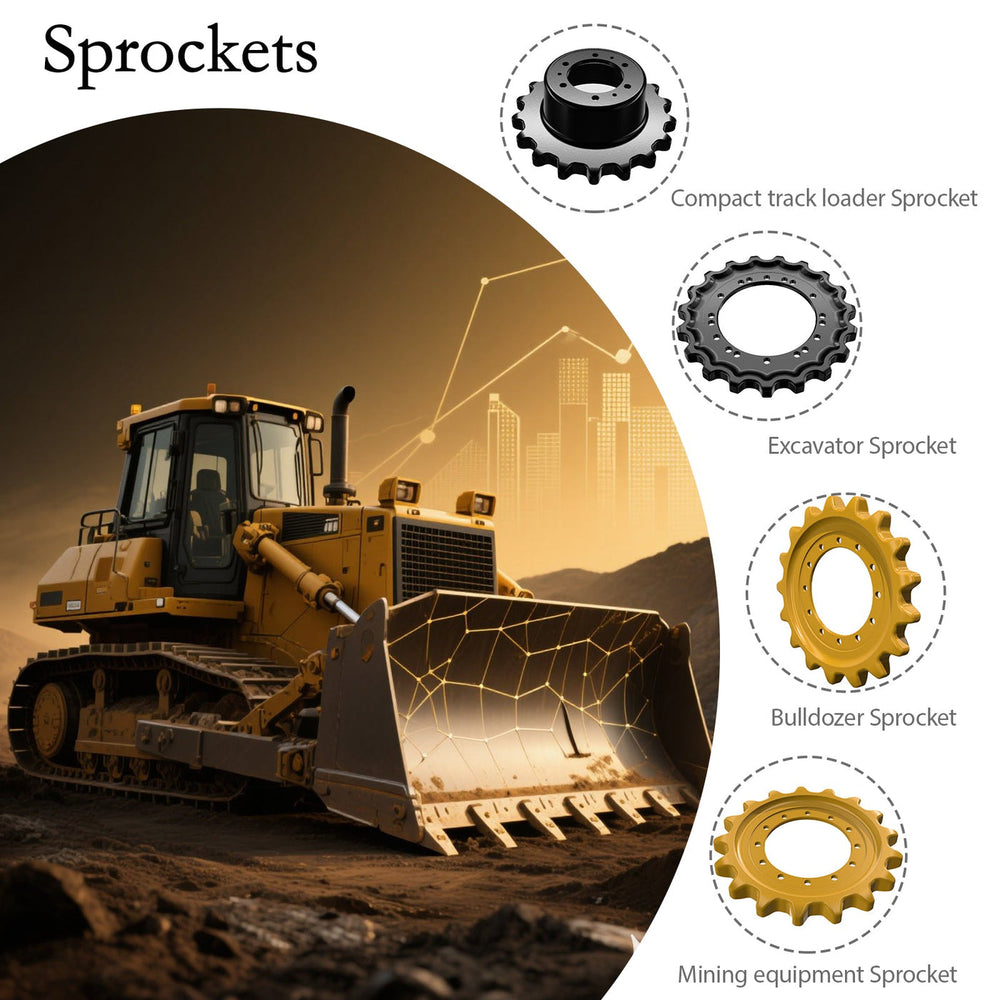
The terms can also cause confusion. In heavy equipment, “bolt-on spider” may refer to the hub or mounting structure behind a bolted sprocket rim, while the replaceable outer pieces are more commonly called sprocket segments. A one-piece, full-cut sprocket combines the hub and teeth into one component. A segmented sprocket uses a retained hub or rim with individually bolted tooth sections.
Both designs transfer power to the track chain. Their fundamental difference appears during service: segmented assemblies separate the wear surface from the mounting structure, while one-piece drive wheels prioritize a continuous component. That distinction affects field replacement, labor exposure, maintenance cost, alignment risk, and load behavior.
segmented vs one-piece excavator sprockets
What separates the two designs?
A segmented sprocket consists of several toothed sections bolted around a hub ring or drive adapter. When the teeth wear, the outer segments can usually be replaced without removing the complete track chain. A one-piece drive wheel is machined or cast as a single unit and is replaced as a whole when its tooth profile reaches the service limit.
The important distinction is therefore not that one system drives the track and the other does not. Both perform the same basic job. The difference is where the machine concentrates its serviceable joints:
Segmented design: replaceable tooth sections, separate hub or rim, multiple fasteners.
One-piece design: hub and tooth ring formed as one component.
Segmented replacement: normally suited to machines designed around bolt-on sections.
One-piece replacement: normally requires more disassembly, but leaves fewer bolted joints in the final-drive assembly.
A segmented sprocket should not be treated as a universal upgrade for a one-piece machine. The final-drive flange, bolt pattern, offset, tooth count, chain pitch, and track-frame clearance must all match. Converting between systems can require an adapter, and an incorrectly matched adapter may create more alignment and loosening problems than it solves.
Why is a segmented sprocket easier to change?
The main field advantage is access. A technician can often rotate the track until a worn segment is positioned where it can be unbolted, remove the fasteners, install the replacement, and repeat the process around the sprocket. The track chain typically remains assembled, avoiding a more extensive track-removal procedure.
That does not make the task effortless. Mud packed around the fasteners, seized bolts, damaged threads, corrosion, and limited clearance can slow the work considerably. The machine may still need to be lifted or positioned safely, and the replacement bolts must be tightened in the correct sequence and to the manufacturer’s specified torque.
For daily maintenance planning, the practical difference is substantial:
Less disassembly around the track chain.
Lower risk of disturbing track tension settings.
Fewer lifting and handling requirements.
A smaller replacement part to transport to the jobsite.
Better potential for a planned field repair during a short shutdown.
A one-piece drive wheel generally requires the track to be loosened or removed before the sprocket can be taken off the final drive. That procedure is not automatically a disadvantage. If the machine is already receiving new track chains, rollers, or idlers, the additional sprocket work may fit naturally into a complete undercarriage rebuild.
Field replacement and maintenance cost matrix
The cheapest component to purchase is not always the least expensive maintenance choice. A one-piece sprocket may have a lower unit price than a complete segmented assembly, while a segmented system may reduce labor and downtime because only the worn tooth sections are changed.
| Maintenance factor | Segmented sprocket rim assembly | One-piece drive wheel |
|---|---|---|
| Basic construction | Several toothed segments bolted to a hub or rim | Hub and tooth ring formed as one component |
| Typical field access | Usually can be serviced without breaking the track chain | Usually requires greater track disassembly |
| Replacement quantity | Only worn segments may be replaced | Entire sprocket is replaced |
| Initial part cost | Higher if purchasing a full set, often lower for partial replacement | Often lower per complete unit |
| Labor exposure | Lower for a segment-only change | Higher when track removal is required |
| Fastener maintenance | Critical; bolt torque and thread condition matter | Fewer external segment fasteners |
| Best maintenance case | Mid-cycle tooth wear, remote work, short shutdowns | Full undercarriage rebuild or factory one-piece configuration |
| Transport and handling | Smaller parts, easier to carry individually | Heavier complete component |
| Main structural concern | Joint slip, bolt loosening, poor seating | Damage to the complete unit or mounting interface |
The matrix describes normal design intent, not a guaranteed result. A segmented sprocket with seized bolts can take longer to repair than expected, while a one-piece sprocket may be changed efficiently in a properly equipped workshop.
Which design has greater structural strength?
A one-piece drive wheel generally has the simpler load path because the hub and tooth ring are integrated. There is no segment-to-hub joint to inspect, no bolt preload to maintain, and no possibility of a segment seating unevenly against the mounting surface. Under severe shock loading, that simplicity can be valuable.
However, “one-piece” does not automatically mean stronger in every application. Tooth geometry, steel quality, heat treatment, hub design, machining accuracy, final-drive condition, track alignment, and operating technique often matter more than the construction label. A poorly manufactured full-cut sprocket can wear or crack earlier than a properly engineered segmented assembly.
Segmented sprockets introduce interfaces, but those interfaces can be designed for heavy loads. The hub supports the rim, the fasteners clamp the sections in position, and the tooth sections carry the chain-engagement load. The system depends on correct contact between mating surfaces and sufficient bolt preload. If a segment is not fully seated, the load can become uneven, encouraging fretting, bolt movement, or localized cracking.
KTSU’s sprocket manufacturing information describes reinforced geometry at stressed areas, precision machining, and induction-hardened teeth with surface hardness and case depth matched to component size. These characteristics can support wear resistance and load stability, but they should not replace checking the exact machine application and component specification.
Does segmented construction always reduce cost?
No. Segmented construction usually reduces the cost of a partial repair, but its total ownership cost depends on how the fleet is operated and maintained.
If only two or three segments are worn and the hub remains within specification, replacing those sections avoids buying a complete drive wheel. That advantage becomes more pronounced when downtime is expensive or when the machine works in a remote quarry, mine, demolition site, or agricultural field.
The cost calculation changes when:
The hub or adapter is already worn.
Several segments have reached the same wear limit.
Bolts are seized or their threads are damaged.
The sprocket has run with an incorrect track chain.
The complete undercarriage is being rebuilt.
The machine has accumulated enough hours to justify replacing the full assembly.
A one-piece drive wheel can be financially sensible during a full rebuild because the track is already coming off. Replacing one integrated component also removes questions about the condition of segment bolts and mounting faces. In contrast, fitting only a few new segments to a badly worn hub may create a new tooth profile against an old, misaligned support structure.
The better question is not “Which part costs less?” It is “Which repair avoids paying twice for labor, track removal, and premature wear?”
Why can either system fail in real use?
The most common expectation gap is assuming that a replaceable segment solves every sprocket problem. It only replaces the worn tooth section. It does not correct an elongated track chain, damaged bushings, incorrect track tension, worn final-drive bearings, poor alignment, or a distorted hub.
Segmented systems may produce inconsistent results when operators replace only the visibly damaged section while ignoring the rest of the tooth ring. Different wear levels around the sprocket can cause uneven chain engagement. New segments may also run against a chain that has already developed a worn pitch, accelerating the new component’s wear.
Typical segmented-system failure causes include:
Incorrect or uneven bolt torque.
Dirt or paint trapped between segment and hub.
Reused, stretched, or damaged fasteners.
Incorrect segment orientation or tooth count.
Excessive track tension.
Final-drive flange or hub wear.
Shock loading from turning aggressively on hard ground.
Running a new segment set with a severely worn track chain.
One-piece sprockets have their own limitations. A complete unit may be expensive to transport and difficult to handle without lifting equipment. If one tooth is damaged by an impact, the entire component may need replacement. A worn chain can also damage a new one-piece sprocket quickly, so the apparent simplicity of installation does not remove the need for an undercarriage inspection.
How should a fleet choose between them?
Start with the machine’s original configuration. If the final drive was designed for bolt-on segments, retain that arrangement unless the manufacturer or a qualified undercarriage engineer has approved a conversion. If the machine uses a one-piece sprocket, replacing it with another correctly matched one-piece unit is generally the least complicated path.
Then examine the operating pattern:
Choose segmented assemblies when short field shutdowns and partial replacement are high priorities.
Choose one-piece drive wheels when the machine is entering a complete undercarriage rebuild.
Favor segmented systems when transport access is difficult and replacement parts must be carried to the machine.
Favor one-piece systems when the fleet has strong workshop lifting capability and wants fewer external fasteners.
Compare the condition of the hub, chain, and final drive before deciding that only the teeth need replacement.
Use the machine’s service manual for tooth count, pitch, bolt specification, torque, and installation sequence.
For mixed fleets, standardization can matter as much as component price. A maintenance team already trained to inspect segment seating and torque may work more efficiently with segmented systems. Another fleet may prefer one-piece assemblies because its workshop process is built around complete undercarriage replacement.
KTSU’s catalog includes more than 3,000 undercarriage items for equipment associated with brands such as Caterpillar, Komatsu, and Hitachi. That breadth illustrates an important purchasing reality: the correct choice depends on the exact machine family and configuration, not merely on whether a component is marketed as segmented or full-cut.
KTSU Expert Views
From a practical undercarriage perspective, segmented sprocket rim assemblies make the most sense when the fleet values controlled, localized repair. Their strength is not simply that the sections are removable; it is that the repair can be matched to the actual wear pattern. That benefit disappears if the supporting hub is ignored or if fastener installation is treated as routine assembly work.
One-piece drive wheels remain a sound choice where the original machine design uses them or where a complete undercarriage rebuild is already scheduled. Their continuous construction reduces joint-related maintenance, but it also makes every replacement a larger intervention. The decision should therefore be based on the machine’s service cycle rather than on a general claim that one style is always stronger.
At KTSU’s 70,000-square-meter Kunshan facility, Japanese technical practices are combined with CAD/CAM production, NITTO friction welding, robotic CO2 welding, and CNC machining. Those capabilities matter when they support consistent geometry, hardness, sealing, and interchangeability across repeat orders—not as a reason to skip field inspection.
For fleet managers, the most reliable selection process is straightforward: verify the original configuration, inspect the mating components, calculate labor and downtime, and match the wear material to the application. A well-maintained segmented system and a correctly manufactured one-piece system can both perform effectively when used within their intended design limits.
What each design gives, and what it asks for
The choice is usually described as strength, and it is mostly about how the replacement is done and how the drive load is shared.
| Factor | Segmented sprocket | One-piece drive wheel |
|---|---|---|
| How the replacement is carried out | In the field, with the track held out of the way rather than removed | With the assembly removed, which needs more access and time |
| How the drive load is shared | Through the segment fixings as well as the rim, so bolt condition matters | Through the wheel itself, so there are fewer fasteners to work loose |
| Where a fault can appear | A loose or sheared segment fixing, and uneven wear between segments | Uneven wear across the wheel, which cannot be partly replaced |
| What it suits | Machines working far from a workshop, where getting back into service matters | Machines that can be brought in, and fleets that prefer fewer fasteners to check |
Either design can fail for the same reasons: extended chain pitch, a worn idler or roller allowing the chain to move, or a segment or wheel that is not torqued as specified. The choice between them changes how the replacement is made and not how long the tooth lasts under the same chain.
How can service life be improved?
The first improvement is accurate wear diagnosis. Measure the tooth profile and inspect the chain, bushings, track tension, and final-drive mounting surfaces before ordering parts. Replacing a sprocket without correcting the component that caused abnormal wear often produces a short and disappointing service interval.
For segmented assemblies, maintenance discipline should include:
Cleaning the mating faces before installation.
Inspecting bolt holes and threads for elongation or damage.
Using the specified fasteners rather than visually similar hardware.
Applying the required torque with calibrated equipment.
Rechecking fastener condition after the initial operating period when the service procedure calls for it.
Replacing segments as a matched set when wear differences would otherwise become excessive.
Confirming that the new teeth match the installed chain pitch and configuration.
Operating technique also changes wear. Avoid unnecessary counter-rotation on abrasive or rocky ground, keep track tension within the specified range, and remove packed material before it hardens around the sprocket. These actions usually cost less than changing from one sprocket architecture to another.
KTSU’s component development work emphasizes surface hardness, case depth, sealing, and production consistency. In practice, those characteristics must be paired with correct chain compatibility and installation control; material performance cannot compensate for an incorrect fit or an overloaded final drive.
Frequently Asked Questions
What is the difference between a segmented sprocket and a one-piece drive wheel?
The segmented version is made of separate rim segments bolted to a hub, so it can be replaced in the field. The one-piece version is a single wheel, which needs the assembly removed but has fewer fasteners.
Is a segmented sprocket as strong as a one-piece?
Both are designed for the drive load of the machine, and the segmented version shares that load through its fixings. What changes is the number of things that have to be correct at assembly, not the strength of the design when it is right.
Does segmentation always reduce cost?
It reduces the cost of the replacement occasion, which matters most on a machine working far from a workshop. Where access is not a problem, the difference in the replacement method is worth less than the design preference.
Why can either design fail in real use?
Both are driven by the same chain. Extended pitch, a worn idler or roller, or fixings that are not torqued as specified will end either design early.
Sources
This article is part of Sprocket Wear and Replacement: What Ruins a Drive Sprocket, the guide that covers this topic in decision order.
More Technical Guides guides
Find the next article for your component, application or buying decision.
Back to Technical Guides