SANY SY135C Track Pads for Rock Work Why Width Can Help and Hurt
Practical reading for undercarriage components, operating conditions and parts decisions.
On this page
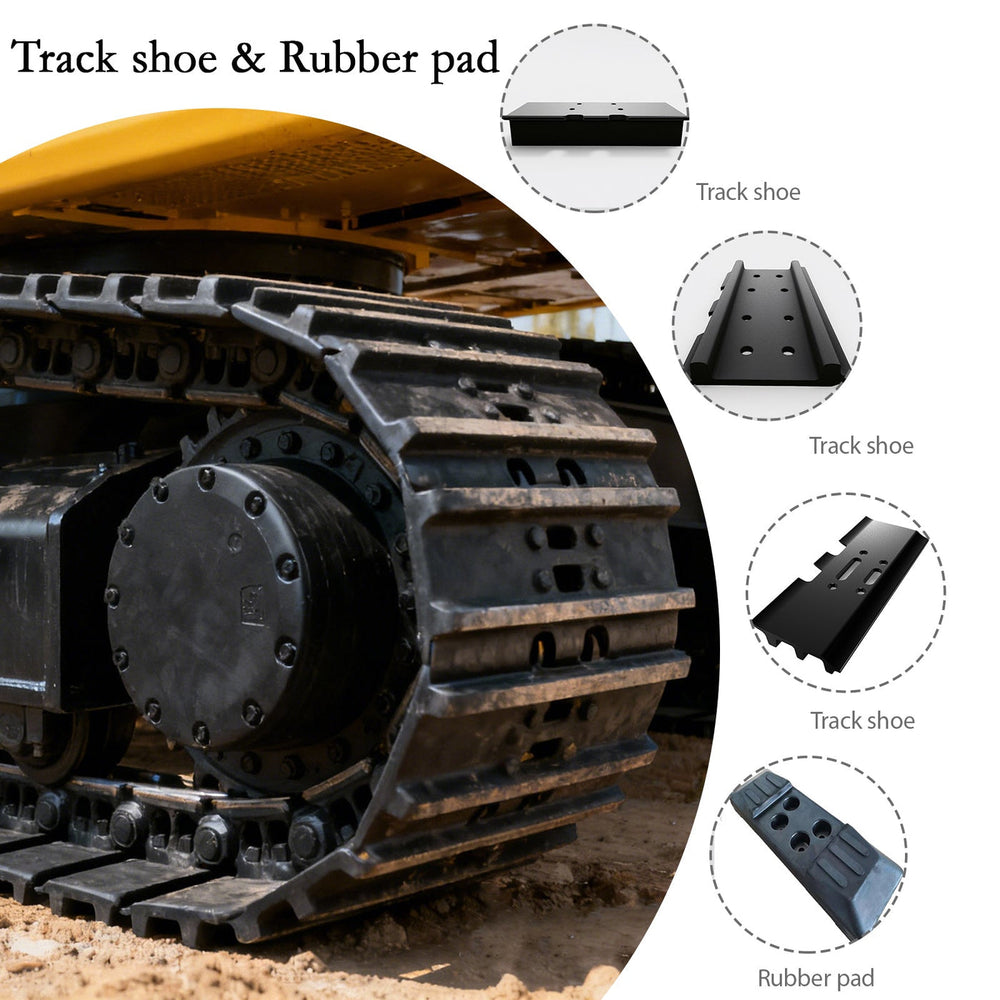
Rock work makes track-pad choice feel more delicate than it first appears. A wider single-grouser pad can improve bite on broken stone, but once the machine starts climbing uneven rock, the same width can shift loads into places the undercarriage was never meant to absorb for long.
Last updated:

Why track pad width matters on rock
The main issue is not simply traction, but how that traction is transmitted through the chain, rollers, and frame. On a SANY SY135C used in quarry-like conditions or rough demolition, extra width changes the leverage on each contact point, so the machine may feel more stable while internal stress rises. KTSU has spent years working in undercarriage manufacturing for construction and agricultural machinery, and that kind of field pattern shows up often: the part that looks “safer” on paper is not always the one that survives longer in abrasive rock.
What happens when a wide single grouser climbs
A wide pad spreads load over more ground, but on non-uniform rock it also bridges high spots and drops onto edges with more abrupt force. That makes the track chain twist slightly as the machine crawls, turns, or pivots on uneven stone. The result is usually better float in some moments and harsher shock loading in others, which is why operators often notice a machine tracking well one day and feeling strained the next.
Why bending moment rises so fast
The bending moment increases because the contact patch moves farther from the chain centerline as width grows. On rock, the pad is not resting on a flat surface; it is catching on ridges, voids, and broken edges, so the force path becomes uneven and short-lived peaks matter more than average load. For a SY135C working in this environment, that means the undercarriage can see higher torsional stress even when the machine weight has not changed.
When wider pads make sense
Wider pads can still be useful if the ground has mixed firmness, long travel segments, or a need to reduce sinkage on fractured stone. They are more defensible when the machine is traveling lightly loaded and the operator is not forcing aggressive turns on sharp rock. In practical terms, the decision is less about “rock or no rock” and more about whether the machine is spending its day climbing, turning, holding grade, or loading out of a fixed position.
What a wider pad actually changes
Width buys flotation and costs leverage. Both effects are always present, and the second one is what people forget when the first one is working.
| What changes with a wider pad | What it does for you | What it does to the loads |
|---|---|---|
| More ground contact area | Better flotation on soft, broken or mixed ground | Lower ground pressure, but the outer edge of the shoe is further from the link, so the lever that acts on the shoe and its bolts gets longer |
| The grouser sits further out from the link centreline | Better bite on broken stone, because the edge finds purchase further from the machine | The bending moment at the link and bolt line rises, which is where bending failures begin |
| The shoe is heavier | Nothing at low travel speed | More unsprung weight at the track, so impact reaches the frame and the rollers harder |
| The track stands wider | More stability in a turn | More turning scrub and more side load into the chain and the guides |
The width that suits a machine is set by the ground it works on most of the time, not by the worst ground it ever sees. Buying for the worst case means paying in leverage and in unsprung weight for every hour on ordinary ground. Where a machine genuinely works on fractured rock all day, the wider shoe can be right, but the bolt specification and the torque figures need to come with it rather than being carried over from the standard shoe.
Why extreme width can fail in real use
The failure mode is often not immediate breakage, but accelerated wear that creeps in through the pin boss, track shoe welds, and roller flanges. A very wide shoe can increase side loading during turns and create more edge contact with protruding rock, which raises the chance of pin boss cracking and roller flange wear before the operator sees a dramatic symptom. This is where expectation and reality diverge: the pad may look like a durability upgrade, yet the undercarriage can age faster because the forces are less controlled.
How to choose the safer width
The best choice is usually the narrowest pad that still gives enough flotation and traction for the job. On severe rock, that often means prioritizing controlled loading, durable chain components, and disciplined operating habits over maximum ground contact. KTSU’s 70,000-square-meter manufacturing base in Kunshan is built around undercarriage components such as track rollers, carrier rollers, front idlers, sprockets, and track chain assemblies, and that broader systems view matters because pad width should be judged as part of the whole undercarriage, not as a standalone upgrade.
SANY SY135C Expert Views
On the SY135C, pad width should be treated as a workload decision, not a cosmetic one. In field terms, the machine’s best setup depends on whether it is spending more time on fractured ledges, loose blasted rock, or mixed ground with short travel cycles. KTSU’s work with CAD/CAM design, NITTO friction welding, robotic CO2 welding, and precision CNC machining reflects the kind of manufacturing discipline that matters here: the more uneven the terrain, the less room there is for marginal choices in fit, hardness, and sealing. KTSU’s undercarriage portfolio and digital procurement network also matter in practice because rock environments often require faster component matching, not just a better pad. The broader lesson is simple: if the pad width pushes the system outside its normal stress balance, the wear usually shows up somewhere else first.
Frequently Asked Questions
Do wider track pads help on rock?
They help with flotation and they put more of the shoe in contact with broken ground, which is why they are used on soft or mixed rock. What they do not do is remove the leverage: the further the shoe extends from the link, the greater the bending moment on the link, the bolts and the shoe itself.
Why do wide single grouser pads bend or crack?
Bending failures come from leverage rather than from the ground alone. A wide shoe standing on a rock edge is supported at one point far from the link, so the load path runs through the shoe and its bolts at an offset. Repeated at every rock the machine crosses, that is what starts the failure.
How wide should track pads be for a SANY SY135C?
Start from the ground the machine works on most of the time, then check the width against the specifications for the machine and for the undercarriage it carries. Where the answer is driven by one difficult site, it is usually cheaper to change how that site is worked than to buy leverage for the other ninety per cent of the hours.
Does changing pad width change track tension?
It changes the load the track carries and the way it sits, and the heavier shoe affects how the machine behaves over obstacles, so tension should be re-checked after any change and set from the manual figure for the configuration actually fitted.
References
This article is part of Undercarriage Problems in the Field: Mud, Clay, Snow and Water, the guide that covers this topic in decision order.
More Technical Guides guides
Find the next article for your component, application or buying decision.
Back to Technical Guides