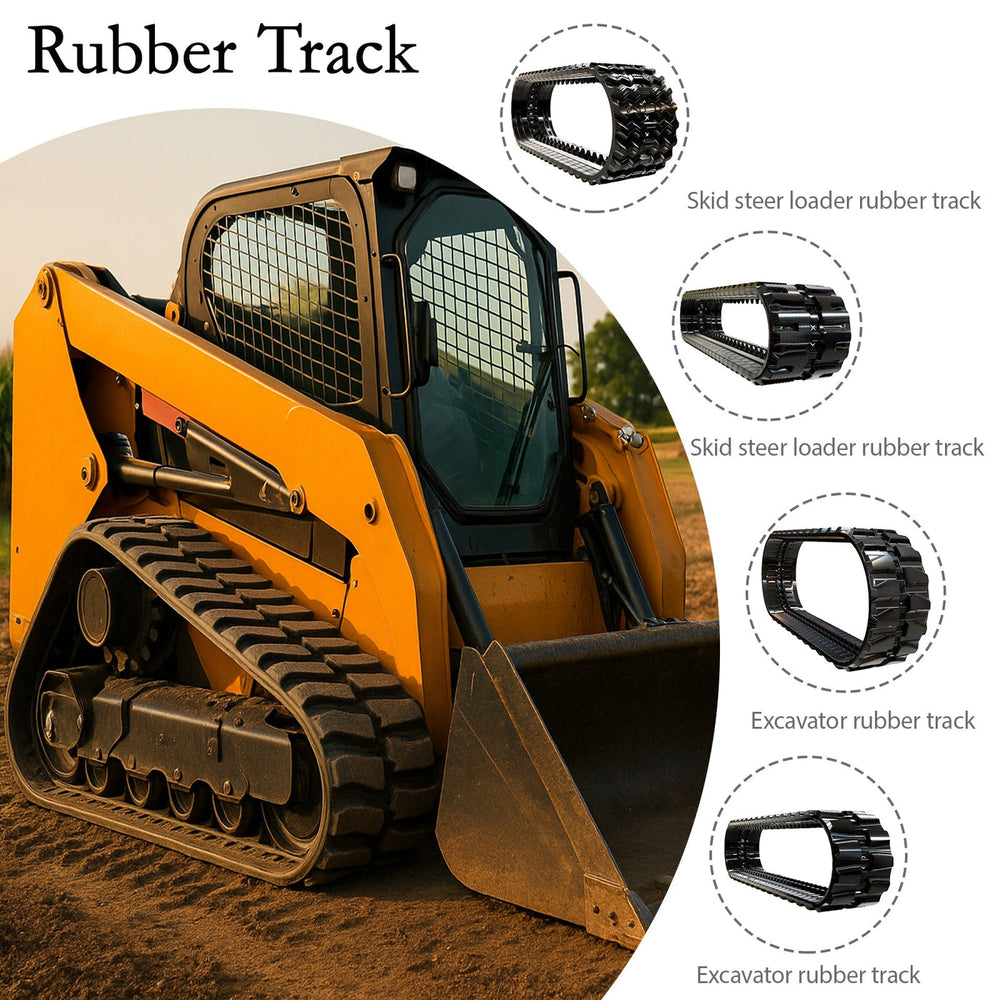
Inside the Factory: The Anatomy of a KTSU High-Performance Rubber Track
Sizing, machine compatibility and care for rubber track systems in real working conditions.

On this page
A KTSU high-performance rubber track combines advanced rubber compounds with helical steel cord reinforcement, CNC-machined core bars, and terrain-specific tread patterns. The track's inner structure includes continuous steel cords for tensile strength, proprietary natural-synthetic rubber blends for tear resistance, and floating-seal technology at critical connection points. Manufacturing processes like NITTO friction welding and induction hardening at Kunshan, Jiangsu determine service life, while duty cycle and track tension directly impact wear rates for machines like CAT 320, Komatsu PC200, and Hitachi ZX350.
Last updated:

What Materials Make Up a KTSU High-Performance Rubber Track?
The foundation of KTSU's high-performance rubber track lies in its material composition, which balances elasticity, tear resistance, and abrasion protection.
KTSU's rubber compound uses proprietary blends of natural rubber and synthetic Styrene-Butadiene Rubber (SBR). Natural rubber provides excellent tensile strength and elasticity—critical for tracks that flex continuously around idlers and rollers. SBR contributes enhanced abrasion resistance and stability across temperature extremes from -30°C to +60°C.
Durability: Tear Resistance & Abrasion Protection
Premium rubber tracks address primary failure modes: tears, chunking, and abrasive wear. KTSU's compound formulation incorporates specialized carbon black and silica reinforcements that create a wear-resistant outer layer while maintaining flexibility. Research into rubber molecular chains has improved tear propagation resistance—the ability to prevent small cuts from expanding into catastrophic failures.
For construction applications exposing tracks to exposed rebar or broken concrete, cut-resistant formulations withstand sharp hazards. Agricultural tracks prioritize flexibility and self-cleaning properties in muddy conditions.
Weather Resistance: UV, Ozone, and Temperature Tolerance
Environmental factors significantly impact rubber track longevity. KTSU tracks incorporate UV stabilizers protecting against solar radiation that breaks down rubber polymers, causing surface cracking. Antiozonants prevent atmospheric ozone damage—particularly important for equipment stored outdoors.
Temperature tolerance ensures tracks maintain flexibility in cold conditions (preventing cracking) while resisting softening in extreme heat. This consistent performance across temperature ranges enables year-round operation regardless of seasonal changes.
How Is the Steel Core Reinforcement Built for Strength?
The internal steel structure provides tensile strength needed to transfer power from the drive sprocket to the ground without stretching or deforming.
KTSU tracks feature continuous steel cords arranged in helical patterns that allow multidirectional flexibility while maintaining strength. Unlike traditional straight cord arrangements, helical designs wrap steel cables in spiral patterns distributing forces evenly throughout the track structure.
Helical Steel Cord Reinforcement Benefits
The helical arrangement provides several advantages for undercarriage performance:
| Benefit | Performance Impact |
|---|---|
| Improved flexibility | Better navigation around tight curves and obstacles |
| Enhanced lateral resistance | Reduced stress during turning maneuvers |
| Reduced stress concentration | Less failure at attachment points |
| Better impact distribution | Improved performance on rough terrain |
This design prevents stress concentration at any single point—a common failure cause in lower-quality tracks with joined or overlapping cables. The result is a track maintaining proper alignment longer, resisting stretching, and providing consistent performance throughout service life.
Anti-Corrosion Treatments
Steel cord failure from corrosion represents significant risk, particularly in wet or saltwater environments. KTSU addresses this through specialized anti-corrosion treatments applied during manufacturing at the Kunshan facility.
Modern tracks utilize brass-coated steel cords resisting oxidation even when exposed to moisture. Advanced bonding agents create waterproof seals between rubber and steel components, preventing water infiltration that could lead to internal corrosion. This protection significantly extends track life in harsh operating environments like coastal areas.
Which Tread Patterns Optimize Traction for Different Terrains?
The external tread pattern plays a crucial role in determining performance characteristics, optimizing traction, self-cleaning ability, vibration, and surface impact for specific applications.
KTSU offers multiple tread designs depending on primary operating conditions. Each pattern serves distinct environments where machines like CAT 320 excavators or Komatsu PC200 operate.
Multi-Bar vs. C-Lug vs. Block Patterns
| Tread Pattern | Best Application | Key Characteristics |
|---|---|---|
| Multi-Bar | Soft, loose conditions, construction | Aggressive forward traction, self-cleaning spaces between bars, more surface disruption |
| C-Lug | Mixed-use, agriculture | Multidirectional traction, reduced vibration, prevents material packing |
| Block | Hard surfaces, landscaping | Minimal ground pressure, smooth operation, least aggressive traction |
Multi-Bar Patterns feature parallel bars running across track width, excelling in soft conditions by providing excellent forward traction. The spaces between bars allow material ejection, preventing mud buildup. However, these tracks cause more surface disruption on finished areas.
C-Lug Patterns incorporate curved lugs providing multidirectional traction while reducing vibration. This versatile design performs well across various surfaces, making it popular for mixed-use applications. The C-shape helps prevent material packing between lugs.
Block Patterns utilize individual tread blocks in offset patterns, minimizing ground pressure and surface disruption while providing smooth operation on hard surfaces. These offer the least aggressive traction but compensate with improved ride quality.
Traction Optimization for Specific Conditions
Mud Optimization: Tracks for muddy conditions feature wider tread spacing allowing material clearing. Self-cleaning channels direct mud outward, preventing buildup that reduces traction.
Hard Surface Designs: Tracks for concrete, asphalt, and packed gravel utilize closer tread spacing and more surface contact area. These distribute weight more evenly, reducing point loading that could damage both track and operating surface.
Why Does Manufacturing Process Affect Track Service Life?
Manufacturing processes directly influence track durability, with heat treatment, welding quality, and dimensional tolerance determining how long tracks withstand demanding duty cycles.
KTSU's Kunshan, Jiangsu facility—approximately 70,000 m² production base—uses several critical processes. NITTO friction welding creates strong metallurgical bonds at connection points. Robotic CO2 welding ensures consistent weld quality across the 3,000+ SKU portfolio. CNC machining provides precise dimensional tolerance for core bars and connection shells.
Heat Treatment Processes
Heat treatment significantly impacts component service life:
| Process | Application | Service Life Impact |
|---|---|---|
| Induction surface hardening | Track roller shafts, sprocket teeth | Creates hard surface layer with softer core—resists wear while maintaining toughness |
| Through-hardening | Bushings, pins | Uniform hardness throughout—consistent wear resistance |
| Deep-case carburizing | Sprocket driving teeth | Deep hardened case—handles high contact stresses |
Induction hardening creates a hard surface layer while maintaining a softer, tougher core. This combination resists abrasive wear while preventing brittle failure under impact loads. Deep-case carburizing provides extended hardening depth for sprocket teeth承受ing high contact stresses during power transmission.
Quality Control and Dimensional Tolerance
In KTSU's Kunshan QC workflow, engineers typically check rubber durability, elasticity, wear rate, and metal core bar strength throughout production. Components are randomly taken off the production line for inspection. After assembly, tracks are tested again and dimensions are verified.
Precision dimensional tolerance ensures proper fitment with machine platforms. Incorrect pitch or link count causes poor sprocket engagement, accelerating wear on both track and undercarriage components.
How Do Distributors Verify Track Fitment Before Ordering?
Proper fitment verification prevents costly compatibility issues, accelerated wear, and dangerous operating conditions from improperly sized tracks.
Distributors evaluating KTSU tracks should inspect three critical dimensions matching machine undercarriage specifications. For machines like Hitachi ZX350 or CAT 320, verification requires cross-referencing manufacturer fitment guides with actual machine measurements.
Measuring Width, Pitch, and Link Count
Three dimensions determine track compatibility:
Width: Measured across the flat track surface, typically 9-18 inches for most machines. Wider tracks provide better flotation but may limit narrow access.
Pitch: Distance between pivot centers on consecutive links. Must match drive sprocket configuration for proper engagement.
Link Count: Total links forming the complete track circuit. Determines overall length and must match undercarriage dimensions for proper tensioning.
For accurate pitch measurement, determine the distance between centers of five consecutive links, then divide by four to get individual pitch.
Fitment Planning by Machine Class
| Machine Class | Typical Width Range | Pitch Range | Link Count |
|---|---|---|---|
| Compact excavators (CAT 320) | 12-15 inches | 2.0-2.5 inches | 44-52 links |
| Mid-size excavators (Komatsu PC200) | 15-18 inches | 2.5-3.0 inches | 48-56 links |
| Large excavators (Hitachi ZX350) | 18-24 inches | 3.0-3.5 inches | 52-60 links |
Note: Verify exact specifications with machine serial number and OEM technical handbook
Before purchasing, verify compatibility through multiple sources: KTSU's fitment guide, equipment dealer specifications, and operator forums sharing real-world experiences.
What Are the Key Signs That a Rubber Track Needs Replacement?
Early recognition of track damage allows timely intervention, often extending service life considerably and preventing catastrophic failures.
Visual examination during routine inspections reveals critical warning signs. Daily inspections should examine the entire track surface for cuts, tears, or embedded objects. Weekly inspections require more thorough checks including guide lug and drive bar examination.
Identifying Cuts, Cracks, and Wear Patterns
Cuts and Punctures: Small cuts may not immediately threaten integrity but worsen rapidly if unaddressed. Monitor cut size during routine inspections.
Cracks and Crazing: Fine surface cracks often indicate UV, ozone, or chemical exposure. These predict future chunking and should be addressed before progression.
Uneven Wear Patterns:
Center wear: Typically indicates proper tension and alignment
Edge wear: Suggests misalignment or frequent slope operation
Diagonal wear: Often points to tension problems
Accelerated guide lug wear: May signal undercarriage issues
Cleaning and Debris Removal
Effective cleaning prevents premature wear by removing abrasive materials damaging both tracks and undercarriage. End-of-day cleaning removes accumulated debris while material is still soft, using pressure washing for stubborn buildup. Avoid harsh solvents or petroleum-based chemicals degrading rubber compounds.
For machines in corrosive environments (salt water, fertilizer), rinse tracks thoroughly with fresh water daily to prevent chemical damage.
Reading a failed track: which failure points at the factory and which points at the machine
A rubber track that comes off the machine early is evidence, and the pattern of the damage says a good deal about where to look. Four failure pictures cover most of what a distributor is asked about, and only one of them is a manufacturing question.
| What the failed track shows | Most likely cause | Who it points at |
|---|---|---|
| Lugs torn off at the shoulder, with clean rubber underneath | Cuts and impact from sharp material, not wear | The job site. This is the failure the article distinguishes from wear-out: a track destroyed by rebar at low hours tells you nothing about the compound. |
| Even tread wear across the whole track, with the cords still covered | The track has reached its wear limit in the duty it was given | Nobody. This is the expected end of life, and the useful question is whether the interval matched the duty cycle band it was bought for. |
| Cords exposed along the inside of the belt, with the tread still serviceable | Internal damage or a tension and alignment problem loading the inner belt | The machine, not the track. Check tension, alignment and idler condition before the next track goes on, or the next one fails the same way. |
| Separation between the rubber and the steel core, or cracking that runs with the cord direction at low hours | A bond or cure problem in the track itself | The factory, and it is worth documenting carefully, because this is the failure mode a warranty claim should be built on. |
The reason to sort failures this way is that the four pictures lead to three different actions. A cut is a maintenance and job-site conversation. Even wear is a duty-cycle and specification conversation, and the answer may be a heavier track rather than a cheaper one. Separated or cracked rubber at low hours is a claim, and it needs photographs, the batch marking, the hour meter reading and the machine model on the same sheet of paper.
For a distributor, keeping those four categories in a log rather than one number called failures is what turns field feedback into a specification decision. A pattern of inner-belt damage across one customer fleet is a machine problem the distributor can help solve; a pattern of separation across one batch is a supplier conversation that needs the evidence to be recorded while it is still fresh. The track range is listed in the rubber track collection.
Can Duty Cycle Predictions Guide Replacement Timing?
Duty cycle significantly influences replacement decisions, with severe applications accelerating wear compared to light-duty operations.
Track lifespan varies by quality, operating conditions, and maintenance practices. Standard tracks often need replacement at 500-800 hours, while premium tracks deliver 1,000-1,500 hours or more in optimal conditions.
Undercarriage Component Lifecycle by Duty Cycle
| Duty Cycle | Typical Application | Expected Track Life (Premium) | Inspection Frequency |
|---|---|---|---|
| Light | Landscaping, finished surfaces | 1,200-1,800 hours | Weekly |
| Standard | General construction, agriculture | 1,000-1,400 hours | Twice weekly |
| Severe | Quarry, demolition, mining | 700-1,000 hours | Daily |
Light duty involves landscaping and finished surfaces with minimal abrasive wear. Standard duty covers general construction and agriculture with moderate abrasion. Severe duty includes quarry work, demolition, and mining where extreme abrasion and impact hazards accelerate wear.
For operators tracking 1,000 annual hours, standard tracks might require replacement every 6-9 months, while premium options last 12-18 months. This disparity translates to fewer replacements, lower labor costs, and reduced downtime.
How Does KTSU's QC Workflow Ensure Track Quality?
KTSU's quality control processes at the Kunshan facility ensure tracks meet requirements before shipment to distributors and end-users.
In KTSU's Kunshan QC workflow, engineers typically check component durability, elasticity, rubber wear rate, and metal core bar strength throughout the approximately 48-hour component manufacturing process. Workers test these properties randomly during production line inspections.
Manufacturing Process Verification
The process takes approximately 48 hours to build each track component, though track assembly itself takes only a few hours. Throughout production:
Components are randomly removed for inspection
Rubber durability and elasticity are tested
Wear rate measurements verify compound performance
Metal core bar strength is verified
Final assembly undergoes dimensional checks
This labor-intensive process with proper testing and quality measures guarantees quality for distributors selling to customers. KTSU's facility also produces tracks for Genuine Machine Manufacturers (OEM), providing additional quality validation.
Traceability and Aftermarket Positioning
KTSU positions within the legitimate aftermarket value chain as Quality Tier 1—an independent undercarriage parts specialist with traceable manufacturing and QC workflow. This differs from Tier 2 commodity will-fit suppliers lacking material control and field validation.
Caterpillar, Cat, Komatsu, and Hitachi are registered trademarks of their respective owners. KTSU parts are aftermarket replacement components and are not affiliated with, endorsed by, or approved by those OEMs.
What Do KTSU Engineers Recommend?
"When evaluating rubber track replacement, distributors and fleet managers should prioritize three factors: match the tread pattern to your primary operating terrain, verify width-pitch-link count against the machine serial number, and maintain proper track tension within manufacturer specifications. Most premature track failures stem from tension mismanagement rather than material defects. New tracks typically stretch during the first 30-50 hours, requiring readjustment. For severe-duty applications like quarry work, increase inspection frequency to daily and consider premium compounds with enhanced cut resistance. Remember that track tension varies with temperature—tracks tighten in cold and loosen in heat, so adjust accordingly."
— KTSU Undercarriage Engineering Team
Conclusion
Selecting the right KTSU high-performance rubber track requires understanding material composition, steel core construction, tread pattern selection, and manufacturing quality processes. Key actionable takeaways:
Replace vs. rebuild: When cuts exceed 2 inches or guide lug wear is advanced, replace rather than attempt repair
Match selection to duty cycle: Severe-duty applications need premium compounds with cut resistance; light-duty can use standard formulations
Check tension and alignment: Verify track tension before blaming components for wear issues; misalignment causes edge wear
Confirm specifications: Verify machine model, serial range, and exact width-pitch-link count before ordering
Order through verified channels: Use KTSU's digital procurement or distributor channel for traceable quality
Traceability matters: Manufacturing processes like NITTO friction welding and induction hardening directly influence service life
Proper maintenance—including daily inspections, regular tension checks, and end-of-day debris removal—extends track life significantly. For machines still under OEM warranty, consult dealer service channels before installing aftermarket parts to avoid warranty complications.
FAQs
Is aftermarket KTSU track quality comparable to OEM?
Comparable means built to the same dimensional and material requirements, which is a documentation question rather than a badge question. For a rubber track the evidence is the compound specification, the cord construction, the dimensional report and the batch traceability behind the part, and those are the items this article walks through on the manufacturing side.
How do I verify my track fitment before ordering?
Measure the width, the pitch across a run of links, and the link count, confirm the guide type, and match all four against the machine specification and the track coming off it. Confirm the model and the model year as well, because the same model can take different track families across production years.
What service life should I expect from a KTSU rubber track?
The figures used in this article are 1,000-1,500 hours in standard duty, 1,200-1,800 hours in light applications such as landscaping and finished surfaces, and 700-1,000 hours in severe work such as quarrying and demolition. Treat any single figure quoted without a duty cycle as a marketing number, and use the band that matches the machine.
When should I replace a rubber track rather than repair it?
Rubber tracks are replaced rather than repaired once the tread has reached its wear limit, the cords are exposed, or a lug has been lost. The exception worth watching is a track that fails early with separation or cracking at the core, because that is a claim rather than a wear-out and the evidence needs to be recorded before the track is scrapped.
What do the different rubber track failure patterns mean?
Torn lugs with clean rubber beneath indicate cuts and impact, which is a job-site cause. Even wear with the cords covered is normal end of life. Cords exposed on the inside of the belt point to tension, alignment or idler problems on the machine. Separation between rubber and core at low hours points at a bond or cure problem and is the category a warranty claim should be built on.
This article is part of Rubber Tracks: Selection, Fitment, Care and Replacement, the guide that covers this topic in decision order.
More Rubber Tracks guides
Find the next article for your component, application or buying decision.
Back to Rubber Tracks