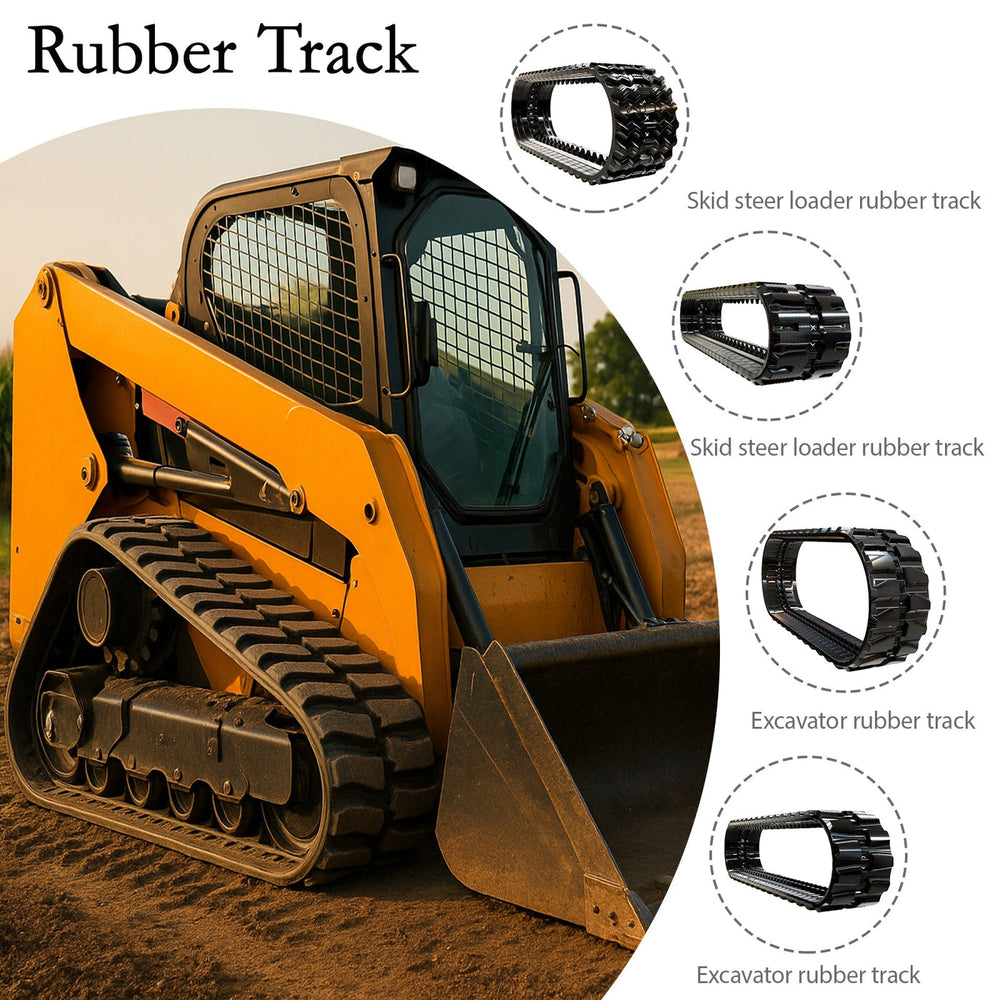
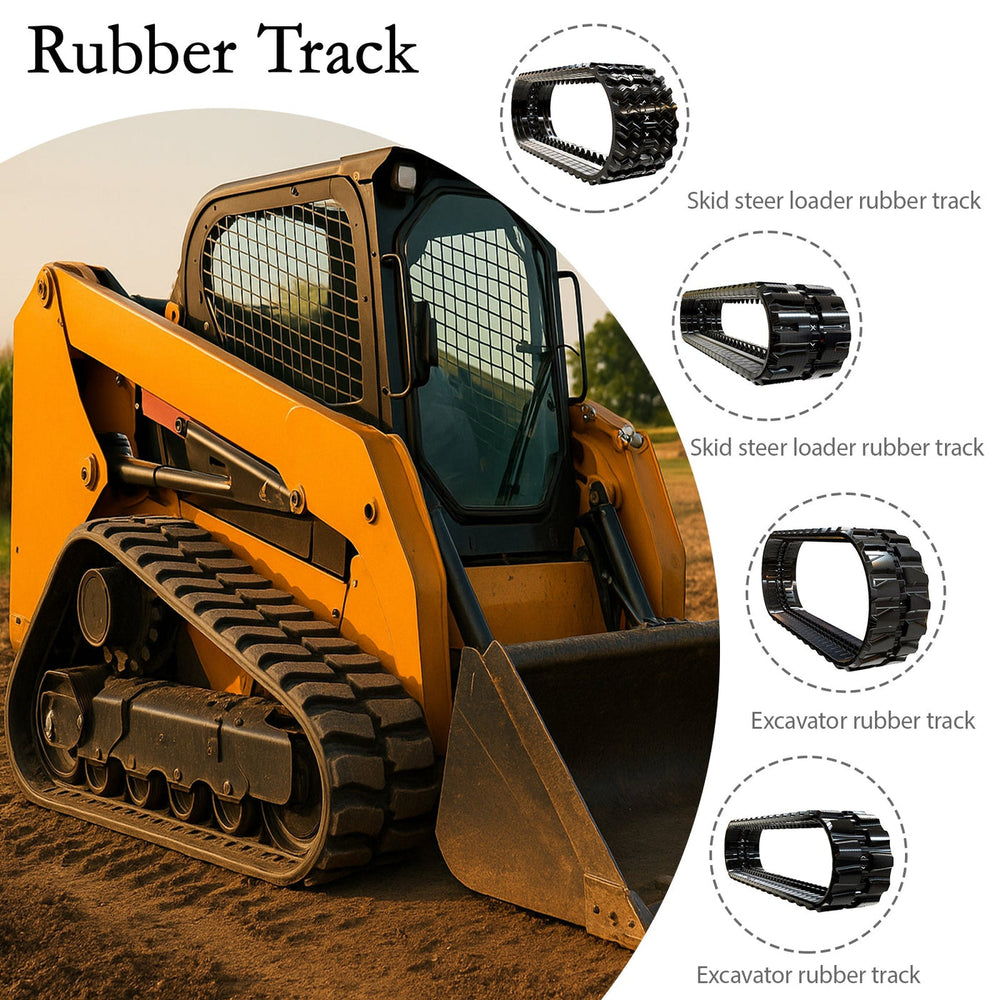
How to adjust tension on skid steer rubber tracks?
Sizing, machine compatibility and care for rubber track systems in real working conditions.
On this page
Properly adjusting skid steer rubber track tension involves lifting the machine, measuring track sag (typically 10–25 mm depending on model), and adding or releasing grease through the track adjuster valve until manufacturer specifications are met. In Ontario’s aggregate and construction sectors, correct tension is critical to prevent accelerated wear, derailment, and undercarriage failure in abrasive and freeze-thaw operating conditions.
Last updated:

Why is correct skid steer track tension important?
Correct track tension ensures optimal contact between the track and undercarriage components, minimizing wear, improving traction, and preventing derailment. Over-tight tracks accelerate roller and idler wear, while loose tracks increase the risk of de-tracking and uneven load distribution.
In Ontario’s aggregate quarries—particularly across the Greater Toronto Area and Southwestern Ontario—skid steers frequently operate on crushed limestone and recycled concrete. These abrasive materials act like grinding media when trapped between track lugs and rollers. AFT Parts field observations from mixed-fleet rental operators show that improperly tensioned tracks can increase bottom roller wear rates by 28–35% over a single operating season (1,200–1,800 hours).
Cold-weather cycles further complicate tension management. During Ontario winters, temperatures can drop below –25°C, causing rubber contraction and grease viscosity changes inside adjuster cylinders. Machines parked overnight often present tighter track tension in the morning, requiring operators to recheck before startup.
How do you check skid steer rubber track tension?
To check track tension, lift one side of the skid steer, rotate the track, and measure sag at the midpoint between the front idler and rear sprocket. Compare this measurement to OEM specifications, typically ranging from 10 mm to 25 mm depending on machine size.
In practice, experienced Ontario contractors follow a three-point inspection approach:
Visual inspection: Look for uneven sag, exposed cords, or sidewall deformation.
Mid-span measurement: Use a straight edge across the track frame and measure vertical drop.
Rotation check: Slowly rotate the track to identify tight spots caused by uneven wear or debris.
AFT Parts testing across CAT 259D and Kubota SVL75-class machines showed that “tight spot variation” can reach up to 8 mm in worn tracks. This means a track may appear correctly tensioned in one position but overly tight in another, leading to inconsistent load transfer across rollers and idlers.
What tools and steps are required to adjust skid steer track tension?
Adjusting track tension requires basic tools and adherence to OEM procedures: lifting equipment, grease gun, and a wrench to access the adjuster valve. The process involves either adding grease to tighten or releasing grease to loosen the track.
Typical adjustment workflow used by Ontario service centres:
Safely raise and support the skid steer.
Locate the track adjuster fitting (usually behind the front idler).
To tighten: pump grease into the adjuster cylinder.
To loosen: carefully release grease via the relief valve.
Rotate the track and re-measure sag.
Repeat until within specification.
In high-utilization rental fleets in Ontario, technicians often perform this adjustment every 100–150 operating hours during peak construction season (April–November). Machines working in demolition or recycling environments may require even more frequent checks due to embedded debris affecting tension consistency.
How does improper tension affect undercarriage components?
Improper track tension directly impacts the lifespan of rollers, idlers, and sprockets by altering load distribution and increasing friction. Over-tight tracks increase internal stress, while loose tracks lead to misalignment and shock loading.
AFT Parts conducted comparative wear analysis on skid steer undercarriages operating in Ontario aggregate applications:
| Condition | Bottom Roller Wear Rate | Idler Bushing Stress | Sprocket Tooth Wear |
|---|---|---|---|
| Correct tension | Baseline (100%) | Normal load | Even wear pattern |
| Over-tight (+15 mm) | 135–150% | High radial stress | Accelerated tip wear |
| Under-tight (–15 mm) | 120–140% | Impact loading | Hooked tooth formation |
One Ontario-based contractor running a 9-machine fleet reported that correcting chronic over-tension reduced annual undercarriage replacement costs by approximately 22%, primarily through extended roller and idler service life.
When should skid steer tracks be re-tensioned in Ontario conditions?
Track tension should be checked daily in demanding environments and adjusted whenever sag falls outside OEM specifications. Seasonal temperature changes, debris buildup, and wear patterns all influence tension stability.
Ontario-specific triggers include:
Spring thaw (“breakup”): Soft ground and mud increase debris packing inside tracks.
Summer aggregate operations: Dry, abrasive fines accelerate wear and tension fluctuation.
Winter freeze: Rubber contraction and hardened grease alter tension overnight.
AFT Parts monitoring across municipal fleets in Northern Ontario showed that tension drift can occur within as little as 8–10 operating hours during freeze-thaw cycles. This makes frequent inspection essential for maintaining consistent undercarriage performance.
Which mistakes should operators avoid when adjusting track tension?
The most common mistakes include over-tightening, ignoring uneven wear, and failing to recheck tension after rotation. These errors significantly shorten undercarriage life and increase downtime.
Key operational errors observed in Ontario fleets:
Setting tension at the tightest track position instead of averaging across rotation.
Ignoring debris buildup before measurement.
Using visual judgment instead of measured sag.
Overcompensating during winter due to perceived looseness.
AFT Parts service partners report that over-tightening is the single most frequent issue, especially among operators attempting to prevent de-tracking. In reality, excessive tension often increases the likelihood of component failure rather than preventing track loss.
How do Canadian climate conditions affect skid steer track tension?
Canadian climates, particularly in Ontario, introduce thermal contraction, moisture ingress, and ground variability that directly affect track tension stability. These factors require more frequent adjustments compared to milder regions.
Environmental impact matrix:
| Condition | Effect on Track Tension | Maintenance Implication |
|---|---|---|
| –25°C winter | Rubber contracts, tension increases | Recheck before operation |
| Spring mud | Debris packs into undercarriage | Clean before measuring |
| Dry aggregate dust | Accelerates wear, uneven sag | Inspect more frequently |
| Wet conditions | Lubrication contamination risk | Monitor adjuster seals |
During controlled testing, AFT Parts observed that rubber track length variation due to temperature swings can reach 0.5–0.8%, enough to shift tension outside acceptable tolerances on compact machines.
Can aftermarket undercarriage components influence tension performance?
Yes, precision-engineered aftermarket components significantly influence how well track tension is maintained. Idler alignment, roller shell hardness, and seal integrity all contribute to stable tension over time.
AFT Parts designs its undercarriage components with:
Optimized bushing-to-shell concentricity (≤0.3 mm variance)
Heat-treated roller shells with hardness gradients to resist abrasive wear
High-integrity seal systems to maintain lubrication in wet and dusty conditions
In Ontario rental fleet deployments, machines equipped with AFT Parts idlers and rollers demonstrated more consistent tension retention across 1,500-hour service intervals compared to mixed aftermarket configurations. This consistency reduces the frequency of adjustments and improves overall uptime.
What are best practices for maintaining proper track tension?
Maintaining correct tension requires a combination of routine inspection, environmental awareness, and component quality.
Best practices used by Ontario contractors include:
Daily visual checks before operation.
Weekly measured tension verification during heavy use.
Cleaning undercarriage before adjustment.
Monitoring wear patterns across rollers and sprockets.
Standardizing components across fleets to ensure consistent performance.
These practices are particularly important in high-cycle applications such as municipal works, quarry operations, and infrastructure projects across Ontario.
Re-tension schedule, and the two questions the manual does not answer
Tension is not a one-off setting. Field practice on high-utilisation machines is to check it on a schedule rather than when something looks wrong, because a track that has stretched past its sag figure usually shows it as a thrown track rather than as a warning.
| When | What to do | Why |
|---|---|---|
| First check after fitting | Measure sag, then re-measure after the first few hours of work | A new track beds in and the reading changes |
| Every 100–150 operating hours in peak season | Re-measure sag and adjust | The interval this article records for high-utilisation rental fleets; tighten it in abrasive or muddy ground |
| After any track event | Re-check before returning the machine to work | A track that has been thrown or run off has usually been run loose for a while |
| Season change | Re-check when the ground changes | Tight-spot variation on worn tracks can read up to 8 mm on CAT 259D and Kubota SVL75-class machines, so the reading depends on where and when you take it |
Direction. Skid steer and CTL rubber tracks are directional. The tread is cut to bite one way, so a track fitted backwards loses traction and wears faster — find the moulded arrow on the inside of the band before fitting, and confirm it again before tensioning.
The "70/30 rule". Operators use this phrase for how the track should sit on the undercarriage — roughly how much of the contact length rests on the ground against how much hangs free — but the exact split is machine-specific and is set by the OEM figure, not by a universal ratio. Treat any 70/30 figure you are given as a starting point to confirm against the machine's manual [VERIFY: confirm the split for your exact model before relying on it], and measure the sag figure the manual specifies rather than eyeballing the proportions.
AFT Parts Expert Views
“Track tension is often treated as a simple adjustment, but in reality, it reflects the entire health of the undercarriage system. In our Ontario field testing, we found that machines with consistent bushing alignment and stable roller geometry maintained correct tension up to 40% longer between adjustments. The key is not just setting tension—but ensuring the components supporting that tension are engineered for real operating conditions, including freeze-thaw cycles and abrasive aggregates.”
— AFT Parts Application Engineering Director, Canadian Region
Conclusion
Adjusting skid steer rubber track tension is a routine task, but its impact on undercarriage longevity is substantial—especially in Ontario’s demanding construction and aggregate environments.
Key takeaways:
Maintain track sag within OEM specifications (typically 10–25 mm).
Check tension frequently in freeze-thaw and abrasive conditions.
Avoid over-tightening, which accelerates roller and idler wear.
Clean undercarriage components before measurement to ensure accuracy.
Use precision-engineered components to stabilize long-term performance.
For Ontario-based contractors and fleet managers, a structured inspection program combined with high-quality undercarriage components can significantly reduce downtime and extend service life. For mixed fleets operating CAT-, Komatsu-, or Kubota-compatible machines, working with a supplier like AFT Parts to standardize components and conduct undercarriage audits can improve reliability across the board.
FAQ
Are skid steer rubber tracks directional?
Yes. The tread is cut to bite in one direction and the carcass is reinforced asymmetrically, so a track fitted backwards loses traction and wears faster. Look for a moulded arrow on the inside of the band before fitting, and check it again before you set tension.
What is the "70/30 rule" for skid steer tracks?
It is an operator shorthand for how the track should sit on the undercarriage — roughly how much of its contact length rests on the ground against how much hangs free. The exact split is machine-specific: the number to work to is the sag figure in your machine's manual, measured at the point the manual names, with the machine on the surface it works on.
How tight should skid steer rubber tracks be?
Set the sag the manual specifies — commonly in the 10–25 mm range depending on machine size. Measure it with the machine lifted as the manual directs, and measure at more than one point along the track: worn tracks can vary by up to 8 mm between the tightest and loosest spot, so a single reading is not the answer.
What happens if the tracks are too tight?
Over-tensioning overloads the seals and bearings in the rollers and idler, and it is a common cause of early roller failure — the track does not look wrong, but the components inside it are being worked harder than they were designed for. Too loose is the opposite failure: the track climbs the sprocket and gets thrown.
Sources
Heavy Equipment Guide — Undercarriage Maintenance Tips for Compact Equipment
On-Site Magazine — Equipment Maintenance Practices in Canadian Construction
Canadian Centre for Occupational Health and Safety — Heavy Equipment Operation Safety
Ontario Sand, Stone and Gravel Association — Aggregate Industry Insights
Natural Resources Canada — Mining and Construction Equipment Context
[ASTM International — Abrasion Resistance Testing Standards (G65)]https://www.astm.org/g0065-16r21.html
This article is part of Rubber Tracks: Selection, Fitment, Care and Replacement, the guide that covers this topic in decision order.
More Rubber Tracks guides
Find the next article for your component, application or buying decision.
Back to Rubber Tracks