Genuine OEM Parts: Verify the Authorized-Dealer Claim for the Lot
Practical reading for undercarriage components, operating conditions and parts decisions.

On this page
A logo, a familiar part number or a part that fits does not show that a part is genuine or that its seller is authorized. Before relying on a "genuine" or "OEM-authorized" claim, pin down the exact wording of the claim, the entity making it, the part and lot it covers, and then confirm it through the named OEM's own channel. The result is a status for that lot: verified within a stated scope, unresolved, or corrected to wording the evidence supports. This article does not rank OEM against aftermarket quality, establish compatibility or say anything about any particular seller's status.

Why appearance and numbers fall short
Caterpillar's own guidance on counterfeit parts, published in March 2025, makes the point from the OEM side. It says counterfeit parts are frequently made to look like OEM parts, with logos, labels and part numbers copied from the originals. It also says genuine parts often carry hard-to-replicate holograms or security seals, and its tips include cross-checking serial numbers, part numbers or trim codes against official records, inspecting workmanship and examining the warranty.
That advice is written about Caterpillar fuel-system and remanufactured products. Its specific features, such as security seals and its Limited Warranty, apply to those products and must not be assumed for another brand or part. What carries over is the principle. Copying a logo or a number is easy, so neither is evidence on its own. Checks that rely on the OEM's records are better evidence than checks that rely on how a box looks.
The same article suggests that if you are unsure, you can take the part to an authorized dealer, whose technicians can help confirm authenticity using specialized tools and databases, and that suspected counterfeits can be reported to an authorized dealer. It also says buying through authorized dealers is the best way to get the right items. Treat all of this as the OEM's own first-party advice. It is not independent proof of any seller's status.
Separate the claims being made
Several different assertions get blended under "genuine." Each needs its own evidence.
| Claim | What it asserts | What it does not establish |
|---|---|---|
| Replacement or compatible | The part is offered to fit or replace an OEM part | Genuine origin, authorization or quality |
| Genuine or OEM-made | The OEM made, or had made, this part | That the seller is authorized, or that this lot is the one made |
| OEM-authorized seller | The OEM has authorized this seller or channel | That every part it sells is genuine, or that this lot was sourced through the authorized channel |
| OEM-remanufactured or OEM-warranted | The OEM stands behind a specific remanufactured or warranted product | Anything about other products from the same seller |
| Aftermarket | Made by another party | Poor quality. It is a statement of origin, not a verdict |
A part can be compatible but of unverified origin. It can also come from a verified authorized seller while the specific lot has no documented link to that channel. Neither situation is proof of wrongdoing. Each is an open point to resolve, not an accusation.
Build a genuine-claim verification card
Keep one card per offered part and lot. It is a recommended review aid, not a form required by any OEM or authority.
| Field | What to record |
|---|---|
| Asserted wording | The exact words used, such as "genuine," "OEM," "authorized distributor," and where they appear |
| Claimant | The legal entity making the claim, as it appears on the offer or invoice |
| Named OEM | The OEM the claim refers to |
| Part and lot | The part number, serial or lot, and quantity the claim is said to cover |
| Official channel | The OEM channel you used to check, such as an authorized dealer or the OEM's own records, and where you found it independently |
| Result | What the channel confirmed, for which entity, which part and which lot |
| Scope and date | What the confirmation covers and when it was made |
| Permitted wording | The wording you can use publicly given the evidence |
| Open items | Anything unresolved, and who owns it |
Find the verification channel yourself, from the OEM's own materials. A contact supplied by the seller whose claim you are checking is part of the claim.
Two illustrative cases
These are hypothetical. In the first, a seller offers a track part described as "fits" a named OEM's machine, with the OEM's logo on the carton. Nothing in the offer says genuine origin. The claim is compatibility, and the logo establishes nothing, so the card records genuine origin as unverified and the wording as "replacement."
In the second, a seller shows that it is an authorized dealer through the OEM's official channel, but the lot offered is not linked to that channel by any document. The seller's status is verified, the lot's origin is unresolved, and the card says so. Ask the seller for the document linking the lot to the authorized source, or correct the wording.
Write the outcome
For each offered lot, record one outcome: verified within a stated scope, unresolved with the missing evidence named, or corrected to supported wording such as "replacement" or "compatible with." If a claim looks suspicious, escalate it through the OEM's channel and note the facts without alleging fraud. Product compatibility is a separate question, handled elsewhere.
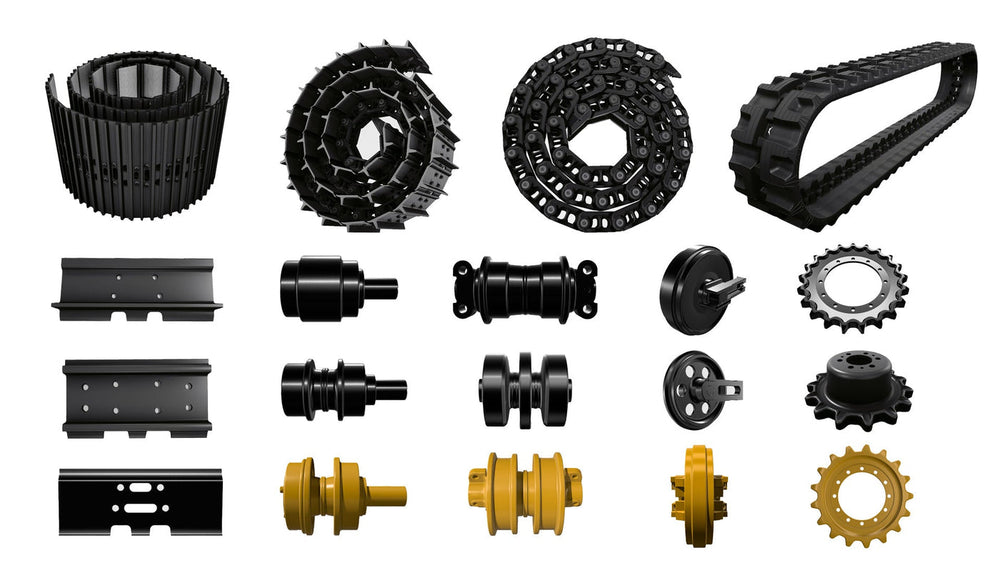
For a part from KTSU, ask which claim, if any, is being made for the exact part and lot, and confirm any OEM-related claim through the OEM's own channel. The public excavator undercarriage parts collection identifies the product family. It does not establish OEM authorization, genuine origin or any affiliation with a manufacturer.
The record is complete when the asserted wording, claimant and lot are matched to an independent OEM-channel check, the scope and date of the confirmation are written down, and the public wording is limited to what the evidence supports.
More Technical Guides guides
Find the next article for your component, application or buying decision.
Back to Technical Guides