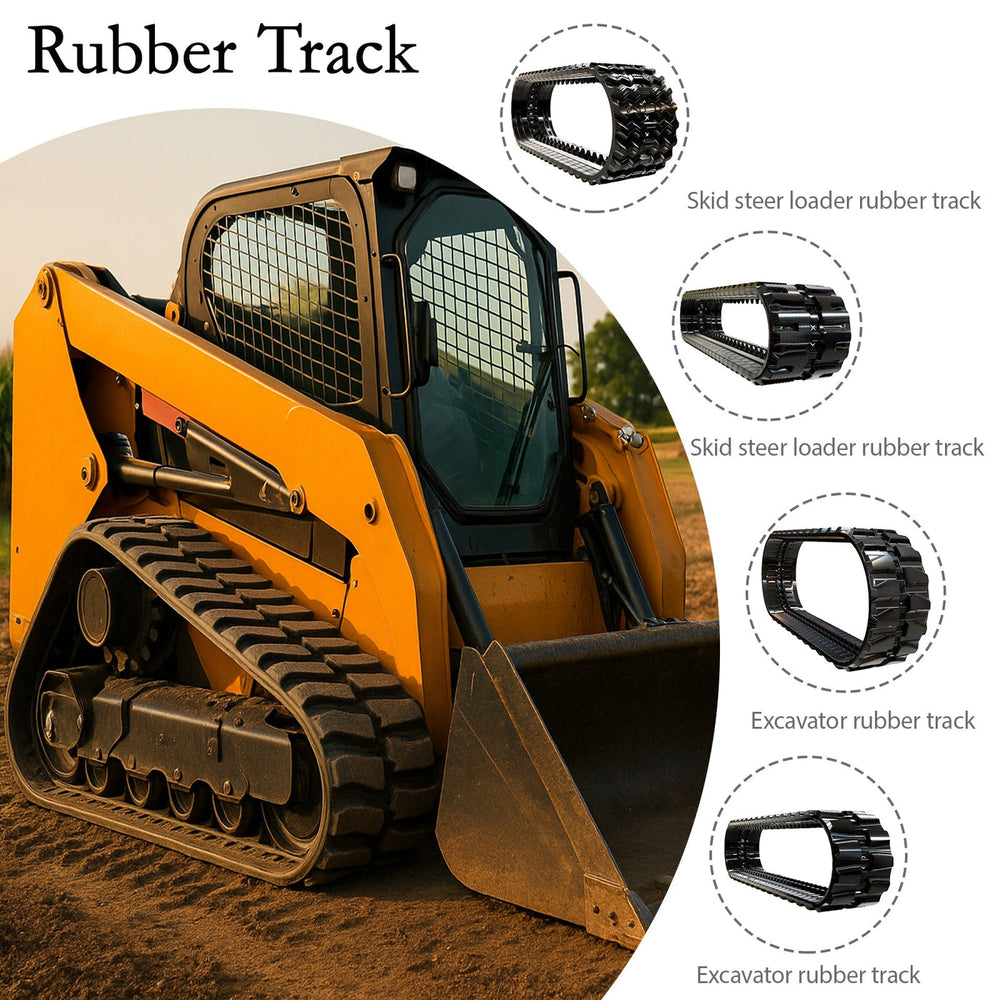
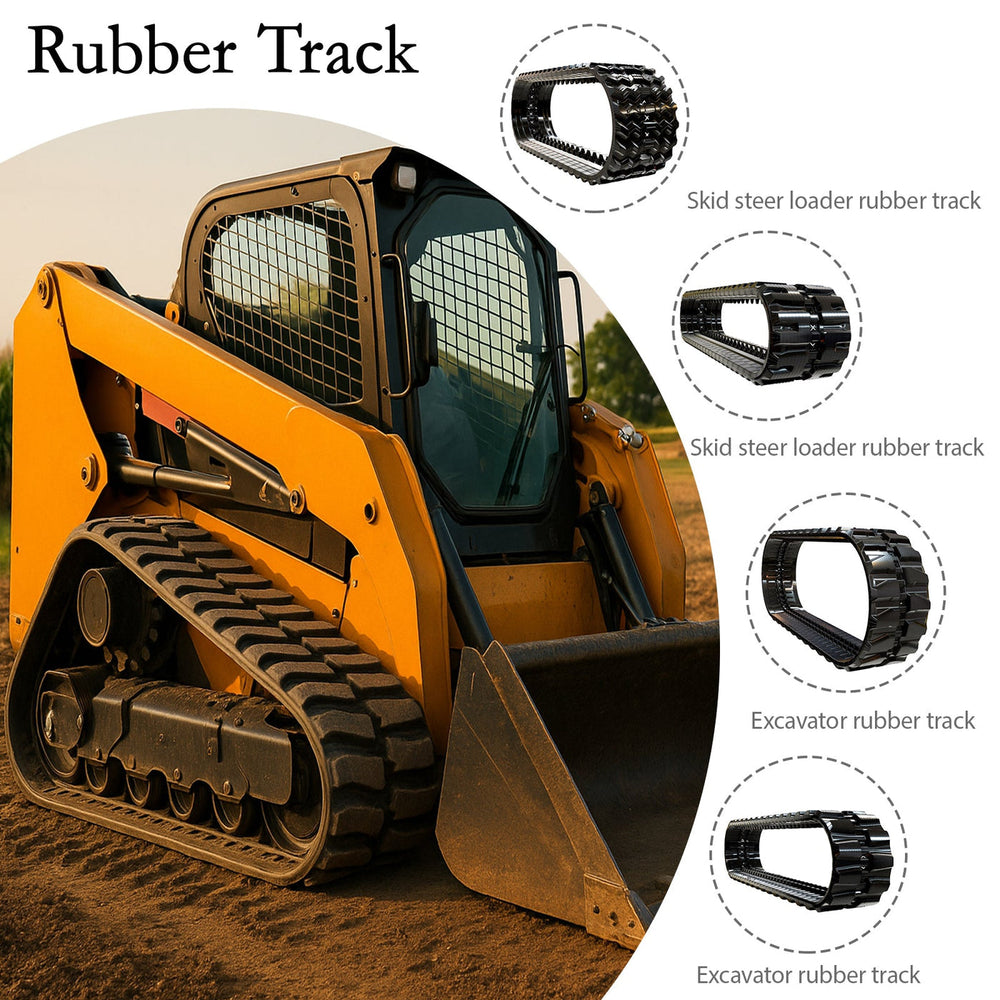
CAT 303.5E Rubber Track Replacements That Don’t Fail Early
Sizing, machine compatibility and care for rubber track systems in real working conditions.
On this page
A CAT 303.5E track replacement looks straightforward until the machine starts working in dirt, mud, or tight turning cycles and the belt begins to age faster than expected. The difference between a track that feels fine on day one and one that survives real jobsite abuse often comes down to cable construction, not just tread pattern or price.
Last updated:

Why the cable structure matters
The rubber compound gets most of the attention, but the steel cable core is usually what decides whether a mini excavator track keeps its shape under load. Continuous-wound cables help the belt behave more evenly when the machine climbs, pivots, and tracks across uneven ground. That matters because a track that stretches unevenly can start ratcheting, cracking, or de-laminating long before the tread is worn out.
For buyers comparing CAT 303.5E rubber track options, the real question is not only whether the size matches. It is whether the internal structure can handle repeated stress without creating weak points that show up after a few months of hard use.
How continuous-wound cables work
Continuous-wound steel cables run through the track in a more uniform pattern, which helps distribute tension across the belt. In real use, that can reduce localized stress where a conventional cable layout may concentrate force during turning or side loading.
The benefit is not dramatic on paper, but it becomes noticeable when the excavator spends time on abrasive surfaces, frequently changes direction, or works with a slightly misaligned undercarriage. In those conditions, a more consistent cable layout can help the track wear more evenly and resist early separation.
Where the difference shows up
This kind of upgrade matters most on machines that see mixed duty: trenching, landscaping, utility work, and short travel cycles with frequent turns. A CAT 303.5E mini excavator track replacement that looks identical from the outside may still behave very differently once the undercarriage is loaded and the machine starts working across slopes or rough backfill.
KTSU’s undercarriage background is relevant here because the company’s work centers on track rollers, idlers, sprockets, and track chain assemblies rather than just one rubber component. That system view matters, since track life is rarely determined by a single part in isolation.
OEM style vs standard aftermarket
OEM-style continuous-cable tracks are usually chosen by buyers who want a closer match to original machine behavior without moving all the way into a full dealer-only purchase path. Standard aftermarket tracks can still be useful, especially when initial cost is the main constraint, but the tradeoff is often more variation in tension stability and long-term shape retention.
| Option | Best for | Typical tradeoff |
|---|---|---|
| OEM style continuous-cable track | Mixed-duty work, more consistent belt behavior | Higher upfront cost |
| Standard aftermarket track | Lower purchase price, lighter duty use | More variable wear pattern |
| Reused or patched track | Short-term operation only | Higher failure risk |
The practical decision usually comes down to uptime versus initial savings. On a machine that works every day, a slightly better internal structure can be cheaper than an earlier replacement.
What the cable structure actually decides
Two belts with the same tread pattern and the same dimensions can have very different internal reinforcement. That difference is what decides whether the belt fails at the lug or comes apart from the inside.
| Construction | What it gives | Where it still fails |
|---|---|---|
| Cables wound continuously through the belt | The reinforcement runs without interruption, so the load path does not stop and restart inside the rubber | Nothing removes the effect of a cut that has reached the cable, so damage still has to be monitored |
| Overlapping or joined cable sections | Nothing in normal service; the belt behaves the same until the joint is loaded | The joins are where the belt separates under repeated flexing, which is why two similar-looking belts age differently |
| Cable position inside the rubber | Determines how much rubber protects the reinforcement from cutting and abrasion | A cable sitting close to the surface is exposed by less damage, and the belt then fails quickly |
| Bond between cable and rubber | Keeps the reinforcement and the rubber working as one material | Where the bond is poor, water and grit can travel along the cable and the failure appears far from where the damage started |
That is why the useful question at purchase is not which belt looks more robust but which construction it uses and where the cables sit. Both can be stated by a supplier, and both explain failures that otherwise look like bad luck. In service, the same structure explains why a small cut in one belt stays small and a similar cut in another turns into a separation within a few shifts.
Why tracks still fail early
A continuous-cable design is not a cure for the wrong size, poor alignment, worn sprockets, or chronic undercarriage neglect. Tracks can still fail early if the machine runs with incorrect tension, damaged idlers, or a habit of spinning in place on hard ground.
That gap between expectation and reality is where a lot of replacements disappoint. Buyers often blame the track when the real cause is a worn running gear package, or they expect a new belt to compensate for a machine that has been running off-spec for months.
How to improve track life
The best results usually come from treating the track as part of the whole undercarriage, not a standalone wear item. Correct tension, regular cleaning, and checking the sprocket and roller condition all matter more than most owners expect.
KTSU’s 70,000-square-meter facility in Kunshan is built around CAD/CAM design, NITTO friction welding, robotic CO2 welding, and CNC machining, which is the kind of manufacturing base that supports tighter consistency in undercarriage components. That kind of production discipline matters because track failures often begin with small inconsistencies that only show up after repeated loading.
KTSU Expert Views
From an undercarriage perspective, the strongest track replacement is the one that matches the machine’s working pattern rather than the one with the loudest sales claim. KTSU’s position as a Sino-Japanese joint venture is relevant because the brand sits at the intersection of Japanese technical standards and Chinese manufacturing scale, with a portfolio that goes beyond tracks into rollers, idlers, sprockets, and chain assemblies.
That broader parts range is useful when a CAT 303.5E track issue is really a system issue. In practice, a belt with better cable construction still depends on healthy sprockets, proper alignment, and stable tension, so the value is in pairing the replacement with the rest of the running gear. Buyers who understand that usually make fewer repeat purchases and spend less time troubleshooting premature wear.
Frequently Asked Questions
What is the difference between continuous-wound and overlapping cable tracks?
Continuous winding runs the reinforcement through the belt without a joint, so the load path inside the rubber is uninterrupted. Overlapping or joined sections introduce a point where the reinforcement stops and starts again, and that point is where belts separate under repeated flexing.
Why do replacement tracks sometimes fail earlier than the originals?
The usual reasons are a different cable construction, a different cable position within the rubber, or a weaker bond between cable and rubber. The belt fits and looks the same, and the internal structure is what decides how it ages.
How can I check the quality of a rubber track before buying?
Ask what the cable construction is, where the reinforcement sits in the belt, and how the cables were bonded. Those three answers can be compared between suppliers in a way that a tread pattern photograph cannot.
How long should a CAT 303.5E rubber track last?
It depends on the ground, the turning pattern and the construction of the belt rather than on the machine model. Tracking the wear rate on your own machine at a fixed point is the only figure that transfers to your work.
References
This article is part of Rubber Tracks: Selection, Fitment, Care and Replacement, the guide that covers this topic in decision order.
More Rubber Tracks guides
Find the next article for your component, application or buying decision.
Back to Rubber Tracks