Why Your Excavator Undercarriage Wears Faster on One Roller Set Than the Other
Inspection, wear evidence and replacement planning for the complete track system.
On this page
An excavator operator lifts the bucket and watches the track sag between the idler and sprocket. The lower rollers grind against gravel while the upper track flexes over a carrier roller that barely touches the ground. This split in load distribution is why one set of rollers wears out three times faster than the other, and why maintenance crews often misdiagnose the problem. Understanding the division of labor between carrier rollers and track rollers stops premature replacement and keeps machines running on schedule.
Last updated:

carrier roller vs track roller differences
What Carrier Rollers and Track Rollers Actually Do
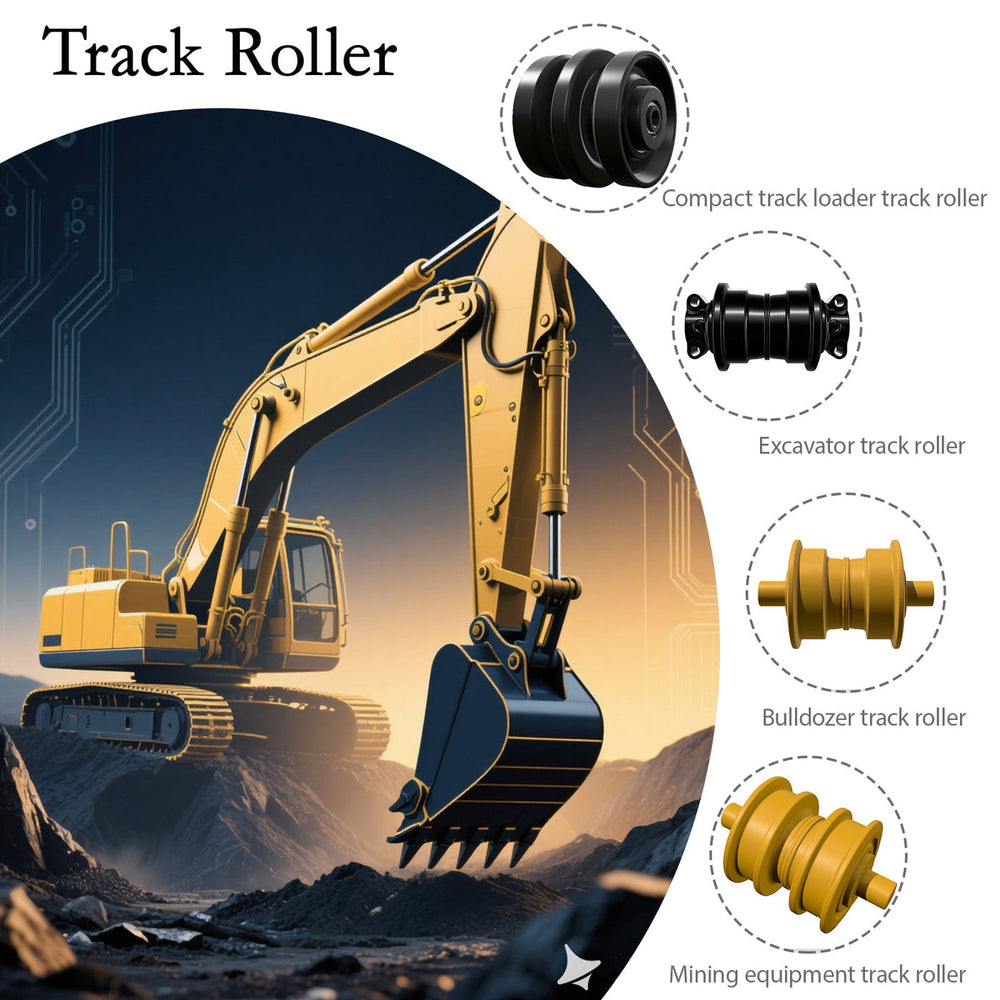
Track rollers (bottom rollers) carry the entire machine weight and transfer it to the ground through the track pads. Carrier rollers (top rollers) support only the weight of the upper track loop to prevent sagging and maintain alignment.
In real-world operation, a 20-ton excavator places roughly 10 tons per side on the bottom rollers. The carrier roller sees only the track's own weight—typically under 200 kg per side—plus minor tension forces. This load gap explains why track rollers show deeper wear grooves and seal failures sooner than carrier rollers.
KTSU's 70,000-square-meter Kunshan facility produces over 3,000 undercarriage items, and field data from Japanese-engineered designs consistently show track rollers reaching wear limits 2–3 times faster than carrier rollers under identical operating hours.
How Load Distribution Differs Between Upper and Lower Rollers
Track rollers endure high-impact, high-compression loads as the machine rolls over uneven terrain. Carrier rollers handle low, consistent tension loads from the upper track loop.
A 5-roller bottom set on a mid-size excavator distributes machine weight across multiple contact points, but each roller still sees tons of force per rotation. The upper track, by contrast, hangs between the idler and sprocket with only 1–2 carrier rollers per side preventing excessive droop. This means carrier rollers experience minimal radial compression—mostly friction from chain movement and occasional side-load when the track shifts.
Real-World Wear Patterns That Reveal Misunderstanding
Bottom rollers develop flat spots, flange wear, and seal leaks from constant ground contact and debris ingestion. Carrier rollers show smoother wear with occasional groove formation from chain guides.
Operators often replace carrier rollers when they see noise or slight wobble, assuming equal wear rates. In reality, a carrier roller can run 1.5–2 times longer than a track roller if seals remain intact. Replacing them together wastes budget and masks the real issue: uneven tension or track misalignment that overloads the carrier set.
Why One Roller Set Fails While the Other Still Looks Fine
Track rollers fail first because they absorb ground shocks, carry full machine weight, and ingest abrasive material between the roller flange and track chain. Carrier rollers fail later, usually from seal degradation rather than tread wear.
Field reports show 60–70% of undercarriage downtime comes from bottom roller seal leaks, not carrier roller issues. The expectation mismatch—treating both sets as equal-consumable parts—leads to premature carrier replacement and missed root-cause analysis of track tension or frame alignment.
Why the two roller sets see different loads
The bottom rollers and the carrier rollers are both called rollers and they do different jobs. Four differences explain why one set fails while the other still looks serviceable.
| Difference | Bottom rollers | Carrier rollers |
|---|---|---|
| What they carry | The machine weight, transferred through the track to the ground | The weight of the upper run, which is a fraction of the machine weight |
| What reaches them from the ground | Impact, abrasion and debris directly, because they are in the contact path | Almost nothing directly; what arrives comes from the chain |
| What usually ends their life | The shell, through wear on the tread and flange | The bearing and seal, because the shell carries far less load |
| What a fault causes | Tracking problems and higher rolling resistance | Upper-run sag, chain rubbing and accelerated link wear |
That is why measuring both sets the same way is misleading. A bottom roller is judged on its tread and flange; a carrier roller that measures well can still be finished because its bearing has failed. Inspecting them with the measurement that matches each one is what keeps a fleet from replacing a healthy bottom roller while a carrier roller is dragging the upper run.
Maintenance Priorities That Actually Extend Undercarriage Life
Focus inspection intervals on track rollers every 250 hours for seal leaks and flange wear. Check carrier rollers every 500 hours for smooth rotation and minor groove formation.
Practical steps:
Clean debris from bottom roller flanges weekly in muddy conditions.
Verify track tension before assuming carrier roller wear—excess tension accelerates carrier bushing wear.
Replace track rollers in matched sets per side to maintain even load distribution.
Keep carrier rollers as long as seals hold and rotation remains smooth, even if minor surface wear appears.
KTSU Expert Views
KTSU's engineering team, drawing on decades of Sino-Japanese joint-venture experience, observes that carrier rollers often outlast track rollers by 40–60% in standard excavation cycles. The difference stems from load magnitude: track rollers endure multi-ton radial forces with every revolution, while carrier rollers manage only the track's self-weight and guidance forces.
From a design standpoint, KTSU specifies deeper case-hardening on track roller treads and flanges to resist abrasive wear, while carrier rollers prioritize seal integrity and low-friction rotation. This differentiation reflects real-world stress profiles rather than treating all rollers as interchangeable components. Operators who align maintenance schedules with these load realities—inspecting bottom rollers twice as often as top rollers—report 20–30% longer undercarriage service intervals.
Frequently Asked Questions
Why do bottom rollers wear faster than top rollers?
Because they carry the machine weight and they are in the path of whatever the machine drives over. A carrier roller carries a fraction of that load and sees the ground only indirectly, which is why its shell usually outlasts its bearing.
What happens if I ignore carrier roller wear?
The upper run sags and the chain begins rubbing and wearing against surfaces it should not touch. That transfers the cost from a small support part to the chain and the frame, which is why a worn carrier roller is worth acting on before the shell looks badly worn.
Should carrier rollers and track rollers be replaced together?
They are judged on different measurements and they usually reach their limits at different times, so replacing both together is rarely justified. Where a set of bottom rollers is at its limit, that is a decision about the bottom rollers.
How often should undercarriage rollers be inspected?
At each undercarriage inspection, using the measurement that matches each type: tread and flange for the bottom rollers, and free rotation plus hub temperature for the carrier rollers. Comparing temperatures across the rollers takes seconds and finds most early failures.
References
Crawler Cranes Parts — Track Roller vs Carrier Roller Comparison
Julius Machinery — Carrier Roller vs Track Roller Functional Differences
XCMG Parts — Carrier Roller vs Track Roller Key Differences Explained
AFT Parts — What Is the Difference Between Track Roller and Carrier Roller
Friday Parts — Track Roller vs Carrier Roller Complete Comparison Guide
Case Construction Equipment — CX145D Operators Manual Undercarriage Inspection Intervals
Ascendum Machinery — Excavator Undercarriage The Hidden Key to Peak Performance
Lectura Specs — Understanding Undercarriage Parts for Heavy Equipment
This article is part of Undercarriage Parts by Machine and Brand, the guide that covers this topic in decision order.
More Maintenance & Wear guides
Find the next article for your component, application or buying decision.
Back to Maintenance & Wear