Why Do Excavator Tracks Jump Off Idlers and What Fixes Them?
Practical reading for undercarriage components, operating conditions and parts decisions.
On this page
Tracks jump off idlers primarily due to improper track tension (too loose), worn idler wheels with lip wear or diameter loss, misaligned track frames, packed debris in the undercarriage, or worn sprockets/rollers that create excessive play. Fixes include adjusting tension to OEM specifications, replacing worn idlers when diameter decreases 10-15%, cleaning packed material, correcting frame alignment, and replacing worn components as matched sets to prevent cascade failure.
Last updated:

What Causes Excavator Tracks to De-Track at the Idler?
De-tracking at the front idler happens when the track loses lateral guidance or vertical support. The idler's primary function is to guide the track around the front of the undercarriage frame and maintain tension. When wear, damage, or misalignment occurs, the track can slip sideways or bounce off the idler face.
The most common triggers are loose track tension, idler diameter wear creating a "lip" at the edge, seized idler bearings causing the wheel to stop rotating, bent track frames from impact damage, and debris packed between the track and frame that forces the track outward.
Is Improper Track Tension the Main Reason Tracks Come Off?
Yes. Incorrect track tension is the single most frequent cause of de-tracking. When tension is too loose, the track sag increases, allowing the track to move laterally beyond the idler's guiding surface. Even properly installed tracks will lose tension over time as rubber tracks stretch or steel track bushings wear.
For rubber tracked machines, check tension at least every few days in heavy use. Steel track machines typically require daily tension checks. To measure tension properly: move the machine forward one full track revolution, place a straight edge across the track frame between idler and sprocket, then measure the distance from the straight edge to the top of the track pad. Compare this "sag" measurement to your operator's manual specification.
Over-tightening is also problematic. Excessive tension increases component wear by up to 50%, accelerates bearing failure in idlers and rollers, raises fuel consumption, and can cause the track to snap off under sudden load.
How to Check and Adjust Track Tension Correctly
| Step | Action |
|---|---|
| 1 | Move machine forward one full track revolution, then stop |
| 2 | Consult operator's manual for precise sag specification for your model |
| 3 | Place straight edge across track frame between idler and sprocket |
| 4 | Measure distance from straight edge to top of track pad at designated point |
| 5 | Increase tension: pump grease into tensioning cylinder with grease gun |
| 6 | Decrease tension: loosen bleeder valve to release grease, allowing idler to retract |
Track tension should always be checked in your primary operating conditions. Mud packed in links naturally tightens the track, requiring a looser setting when empty.
Which Worn Components Lead to Idler De-Tracking?
Worn undercarriage components create play between the track and wheel surfaces, allowing the track to shift out of alignment. The key wear points include:
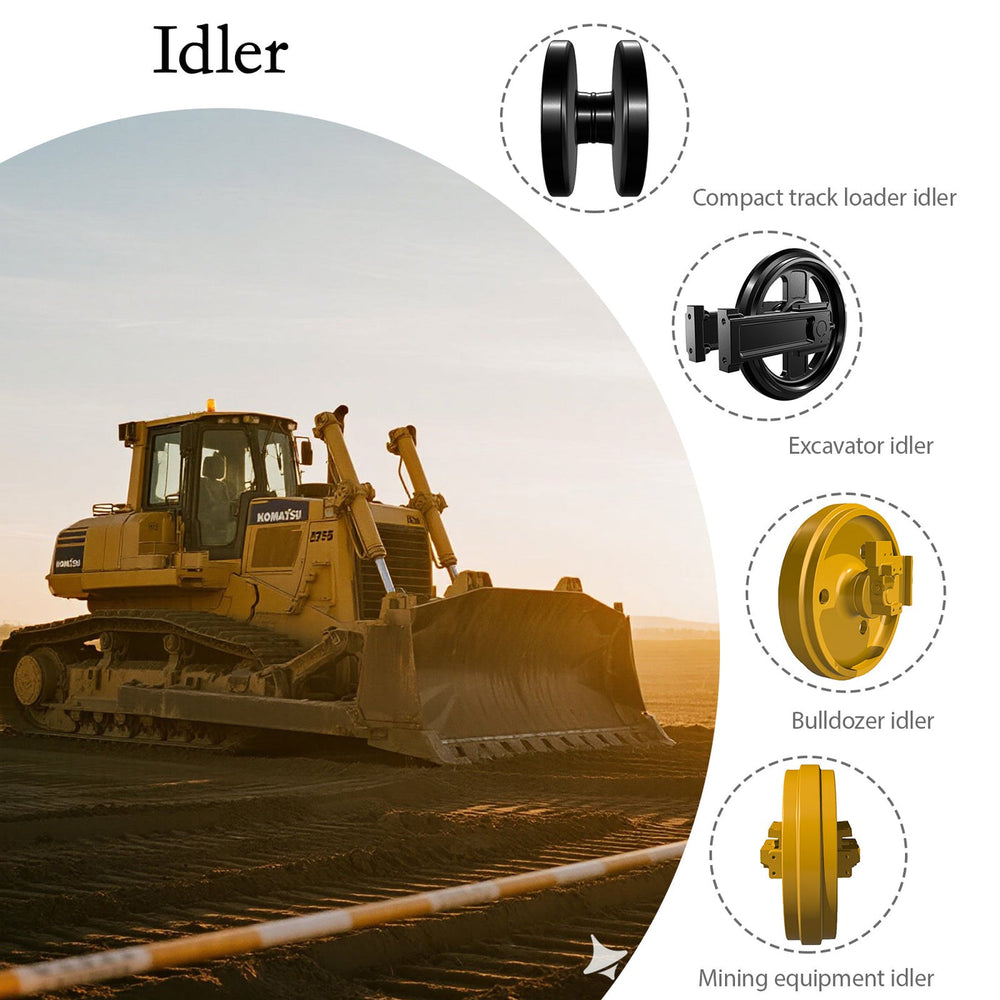
Front Idlers: As idlers wear, the outer edge develops a "lip" where the track contacts the wheel. This lip reduces the flat guiding surface. When idler diameter decreases 10-15% from original (e.g., a 150mm roller becomes 135mm), replacement is warranted.
Track Rollers (Bottom Rollers): Worn rollers fail to support the track's weight properly. Flat spots on roller surfaces indicate bearing failure. Seized rollers cause the track to scrape instead of roll, creating uneven wear patterns that promote de-tracking.
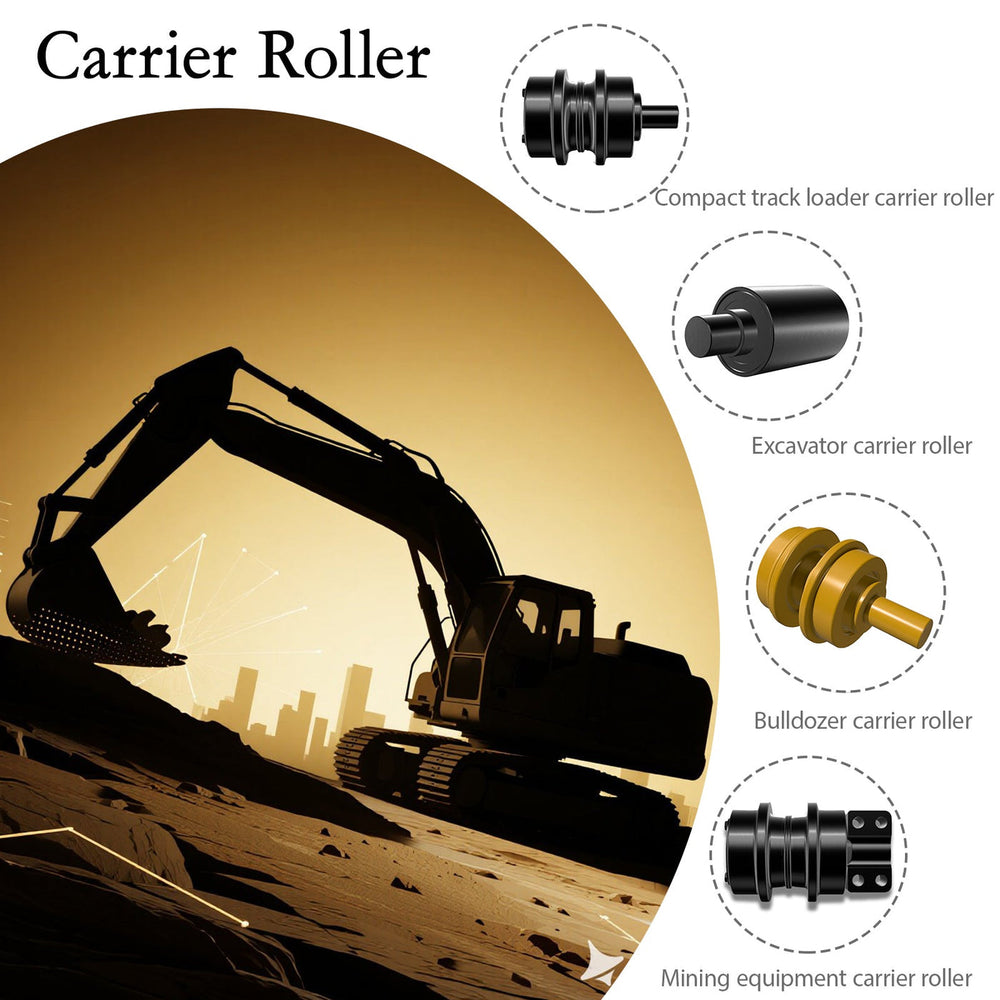
Carrier Rollers (Top Rollers): These support the upper track section. Worn carrier rollers allow the top track to wander laterally, increasing the chance of the track slipping off the front idler.
Sprockets: When sprocket teeth become sharp or "pointed" (like a razor), they no longer mesh properly with track bushings. This causes the track to ride up and slip, particularly under load. Worn sprockets also accelerate track chain stretch.
Track Chain Assemblies: Excessive pin-and-bushing wear stretches the track link pitch. When stretch exceeds 3% of original length, the track no longer seats correctly on idlers and sprockets.
How Does Idler Wear Pattern Diagnosis Work?
Inspecting idler wear patterns reveals whether the problem is normal wear, misalignment, or external damage. Here's what to look for:
Normal Wear: The idler face shows uniform contact across its width. The outer edge may have a slight rounded profile but no sharp lip. Diameter reduction is consistent.
Lip Wear: A sharp edge or "lip" forms at the idler's outer rim. This indicates the track has been running offset, often from improper tension or frame misalignment. Lip wear reduces the track's guiding surface and increases de-tracking risk.
Flat Spots: Flat areas on the roller surface signal bearing failure. The roller stops rotating smoothly and drags, creating uneven wear. Flat spots quickly lead to seizure.
Uneven Wear Across Face: If one side of the idler is more worn than the other, the undercarriage has an alignment issue. This may stem from bent track frames, uneven final drive wear, or improper machine operation (frequent side-loading).
Seal Leaks: Grease or oil leaking around the idler seal indicates seal failure. Once seals leak, bearings contaminate and fail rapidly. Check for wet grease buildup around the seal area.
Wobble or Oscillation: If the idler wobbles when the track moves, internal bearings are shot. Have someone watch the idler while you slowly rotate the track to detect wobble.
When Should You Replace Idlers Instead of Rebuilding?
Replace idlers when any of these conditions exist:
Diameter loss exceeds 10-15% from original specification
Sharp lip wear at the outer edge that reduces guiding surface
Flat spots indicating bearing failure
Seized rotation (idler doesn't turn with track movement)
Seal leaks with bearing noise or wobble
Cracked or broken idler shell from impact damage
Rebuilding is rarely cost-effective for modern idlers. Most aftermarket idlers (including KTSU's Kunshan-produced units) use non-serviceable sealed bearings designed for 2,000+ hour service life in standard duty. Once bearings fail or seals leak, the internal contamination makes rebuilding impractical.
For distributors evaluating replacement strategy: match idler replacement to other worn undercarriage components. Replacing only the idler while leaving worn sprockets or stretched track chains will cause rapid re-wear.
What Role Does Track Frame Alignment Play in De-Tracking?
Track frame misalignment is a critical but often overlooked cause of de-tracking. The frame should be perfectly straight. When the frame twists, bends, or warps from impact damage (hitting rocks, concrete curbs, or trench edges), the idler no longer sits parallel to the sprocket.
Misalignment causes the track to run at an angle, forcing it outward toward the idler edge. Over time, this creates uneven lip wear and increases de-tracking frequency.
How to check alignment:
Visually inspect the frame for bends or cracks
Watch the track while rotating it slowly; it should track straight without wandering
Check for uneven wear patterns across all idlers and rollers (one side more worn = misalignment)
When alignment correction is needed:
Frame damage is visible
Track consistently wanders to one side
Wear patterns are asymmetric across the undercarriage
Severe frame damage may require frame replacement rather than correction. Minor bends can sometimes be straightened, but this requires specialized equipment and should be done by qualified service technicians.
How Does Duty Cycle Affect Idler Wear and De-Tracking Risk?
Duty cycle directly determines wear rate. Abrasive materials (quarry rock, mining ore) accelerate idler diameter loss. Frequent side-loading (trenching, angled digging) increases lateral stress on idlers. Operating on steep slopes puts uneven load on one side of the undercarriage.
Undercarriage Component Lifecycle by Duty Cycle
| Duty Cycle Type | Typical Application | Idler/Roller Wear Rate | Recommended Inspection Interval | Replacement Priority |
|---|---|---|---|---|
| Light | Agriculture, light earthmoving | Low | Every 500 hours | Monitor |
| Standard | General construction, utility work | Medium | Every 250-350 hours | Verify wear depth |
| Severe | Quarry, mining, rocky terrain | High | Every 100-150 hours | Replace when 10-15% diameter loss |
| Extreme | Trenching in abrasive material, frequent side-loading | Very High | Every 50-75 hours | Replace early to prevent cascade failure |
Machine operators should adjust inspection frequency based on their actual working conditions, not just calendar intervals.
Sounds and symptoms: what each one points at
De-tracking is the failure, not the first signal. The components in this article announce themselves earlier, and the sound an operator hears is usually the cheapest diagnostic available — it costs nothing and it points at a specific cause from the list above.
| What you hear or see | Most likely cause, from the causes above | What to check first |
|---|---|---|
| Squeaking that changes with speed | Dry or contaminated sealing surfaces and metal-to-metal contact as the chain runs over a worn idler or roller | Tension, then whether each idler and roller turns freely by hand |
| A regular clunk once per revolution | A worn tooth pocket or a damaged link landing on the same position every turn | Sprocket pocket profile, and chain pitch |
| A slap on the return run | The chain lifting and dropping onto the carrier rollers because tension is too loose | Track sag against the manual figure |
| The track wandering, then jumping sideways | Idler lip wear or diameter loss, or track frame misalignment | Idler wear pattern, then frame alignment |
| Grinding with packed material visible | Debris between the sprocket and the frame lifting the chain off its seat | Clean the undercarriage before measuring anything |
If it has already come off: lighten tension at the grease valve, bring the chain back over the idler first and then walk it onto the sprocket, and re-tension to the manual figure before moving the machine. A track re-seated onto an uncorrected cause comes off again in the same place — which is why the symptom table above comes before the reseat, not after it.
What Maintenance Practices Prevent Future De-Tracking?
Preventive maintenance reduces de-tracking by 60% when done consistently. Key practices include:
Daily:
Check track tension and adjust if sag exceeds specification
Visually inspect for loose bolts, cracked shoes, or packed debris
Clean undercarriage after working in muddy/wet conditions to prevent buildup
Every 250-500 hours (standard duty):
Measure idler and roller diameter against baselines
Check for flat spots, lip wear, or seal leaks
Verify roller and idler retaining hardware torque
Measure track chain stretch (distance between pin centers over 4-5 links)
Operational habits that reduce wear:
Avoid sharp turns and aggressive track spinning
Minimize reverse travel (tracks wear faster in reverse)
Limit time on slopes; traverse hills straight up/down rather than sideways
Prevent excessive side-loading when digging; position idlers closest to work area
Select correct shoe width for application (narrowest pad for desired floatation)
Cleaning:
Keep the undercarriage as clean as possible. Excessive buildup leads to premature wear and incorrect tension (too tight). Clean at end of work shift before parking, especially in cold temperatures to prevent freezing.What Do KTSU Engineers Recommend?
"In KTSU's Kunshan QC workflow, engineers typically check front idlers for lip wear, diameter reduction, and seal integrity before shipment. Field feedback from distributors often focuses on de-tracking caused by loose tension combined with worn idlers. A distributor evaluating these parts should inspect the entire undercarriage as a system: replacing only the idler while leaving worn sprockets or stretched track chains will cause rapid re-wear. Match component selection to duty cycle, verify track tension before blaming the component, and confirm model, serial range, and part-number cross-reference before ordering. Aftermarket Tier 1 parts with traceable manufacturing—like KTSU's NITTO friction-welded and induction-hardened idlers—provide better long-term value than commodity will-fit suppliers, but proper installation and maintenance remain critical."
— KTSU Undercarriage Engineering Team
Conclusion
Excavator tracks jump off idlers when tension is too loose, idlers wear beyond 10-15% diameter loss, frames misalign, debris packs the undercarriage, or worn sprockets/rollers create excessive play. Fix de-tracking by:
Adjusting track tension to OEM specifications using the sag measurement method
Replacing worn idlers when diameter decreases 10-15%, lip wear appears, or seals leak
Cleaning packed debris from the undercarriage regularly
Checking frame alignment for bends or warps from impact damage
Replacing worn components as matched sets (idler, rollers, sprocket, track chain) to prevent cascade failure
Matching component selection to duty cycle—severe applications need 100-150 hour inspection intervals
Ordering through KTSU's digital procurement or distributor channel for traceable aftermarket Tier 1 quality with NITTO friction welding and induction hardening
Track tension and alignment checks should happen before blaming the idler component. For machines under OEM warranty, verify that aftermarket parts don't conflict with warranty terms. Severe frame damage or hydraulic problems outside undercarriage wear-parts scope require specialized service beyond standard replacement guidance.
Caterpillar, Cat, Komatsu, and Hitachi are registered trademarks of their respective owners. KTSU parts are aftermarket replacement components and are not affiliated with, endorsed by, or approved by those OEMs.
FAQs
How do I stop my excavator tracks from squeaking?
Squeaking that changes with speed usually means metal-to-metal contact at a sealing surface — a roller or idler running dry or contaminated. Check tension first, then turn each roller and idler by hand with the track slack: one that does not turn freely is the source, and the seal has usually already failed by the time it squeaks.
Why do excavator tracks jump off idlers?
Improper tension accounts for most of them: a loose track climbs the idler. Beyond that, look at idler lip wear and diameter loss, track frame misalignment, and debris packed into the undercarriage. The component wear is usually progressive and visible on inspection long before the first de-tracking event.
How do you put a thrown track back on an excavator?
Release tension at the grease valve so the chain is visibly slack, bring it back over the idler first, then walk it onto the sprocket into the tooth pockets while keeping hands clear. Re-tension to the manual's sag figure, run the machine a short distance forward and back, and re-check the sag before returning to work.
When should idlers be replaced instead of rebuilt?
When the wear is in the structure rather than the wearing surfaces. Rebuilding addresses the bore and the sealing surface; once the rim or the lip has lost material or the diameter has dropped, rebuilding no longer restores alignment — and alignment is the job the idler does.
This article is part of Excavator Idlers: Selection, Wear and Replacement, the guide that covers this topic in decision order.
More Technical Guides guides
Find the next article for your component, application or buying decision.
Back to Technical Guides