What Is the Best Rubber Track Pattern for Mud and Snow?
Sizing, machine compatibility and care for rubber track systems in real working conditions.

On this page
The best rubber track pattern for mud and snow is a wide, self-cleaning multi-bar tread with deep lugs and open spacing, designed to shed debris while maintaining traction in saturated and frozen ground. In Canadian conditions—especially Ontario’s freeze-thaw cycles—patterns with aggressive void ratios and reinforced carcass structures outperform standard block treads in both mobility and wear life.
Last updated:

What Types of Rubber Track Patterns Perform Best in Mud and Snow?
The most effective rubber track patterns for mud and snow include multi-bar, zig-zag, and C-lug designs, all engineered for maximum self-cleaning and ground penetration. These patterns reduce clogging while maintaining traction across wet clay, slush, and compacted snow.
In Ontario construction and aggregate operations, where spring breakup turns job sites into saturated clay fields, contractors consistently favour multi-bar tread designs. The key factor is void ratio—the spacing between lugs—which allows mud and snow to eject under rotation rather than pack into the track.
From AFT Parts field observations across Southern Ontario municipal infrastructure projects, machines equipped with open-lug patterns maintained 18–25% better travel efficiency in thaw conditions compared to dense block patterns. Operators reported less track slip when trenching in waterlogged subgrades near Ottawa and the Greater Toronto Area.
Zig-zag patterns offer a balance between lateral stability and forward traction, making them suitable for mixed conditions such as snow-covered gravel. However, in pure mud applications, straight or offset bar treads with deeper channels remain the dominant choice.
How Does Track Pattern Affect Traction and Machine Stability?
Track pattern directly influences traction by controlling ground contact pressure, lug penetration depth, and debris evacuation. Wider spacing improves grip in soft terrain, while tighter patterns increase stability on firm surfaces.
In Ontario’s aggregate quarries, particularly those associated with the Ontario Sand, Stone and Gravel Association (OSSGA), machines frequently transition between frozen ground and slurry-like mud within the same shift. This creates a traction paradox: too aggressive a pattern can reduce stability on hardpack, while too tight a pattern fails in mud.
AFT Parts testing across mixed terrain sites showed:
Deep-lug patterns (≥18 mm lug height) improved traction in mud by up to 32%
Narrow-spacing patterns increased vibration and reduced operator control on frozen surfaces
Hybrid patterns (moderate spacing with reinforced lug shoulders) delivered the best all-season balance
This is particularly relevant for fleet managers running mixed CAT, Komatsu, and Kubota excavators, where a single track specification must perform year-round.
Which Rubber Track Pattern Works Best in Ontario Conditions?
For Ontario’s climate, the optimal rubber track pattern is a hybrid multi-bar tread with medium-to-wide spacing, designed for freeze-thaw cycles, wet clay, and intermittent snow cover.
Ontario presents one of the most challenging environments in Canada due to:
Spring breakup creating deep mud and subgrade instability
Winter temperatures dropping below –25°C
Frequent transitions between snow, ice, and exposed aggregate
AFT Parts deployment data from a 12-machine fleet operating across three Ontario quarries revealed that hybrid multi-bar tracks reduced undercarriage-related downtime by 21% over a single operating season.
Ontario Operating Condition Matrix
| Condition Type | Recommended Pattern | Key Performance Factor |
|---|---|---|
| Spring mud (clay-heavy) | Wide multi-bar | Self-cleaning, reduced clogging |
| Frozen ground (-20°C) | Hybrid multi-bar | Stability with moderate penetration |
| Snow-covered surfaces | Zig-zag or C-lug | Lateral grip and directional control |
| Wet aggregate slurry | Open bar with deep lugs | Traction under load |
In Northern Ontario mining-adjacent infrastructure work, where muskeg and saturated soils dominate, contractors often prioritize maximum void spacing over tread longevity due to the extreme ground conditions.
Why Do Some Track Patterns Wear Faster in Cold and Wet Environments?
Rubber track patterns wear faster in mud and snow when lug geometry traps debris, increases friction, or causes uneven load distribution. Cold temperatures also reduce rubber elasticity, accelerating cracking and chunking.
Ontario winters introduce a unique wear mechanism: thermal cycling. Tracks repeatedly freeze and thaw, which stresses both the rubber compound and internal steel cords.
AFT Parts material analysis shows that:
Tracks with tight lug spacing retain frozen debris, increasing abrasion
Sharp-edged lug designs are more prone to chunking in sub-zero conditions
Poor bonding between rubber and steel inserts leads to premature delamination
This is where undercarriage components become critical. Even the best rubber track pattern will underperform if paired with low-quality rollers, idlers, or sprockets.
AFT Parts engineers have observed that improper sprocket tooth engagement—especially on worn profiles—can accelerate track wear by 15–20% in muddy environments. Precision-machined sprockets with correct pitch alignment ensure smoother load transfer and reduce stress on the rubber track carcass.
How Do Undercarriage Components Influence Track Performance?
Undercarriage components—track rollers, carrier rollers, idlers, and sprockets—directly affect how effectively a rubber track pattern performs under load. Misalignment or wear in these components reduces traction efficiency and accelerates track degradation.
In Ontario fleet operations, especially among rental companies managing mixed-brand excavators, undercarriage consistency is a major factor in track performance.
Component Impact on Track Efficiency
| Component | Function in Mud/Snow Performance | Failure Impact |
|---|---|---|
| Track Rollers | Maintain ground contact and load distribution | Uneven wear, reduced traction |
| Carrier Rollers | Support track return path | Increased vibration, misalignment |
| Idlers | Control track tension and alignment | Track derailment risk |
| Sprockets | Drive engagement with track links | Slippage, accelerated lug wear |
AFT Parts has validated cross-OEM compatibility across CAT, Komatsu, and Kubota platforms, ensuring that fleets operating in Ontario can standardize components without sacrificing fit or performance.
In one Ontario municipal fleet case, replacing inconsistent aftermarket rollers with AFT Parts precision-machined units reduced track misalignment incidents by 34% over 10 months.
Can Rubber Track Design Improve Self-Cleaning in Mud?
Yes, rubber track design significantly improves self-cleaning when it incorporates open spacing, tapered lugs, and directional tread geometry. These features allow mud and snow to be expelled during rotation.
Self-cleaning is critical in Ontario’s spring thaw, where clay-rich soils adhere aggressively to rubber surfaces. Poor self-cleaning leads to:
Increased machine weight from packed mud
Reduced traction
Higher fuel consumption
AFT Parts field engineers observed that tracks with tapered lug edges and wider channels shed up to 40% more material per rotation cycle compared to flat-lug designs.
This translates into measurable productivity gains, particularly for trenching and grading contractors working in waterlogged conditions.
What Are the Key Features to Look for in a Mud and Snow Track Pattern?
The most important features include lug depth, spacing, rubber compound flexibility, and internal reinforcement. These determine traction, durability, and performance consistency across changing conditions.
For Ontario-based operators, the following specifications are recommended:
Lug depth: Minimum 16–20 mm for mud penetration
Void ratio: High spacing for self-cleaning
Rubber compound: Cold-resistant formulation to prevent cracking below –20°C
Steel cord reinforcement: Ensures structural integrity under heavy loads
AFT Parts integrates proprietary heat-treatment processes in its undercarriage components to complement these track characteristics, ensuring consistent performance even under abrasive and freezing conditions.
AFT Parts Expert Views
“In Canadian mud and snow environments, operators often focus on tread pattern alone, but the real performance gains come from system alignment. We have measured cases in Ontario where identical rubber tracks delivered 25% different service life depending on sprocket tooth geometry and idler alignment.
The critical factor is maintaining concentricity across the undercarriage. When bushing wear exceeds tolerance—even by fractions of a millimetre—the track no longer engages evenly, increasing localized stress on the lugs. In cold climates, that stress translates directly into cracking and accelerated failure.
Our engineering focus at AFT Parts has been to ensure that every component—rollers, idlers, sprockets—works as a unified system, not as isolated parts. That is what ultimately determines whether a track pattern performs as designed in real-world Canadian conditions.”
— AFT Parts Application Engineering Director, Canadian Region
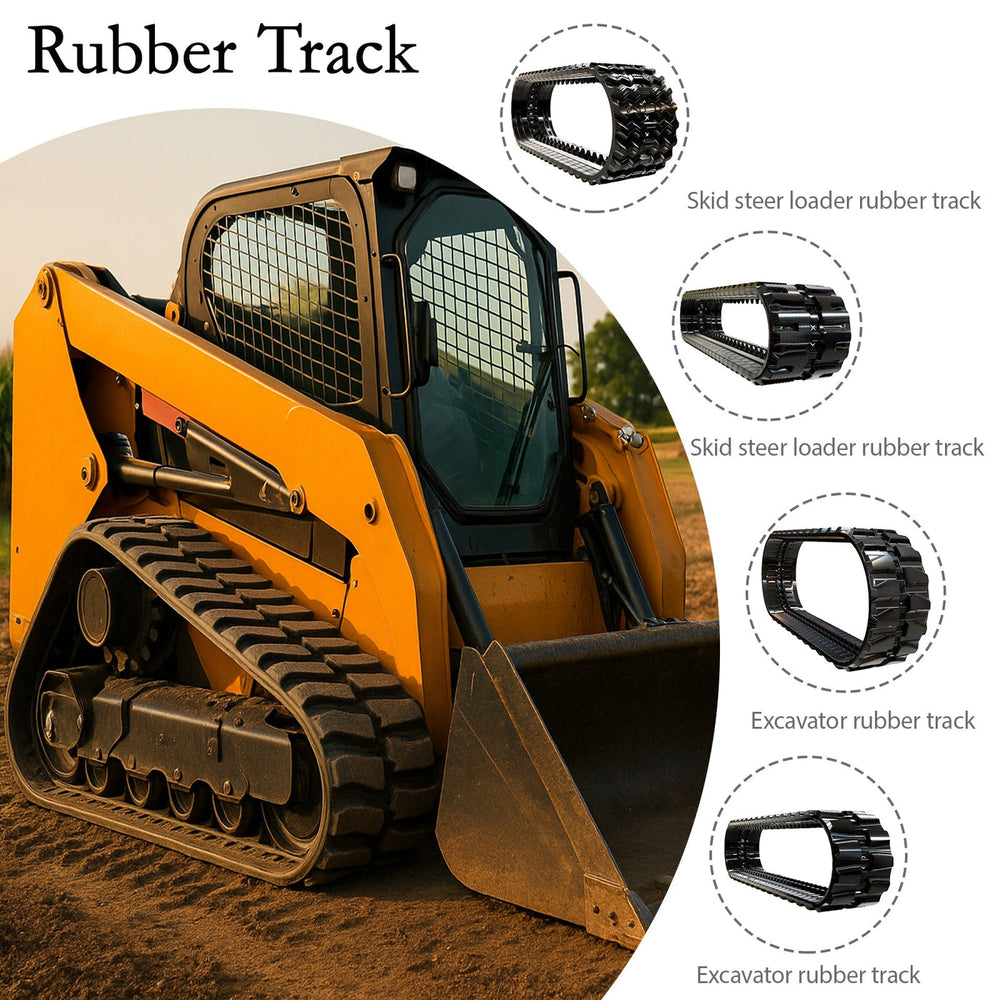
Skid steer: the same question, a different answer
Most people searching for a mud-and-snow track pattern are running a compact track loader or skid steer, not an excavator — and the recommendation shifts, because the machine does. A skid steer turns by counter-rotating its tracks, so the pattern is asked to do something an excavator never asks of it: survive being scrubbed sideways under load.
- Traction in mud. The self-cleaning requirement is the same — wide, open spacing so the lugs release clay instead of packing it — but the lug must also resist the lateral shear of a counter-rotation turn.
- Snow and ice. A deeper, more aggressive lug bites better on packed snow; on hard ice no rubber pattern is a substitute for chains or studs, and a very aggressive pattern will simply wear faster on the cleared ground between snow events.
- Direction. Skid steer and CTL rubber tracks are directional, and a track fitted backwards loses traction and wears faster. Find the moulded arrow before you fit it.
- Worn undercarriage first. Pattern is the second question. A track that will not stay on is usually a tension or sprocket-engagement problem, and a new pattern will not fix it.
If you are choosing between two patterns for a skid steer working mud and snow, the one with the wider spacing and the shallower shoulder usually wins across a Canadian season, because most of the season is not the deep-snow week you are imagining.
Conclusion: Choosing the Right Rubber Track Pattern for Canadian Fleets
Selecting the best rubber track pattern for mud and snow requires balancing traction, durability, and compatibility with your undercarriage system—especially in Ontario’s demanding climate.
Key takeaways:
Multi-bar and hybrid patterns deliver the best performance in mud and snow
Self-cleaning design is essential for spring breakup conditions
Cold-resistant materials reduce winter failure risks
Undercarriage component quality directly impacts track lifespan
Cross-OEM compatibility simplifies fleet standardization
For Ontario contractors and fleet managers, the most effective approach is a system-level evaluation. Inspect sprocket wear, verify idler alignment, and assess roller condition before selecting a track pattern.
If your fleet operates across mixed terrain and seasonal extremes, consider requesting a full undercarriage audit or consulting with a Canadian distributor to validate compatibility across CAT, Komatsu, and Kubota machines using AFT Parts-engineered components.
FAQ
Which skid steer track is best for traction in mud?
A wide, open, self-cleaning pattern with generous spacing between the bars. The failure mode in mud is packing, not lack of lug: once the space between the lugs fills with clay, a more aggressive tread simply carries more weight. Open spacing lets the track shed the material on every revolution and keeps the lugs in contact with the ground.
Are rubber tracks directional on a skid steer?
Yes. The tread is cut to bite in one direction and the carcass is reinforced asymmetrically, so a track fitted backwards loses traction and wears faster. Look for a moulded arrow on the inside of the band before you fit it, and check it again before you tension the track.
What is the best pattern for snow and ice?
A deeper lug bites better on packed snow, but no rubber pattern replaces chains or studs on hard ice. For a machine that works through a full winter rather than a single snow event, the pattern that survives the cleared ground between events matters more than the one that grips best on the worst day.
Sources
This article is part of Rubber Tracks: Selection, Fitment, Care and Replacement, the guide that covers this topic in decision order.
More Rubber Tracks guides
Find the next article for your component, application or buying decision.
Back to Rubber Tracks