What Are the Top‑Rated Replacement Sprockets for Construction Equipment in 2026?
Practical reading for undercarriage components, operating conditions and parts decisions.
On this page
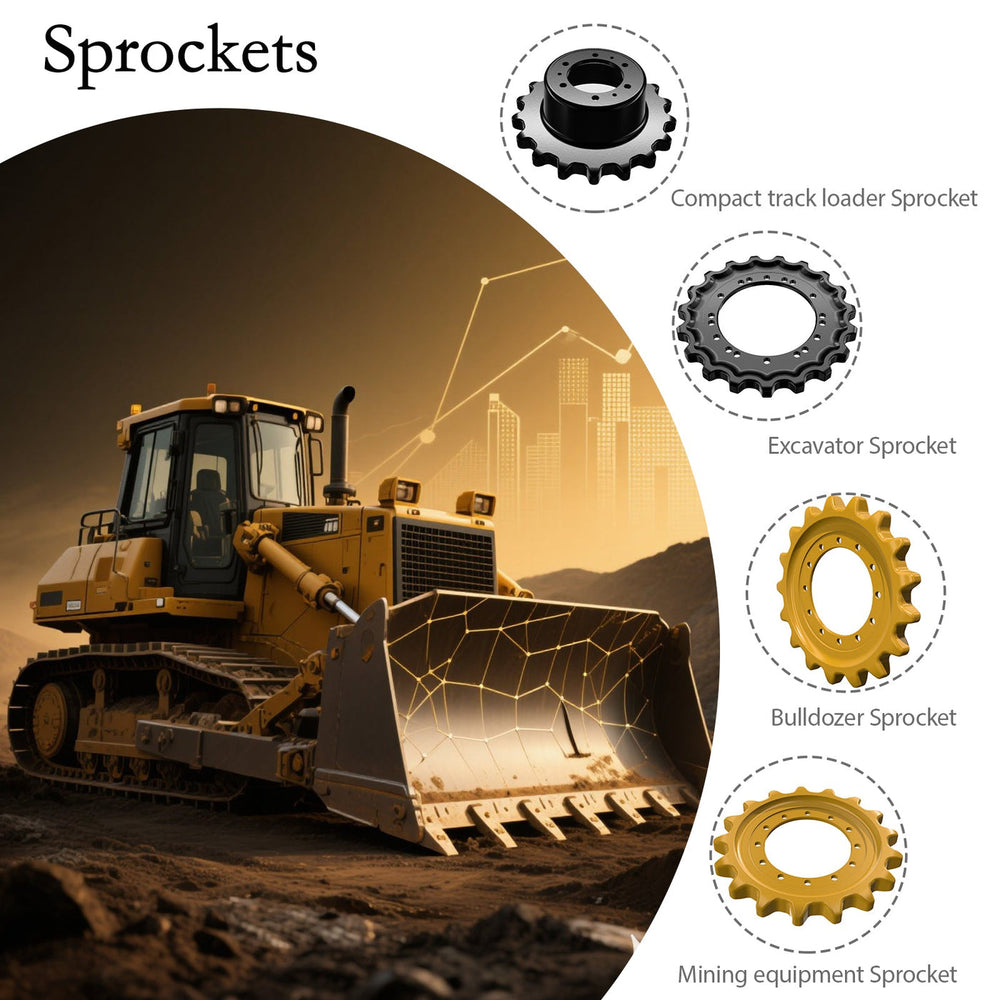
There are no single "top-rated" sprocket brands universally ranked for 2026. Instead, top-rated replacement sprockets are defined by manufacturing quality: induction-hardened tooth profiles, NITTO friction-welded or robotic CO2-welded construction, CNC-machined dimensional tolerance, and compatibility with your machine platform (CAT 320, Komatsu PC200, Hitachi ZX350). Buyers should prioritize Aftermarket Quality Tier 1 manufacturers like KTSU over commodity will-fit suppliers, and always replace sprockets when installing a new track chain to avoid rapid wear.
Last updated:

What Search Intent Drives This Query?
This query reflects commercial investigation and distributor procurement intent. Real buyers—distributors stocking inventory, fleet managers planning replacements, procurement teams evaluating suppliers, and service engineers troubleshooting wear—want to know:
Which sprocket specifications matter most for service life
How duty cycle affects replacement decisions
What manufacturing processes signal quality
How to verify fitment before ordering
Where aftermarket parts fit in the post-warranty chain
The article aligns with this intent by focusing on selection criteria, wear signs, manufacturing quality, and procurement guidance rather than listing unverified brand rankings.
Which Sprocket Specifications Determine Service Life?
The most critical sprocket specifications for service life are tooth profile geometry, hardness distribution, and case depth.
Tooth Profile and Pitch Accuracy
Sprocket teeth must engage precisely with track links. CNC machining ensures consistent pitch and symmetrical tooth shape. Hooked, flattened, or cupped teeth indicate wear and poor engagement.
Hardness and Case Depth
Induction hardening the entire tooth profile—from root to tip—creates wear resistance and fatigue strength. Target hardness typically falls in the 45–55 HRC range for undercarriage sprockets, with case depth sufficient to resist abrasive wear through the full service cycle.
Material and Heat Treatment
High-quality sprockets use low-alloy steel (comparable to JIS G 4053 or GB/T standards) with deep-case carburizing or through-hardening before induction surface hardening. This combination supports load capacity and tooth durability.
| Spec | What It Matters For | Quality Indicator |
|---|---|---|
| Tooth profile geometry | Track engagement, power transfer | CNC-machined symmetry |
| Hardness (HRC) | Wear resistance, fatigue life | Induction-hardened entire tooth |
| Case depth | Long-term abrasion resistance | Sufficient depth for duty cycle |
| Pitch accuracy | Track chain compatibility | Dimensional tolerance control |
How Do You Identify Sprocket Wear That Requires Replacement?
Catch wear signs early to avoid costly undercarriage damage. Look for these six indicators:
Hooked or Sharp Teeth – Teeth should be symmetrical. Hooking means wear and poor seating with track links.
Visible Wear Patterns – Flattened tips, cupped faces, or uneven wear are red flags.
Excessive Track Noise or Vibration – Rough operation suggests incorrect sprocket engagement.
Track Skipping or Jumping – Worn sprockets cause track slip under load—replace immediately.
Poor Track Alignment – Tracks pulling to one side may indicate uneven sprocket wear.
Accelerated Track Chain Wear – Frequent link replacement often points to sprocket as the root cause.
Visual inspection is the first step. Check for cracks, chips, or excessive tooth wear. Consult your service manual for alignment and spacing specifications.
Comparing two sprocket quotations: the lines that have to match before the price means anything
This article argues the right thing — that quality in this category is a matter of manufacturing rather than of a brand league table. That argument is easy to agree with and hard to use at the moment two quotations are in front of you, because the two documents rarely describe the same things in the same words. Six lines make them comparable.
| Line | Why it decides the comparison | The trap in the wording |
|---|---|---|
| Tooth profile and pitch, named as a standard or a dimension | The sprocket and the chain are one wearing pair, and the profile is what transmits the load from the tooth into the bushing | Fits the machine is not a profile. Ask for the tooth pitch and the profile dimension, and check them against the chain being fitted at the same time. |
| Hardness, with the scale and the position it was measured at | The working range quoted in this article is 45-55 HRC, and the number only means something if you know where on the part it came from | A reading taken at a tooth tip, a reading taken on the body, and a reading taken on the core are three different numbers. Hardened on its own is not a figure. |
| Case depth | It is the depth of the hardened layer, not its peak, that decides how much abrasion the tooth survives before the soft material underneath is exposed | Hardened teeth can mean a shallow case on a reinforced tooth. Two suppliers can both use the phrase and describe parts with different lives. |
| Material grade and heat treatment, named | Behind the hard surface is a core that has to absorb shock without cracking | Alloy steel describes almost every sprocket on the market and narrows nothing. |
| The joining method, where the sprocket is built rather than machined in one piece | Friction welding and robotic welding are both named in this article for a reason: the joint is where fatigue failures start | Welded covers a range of processes with different fatigue behaviour, and the quotation should say which one. |
| Dimensional tolerance with the nominal dimensions it applies to | This is what decides how the sprocket seats on the final drive, and it is the dimension most likely to be out on a cheap part | A tolerance band quoted without the nominal it refers to cannot be checked by anyone. |
The practical consequence is blunt. If a supplier cannot put five of those six in writing, the two quotations cannot be compared, and the price difference being argued over may be smaller than the specification difference that is being hidden. The sprocket range is listed in the KTSU sprocket collection.
Why Does Duty Cycle Affect Sprocket Replacement Decisions?
Duty cycle directly determines wear rate. Sprocket lifespan depends on:
Hours of use
Ground conditions (sand, gravel, clay, quarry rock)
Track maintenance (tension, cleaning)
Machine size and workload
Frequency of reversing (reverse operation accelerates tooth wear)
Duty Cycle vs. Wear Severity
| Duty Cycle | Ground Conditions | Wear Severity | Maintenance Focus |
|---|---|---|---|
| Light | Improved surfaces, earthmoving | Low | Monitor tension, clean daily |
| Standard | Mixed soil, clay | Medium | Inspect monthly, replace at chain |
| Severe | Quarry, abrasive rock, mining | High | Inspect weekly, upgrade material |
In severe abrasion (quarry, mining), sprockets wear faster. Selecting sprockets with deeper case hardness or upgraded material helps. In light/standard earthmoving, standard induction-hardened sprockets perform adequately.
Replace sprockets whenever you install a new track chain. A worn sprocket paired with a new chain causes rapid chain wear, shortening life dramatically.
What Manufacturing Processes Signal Quality Aftermarket Sprockets?
Top aftermarket sprockets use proven manufacturing processes that signal durability and traceability.
Induction Hardening
Induction hardening the entire tooth profile creates consistent hardness from root to tip. This prevents brittle zones and ensures wear resistance across the full engagement surface.
Friction Welding and Robotic CO2 Welding
NITTO friction welding provides a metallurgical bond for track chain assemblies. Robotic CO2 welding ensures consistent weld integrity on sprocket hubs and shells. These processes support structural strength and fatigue resistance.
CNC Machining and CAD/CAM Optimization
CNC machining ensures precise tooth pitch, dimensional tolerance, and symmetry. CAD/CAM optimization supports gear load Rating (ISO 6336 / AGMA 2001 context) and improves engagement with track links.
Floating-Seal and Duo-Cone Sealing
While sprockets themselves don't use floating seals (rollers do), quality manufacturers apply the same sealing technology standards across undercarriage components. Proper sealing prevents contamination in final-drive interfaces.
Avoid commodity will-fit suppliers lacking process documentation. Quality Tier 1 manufacturers provide traceable manufacturing workflows and QC records.
Which Machine Platforms Are Compatible With KTSU Sprockets?
KTSU sprockets are designed for compatibility with major machine platforms, including:
Caterpillar / Cat – CAT 320, CAT 336, D6–D8 dozers
Komatsu – PC200, PC360, D61–D155 dozers
Hitachi – ZX200, ZX350, ZX470 excavators
KTSU offers over 3,000 SKUs covering track rollers, carrier rollers, front idlers, sprockets, and track chain assemblies. Compatibility is based on OE specifications, but KTSU parts are aftermarket replacements, not OEM-endorsed.
Caterpillar, Cat, Komatsu, and Hitachi are registered trademarks of their respective owners. KTSU parts are aftermarket replacement components and are not affiliated with, endorsed by, or approved by those OEMs.
How Do Aftermarket Sprockets Fit in the Post‑Warranty Service Chain?
The undercarriage parts market follows a structured value chain:
| Tier | Description | Characteristics |
|---|---|---|
| OE (Original Equipment) | Supplied at machine build | Factory-installed, warranty-covered |
| OES (OEM Service Channel) | Dealer parts network | OEM-branded, higher cost |
| Aftermarket Tier 1 | Independent manufacturers (e.g., KTSU) | Traceable QC, material control, field validation |
| Aftermarket Tier 2 / Will-Fit | Commodity replacement | Low traceability, variable quality |
KTSU positions as Aftermarket Quality Tier 1: a Sino-Japanese joint venture with a 70,000 m² Kunshan facility, 3,000+ SKU portfolio, and digital procurement support for distributors.
Aftermarket Tier 1 parts fit in the post-warranty service chain when:
Machine is out of OEM warranty
Fleet managers seek cost-effective alternatives
Distributors stock inventory for rapid fulfillment
Service engineers need reliable replacement without dealer delays
What Do KTSU Engineers Recommend?
"In KTSU's Kunshan QC workflow, engineers typically verify sprocket tooth profile symmetry, induction-hardening case depth, and weld integrity before shipment. Field feedback often focuses on hooked teeth and track skipping as primary wear indicators. A distributor evaluating these parts should inspect hardness distribution across the full tooth—from root to tip—and confirm pitch compatibility with the existing track chain. Replace sprockets whenever installing a new chain to prevent rapid wear. Duty cycle determines material selection: severe abrasion (quarry, mining) benefits from deeper case hardening, while standard earthmoving works with conventional induction-hardened sprockets."
— KTSU Undercarriage Engineering Team
Conclusion
Choosing top-rated replacement sprockets in 2026 depends on manufacturing quality, not brand rankings. Prioritize:
Induction-hardened tooth profiles for wear resistance
CNC-machined tolerance for proper track engagement
NITTO friction welding or robotic CO2 welding for structural integrity
** Duty-cycle matching** – severe abrasion requires upgraded material
Replace sprockets with new track chains to avoid rapid wear
Verify fitment – confirm model, serial range, and part-number cross-reference
Order through KTSU's digital procurement or distributor channel for traceability
Traceability and manufacturing process matter more than price. Aftermarket Quality Tier 1 manufacturers like KTSU offer Japanese precision plus Chinese manufacturing efficiency, supporting durable solutions for distributors and end-users.
FAQs
Is aftermarket sprocket quality equal to OEM?
It can be, in the sense that a Tier 1 aftermarket sprocket is built to the same dimensional and hardness requirements as the OE part. It is not automatic: the category also contains will-fit sprockets sold on the same numbers. The difference between the two is documentation, which is why this article answers the question with manufacturing rather than with a brand.
How do I verify sprocket fitment before ordering?
Confirm the model and the serial range, then check the tooth count, the pitch, the mounting pattern and the hub dimensions against the sprocket on the machine. Fitment is decided by those four, not by the model name, and a new machine generation can change the serial range a part is valid for.
What affects sprocket service life most?
The chain it runs with, the tension it runs at, and the duty cycle. A sprocket is one half of a wearing pair, so a new sprocket on an elongated chain is destroyed quickly and a new chain on a hooked sprocket wears into the old pattern. Abrasion then sets how fast the remaining life is spent.
How do I compare two sprocket quotations?
Put the same six lines side by side for both: tooth profile and pitch, hardness with the scale and the measuring position, case depth, material and heat treatment, the joining method, and dimensional tolerance with its nominal dimensions. Any line missing from one quotation makes the price comparison meaningless.
Does KTSU preserve the OEM warranty?
No, KTSU is an aftermarket manufacturer and its parts are intended for post-warranty service. On a machine still inside its warranty period, work through the dealer. The aftermarket route is a decision about what happens after that period ends.
This article is part of Sprocket Wear and Replacement: What Ruins a Drive Sprocket, the guide that covers this topic in decision order.
More Technical Guides guides
Find the next article for your component, application or buying decision.
Back to Technical Guides