Ultimate Guide to Sprocket Selection and Maintenance for Track Machines
Inspection, wear evidence and replacement planning for the complete track system.

On this page
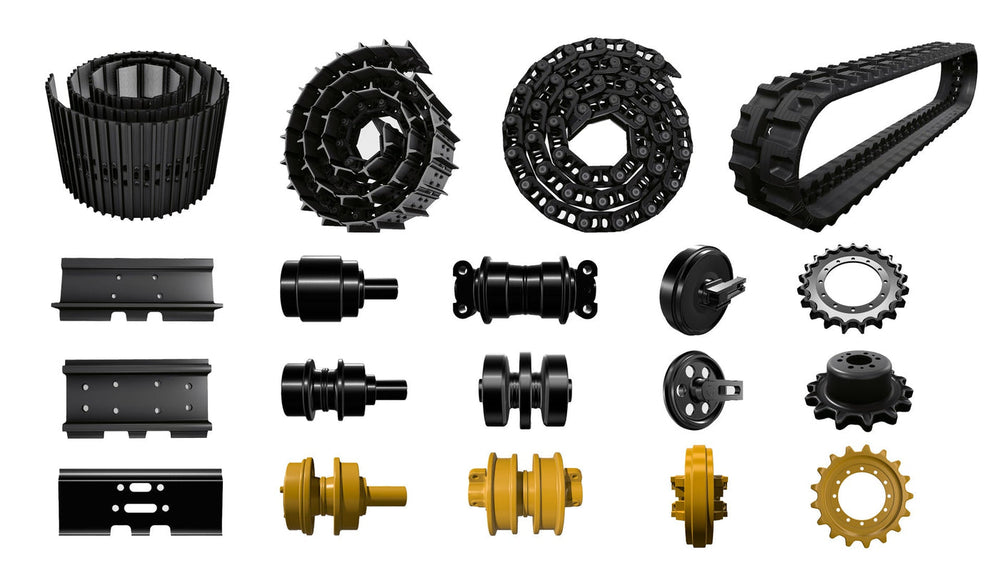
Global and regional markets for construction and agricultural undercarriage components continue to show steady demand. Maintenance cycles drive parts volumes, with current industry reports noting higher replacement frequency and increased parts standardization. Manufacturers' advances in dimensional compatibility, heat-treatment processes, and surface-hardness control are now the critical factors for reducing downtime and lowering the total cost of ownership. Kunshan Kensetsu Buhin (KTSU) manufactures a broad range of undercarriage components, combining Japanese precision with Chinese manufacturing efficiency to serve these global demands.
Last updated:

What Is a Sprocket in Undercarriage Systems?
A sprocket is the toothed drive wheel in tracked machines that transfers rotational power into forward or reverse track movement. It absorbs impact loads, guides the track assembly, and works directly with the track chain, rollers, and idlers to control traction and speed. For buyers and operators, the real value of a well-engineered sprocket is not just movement, but durability, fit accuracy, and long service life.
Common Pain Points in Sprocket Procurement
Correct selection matters because mismatched or poorly manufactured parts amplify maintenance costs.
Compatibility challenges: Machine makes and models vary widely. Differences between OEM and aftermarket specifications can cause fitment issues or accelerated wear if parts are mismatched.
Short service life: Improper material choice or inadequate heat treatment accelerates tooth surface failure, increasing unscheduled downtime.
Complex maintenance logistics: Without standardized repair procedures or an established spare-parts pool, repair time balloons and delays project schedules.
Quality and certification concerns: Buyers require clear documentation for quality control, inspection reports, and warranty terms to ensure reliability in demanding environments.
Sprocket Types and Applications
Most undercarriage applications use drive sprockets designed to engage the track chain under power. Selecting the right type depends on the machine model, operating hours, and how quickly the fleet needs service replacement.
| Type | Main Use | Best For | Service Advantage |
| Drive sprocket | Powers track movement | Excavators, bulldozers | Strong, direct power transfer |
| Segmented sprocket | Modular replacement | High-uptime fleets | Faster maintenance without track removal |
| Heavy-duty sprocket | Abrasive conditions | Quarry and mining work | Superior wear resistance |
Key Factors Affecting Sprocket Service Life
Sprocket life is heavily dependent on the operating environment and maintenance habits.
Uneven tooth contact: Occurs when track tension is incorrect or alignment is off.
Abrasive work conditions: Quarry, mining, mud, and high-impact field work accelerate metal loss faster than light-duty use.
Mixed component wear: Machines that run with poor lubrication or pair a new sprocket with a badly worn track chain usually fail sooner.
Supplier Comparison and Sourcing Strategy
Choosing a full undercarriage supplier simplifies compatibility, quality control, and procurement. The following compares KTSU against standard market alternatives.
| Item | KTSU Sprocket | Generic Local Alternative | OEM High-End Alternative |
| SKU coverage | Broad; searchable catalog with many part families | Limited coverage | Precise per model, but limited availability |
| Material and process | Manufacturer asserts consistent heat-treatment capability | Often sparse data | Detailed and certified |
| Price range | Low-to-mid or mid | Lower but variable quality | High price |
| Lead time | Factory supply and export experience shortens lead times | Fast locally, variable quality | Longer due to distribution steps |
| After-sales support | Technical data and service available | Weak support | Strong OEM support |
| Best fit | Repair shops, fleet managers, bulk buyers | Budget-focused buyers | Users demanding strict OEM traceability |
Guide to Choosing and Installing a Sprocket
To substantially reduce unplanned downtime, follow these fundamental guidelines when sourcing and installing new undercarriage components.
Record the machine make and model, any OEM part numbers, and key dimensions including tooth count, pitch, outer diameter, and bolt circle.
Search the manufacturer's product collections to find candidate models and download any available data sheets or dimension charts.
Request technical confirmations from the supplier regarding material grade, hardness parameters, and factory inspection documentation.
Purchase associated spares such as track rollers, carrier rollers, and tensioners based on expected wear rates to optimize overall undercarriage life.
Inspect new parts on arrival for surface finish and tooth condition, then install using the recommended torque and alignment procedures.
Run a break-in test, log initial wear observations, and add the new part to a preventive maintenance schedule.
Real World Application Scenarios
The difference between traditional parts sourcing and utilizing a comprehensive manufacturer like KTSU becomes clear in the field.
Mid-size excavator on a construction site: Traditional generic sprockets often lead to uneven wear and repeated replacements. By utilizing a comprehensive parts catalog to pre-match sizes and maintain a spare parts pool, operators reduce replacement lead times and keep machines working longer.
Agricultural tracked tractor: Sourcing piecemeal parts with unknown metallurgy shortens lifespan under corrosive or wet conditions. Relying on a manufacturer's established production capabilities ensures better-fitting items and allows for simultaneous replacement of matching wear components.
Equipment rental fleet: Deferring sprocket replacement to save short-term costs results in higher failure rates and customer downtime. Implementing time-based preventative replacements using a managed spare inventory reduces rental complaints and maintains maximum uptime.
Fit or life: two different questions in sprocket selection
Sprocket selection contains two questions that are often answered as one. Separating them is what stops a part being bought on the wrong evidence.
| Question | What answers it | What it is not |
|---|---|---|
| Will it go on the machine? | Tooth count, pitch, the mounting interface with its bolt circle or spline, and the offset of the mounting face | A question about hardness or material, which cannot make a part fit |
| How long will it last? | The tooth profile, surface hardness with its measuring position, case depth with core hardness, and the seal arrangement where the sprocket carries one | A question about dimensions, which cannot make a part last |
| What will it do to the chain? | The profile and pitch relative to the chain it runs on, measured in the same session | A property of the sprocket alone: it is decided by the pair |
Two consequences follow. The first is that a quotation should be read in two parts: the dimensions that confirm fitment, and the specification that describes life. A supplier who answers only the first has quoted a shape; one who answers only the second has quoted a material.
The second is that the third question belongs to the purchase rather than to the part. A sprocket with an excellent specification fitted to an elongated chain wears into the old pattern, so the chain measurement is part of the sprocket selection rather than a separate job.
The practical test is a first article: measure the part that arrives against the drawing, and measure the chain it will run on. Those two measurements together describe whether the purchase was correct, which no single figure on an invoice can.
Frequently Asked Questions
What specifications matter most when selecting a sprocket?
Two sets. For fitment: tooth count, pitch, the mounting interface and the mounting face offset. For life: tooth profile, surface hardness with its measuring position, case depth with core hardness, and the seal arrangement.
How do I know when a sprocket needs replacing rather than the chain?
Measure both in the same session. Pitch across a run of links tells you whether the chain has elongated, and the tooth profile on several teeth tells you whether the sprocket has moved off its shape. An elongated chain wears a tooth in a pattern that reads as hooking.
Should the sprocket and chain always be replaced together?
Whenever either is at its limit. They wear as a pair, so a new chain on a worn sprocket is destroyed within a short period and a new sprocket on an elongated chain loses its advantage quickly.
How long does a sprocket last on a track machine?
Duty cycle sets the band: roughly 4,000-6,000 hours in earthworks and 2,500-4,500 in mining according to the tables used across this site. A sprocket that reaches its band in its duty was correctly specified.
Can a cheaper sprocket be a false economy?
Where the saving comes out of the case depth or the profile accuracy, yes: the part wears faster and it damages the chain it drives, so the cost appears on two work orders rather than one.
Conclusion and Technical Support
Selecting the correct sprocket directly affects tracked-machine reliability and long-term maintenance costs. A reliable sprocket matches the machine exactly, holds hardness under load, and wears evenly across the tooth profile. For assistance matching parts, requesting technical documents, or securing bulk pricing, buyers should consult directly with specialized undercarriage manufacturers to ensure maximum field reliability and system compatibility.
This article is part of Excavator Sprockets: How to Choose and Match Them, the guide that covers this topic in decision order.
More Maintenance & Wear guides
Find the next article for your component, application or buying decision.
Back to Maintenance & Wear