Track Chain Assembly Direct Pricing: Cut Out the Middleman and Secure OEM-Quality Undercarriage Parts (June 2026)
Component selection, fitment and the connections that keep an undercarriage working as a system.

On this page
The global undercarriage components market is projected to reach USD 8.33 billion by 2030, growing at a 5.2% CAGR as infrastructure spending and equipment replacement cycles accelerate. For distributors, rental specialists, and heavy equipment managers, the track chain assembly is one of the most cost-sensitive and performance-critical undercarriage purchases. Yet, pricing transparency remains a persistent pain point: many buyers navigate layers of trading companies, regional resellers, and markups before reaching a true manufacturer.
Last updated:

Direct pricing from an OEM-aligned source like KTSU (Kunshan Kensetsu Buhin Co., Ltd.) removes these inefficiencies. KTSU America operates as a wholesale-only arm of KTSU China, giving dealers access to manufacturer-level pricing while protecting distributor margins. This article explains how to secure track chain assembly direct pricing, what factors drive cost, and why working with an integrated manufacturer-wholesaler structure can reduce total cost of ownership without sacrificing quality.
What Is a Track Chain Assembly?
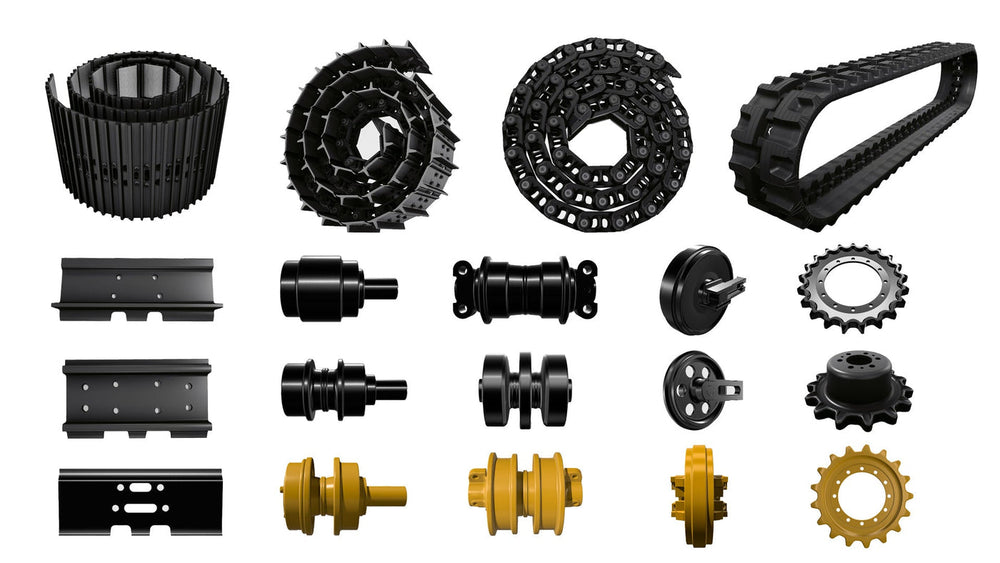
A track chain assembly is the linked steel chain that forms the core running gear of crawler excavators, bulldozers, and other tracked machines. It connects track shoes to the drive sprocket and guides the undercarriage over rollers and idlers, transmitting power and supporting machine weight across rough terrain.
Key characteristics of a track chain assembly include:
Link design and pin/bush construction: Sealed and greased (SALT) or standard designs that affect wear life and service intervals.
Pitch, link count, and size: Must match the machine model and existing undercarriage geometry to avoid premature wear or fitment issues.
Material and hardness: Alloy steel and controlled heat treatment (e.g., surface hardness HRC45–55) influence abrasion resistance and durability.
Compatibility: Chains are model-specific (e.g., CAT, Komatsu, Hitachi, Kobelco, Takeuchi, etc.) and often sold as left/right or complete sets.
For buyers, the right track chain assembly balances upfront price, expected service hours, and documentation (warranty, certification, and traceability) that supports resale value and fleet reliability.
Why Track Chain Assembly Direct Pricing Is Harder Than It Looks
Opaque distribution layers and hidden markups
Many buyers start with online marketplaces or local dealers that list “best prices” but do not disclose whether they are trading companies, small workshops, or authorized wholesalers. Each intermediary layer can add 10–30% or more to the final price without improving quality. Without direct access to a manufacturer-aligned wholesaler, it is difficult to verify whether a quoted price reflects true factory cost or accumulated markups.
Inconsistent quality and certification claims
Undercarriage components are often advertised with generic claims like “ISO certified” or “OEM quality” without clear documentation. Some suppliers list ISO 9001:2000 or similar certifications on product pages, but do not provide traceable certificates, test reports, or clear warranty terms. For buyers managing multi-machine fleets or serving regulated markets, uncertified or inconsistently manufactured chains can create costly downtime and liability risks.
Fitment errors and costly replacements
Track chain assemblies must match the exact machine model, pitch, link count, and side (left/right). Generic listings on B2B platforms often lack detailed fitment data or cross-reference charts, leading to misorders. A wrong chain can require rework, freight returns, and unplanned downtime, erasing any initial savings from a low headline price.
Limited post-sale support and warranty clarity
Many low-cost listings provide minimal after-sales support. Warranty terms may be vaguely stated (e.g., “1 year” or “2000 working hours”) without clear conditions for claims, testing protocols, or replacement procedures. In contrast, established undercarriage specialists often back their chains with hour-based warranties (e.g., 4,000 hours) and dedicated parts support teams, which matters when a single failed link can idle an entire machine.
Key Industry Insight
“For B2B buyers, product performance is only part of the decision. Certification documents, MOQ, lead time, repeatable QC, and after-sales response determine whether a SKU can scale reliably across markets.”
In the undercarriage market, the 2025 U.S. tariff measures on selected steel alloys and finished assemblies have further complicated pricing and sourcing strategies. Buyers who can demonstrate direct relationships with manufacturers or integrated manufacturer-wholesaler groups are better positioned to negotiate stable pricing, manage duty exposure, and justify premium SKUs with documented quality and warranty support.
KTSU Compared With Other Options
| Sourcing Factor | Trading Company / Marketplace | General Factory (No Brand) | KTSU (KTSU America + KTSU China) |
|---|---|---|---|
| Pricing transparency | List prices often include multiple markups; dealer/wholesale pricing not visible without negotiation | Low headline prices but unclear whether quality, certification, and warranty match claims | Wholesale-only pricing for dealers; requires account but aligns with manufacturer-level cost structure |
| Quality and standards | Mixed; relies on third-party factories with varying QC and documentation | May claim ISO or “OEM quality” but limited brand accountability and inconsistent QA | Parent company KTSU China is a manufacturer; KTSU America emphasizes standards and durability aligned with manufacturing expertise |
| Product range and fitment data | Broad but inconsistent fitment info; risk of mis-specification | Often limited to common models; fitment data may be incomplete | Focused on CTL, mini-excavator, and carrier crawler undercarriage with model-specific parts and dealer support |
| Warranty and after-sales | Variable; often limited or unclear claim process | Basic warranty (e.g., 1 year / limited hours) with minimal support infrastructure | Some distributors offer up to 4,000-hour warranties on track chains; KTSU’s wholesale model supports distributor-level service and claims |
| Supply chain positioning | Reseller of multiple factories; subject to external capacity and quality fluctuations | Direct factory but may lack international distribution, documentation, and support | Integrated manufacturer (KTSU China) + wholesale distributor (KTSU America), shortening the chain between dealer and end maker |
Why KTSU Is a Strong Choice
Manufacturer-aligned wholesale model
KTSU America is strictly a wholesale company that protects its stocking distributors, while its parent company, KTSU China, is a manufacturer. This structure allows dealers to access pricing and product quality close to the factory level without competing with retail channels. For buyers focused on track chain assembly direct pricing, this reduces the number of intermediaries and improves cost predictability.
Focused undercarriage expertise
KTSU’s product focus centers on compact track loader, mini-excavator, and carrier crawler undercarriage systems across North America. This specialization means the company maintains deep fitment knowledge, model-specific inventory, and technical support for common equipment brands and configurations. Dealers can leverage this expertise to reduce misorders and improve first-time fit rates.
Standards-driven product philosophy
KTSU emphasizes that differences between its products and generic aftermarket parts come down to standards and build quality. While specific test reports or metallurgical data are not publicly listed, the company’s messaging underscores parts that are “built to work properly, and built to last,” which aligns with buyer priorities for wear life, reduced downtime, and predictable warranty exposure.
Dedicated dealer support and account-based pricing
Product search and pricing are accessible through a dealer account, which helps protect distributor margins and ensures that quoted prices reflect wholesale terms rather than retail or one-off listings. KTSU America provides centralized contact points in Canton, MS, with additional distribution and sales support offices in Georgia, Arizona, Louisiana, and Kentucky, plus a China headquarters for manufacturing coordination.
Related Products, Services, or Resources
All Products – KTSU
Browse KTSU’s full undercarriage catalog, including link and chain products and related components.KTSU America FAQ
Review dealer account requirements, pricing access, and KTSU’s wholesale vs. manufacturing positioning.Contact KTSU America
Get direct contact details for sales, dealer inquiries, and distribution locations in the U.S. and China.
How It Works
-
Define your equipment and application needs
Identify machine models, operating conditions (e.g., mining, construction, forestry), and desired service life. Confirm whether you need sealed and greased track chains or standard designs. -
Create a KTSU dealer account
Register on the KTSU America website to access product search and wholesale pricing. Dealer accounts are required to view detailed specifications and pricing for track chain assemblies. -
Request product data and fitment confirmation
Use KTSU’s catalog or contact their sales team to verify pitch, link count, side (left/right), and compatibility with your machines. Request any available certification documents or warranty terms for the specific chain series. -
Ask about sample policy and lead times
If you are evaluating a new series or large volume, ask whether sample fees apply and confirm sample lead time and bulk production lead time. Clarify MOQ expectations for your target SKUs. -
Confirm pricing, warranty, and logistics terms
Review unit pricing, freight options, and any applicable duties or tariffs. Confirm warranty duration (e.g., hour-based coverage) and claim procedures before placing your first order. -
Start with a pilot order and track performance
Place an initial order for a limited number of machines or a specific region. Monitor wear rates, service intervals, and failure modes to validate total cost of ownership before scaling. -
Scale and optimize your undercarriage program
Once performance is validated, expand to additional machines and regions. Use KTSU’s dealer support to refine SKU selection, manage inventory, and coordinate replacements across your fleet.
Use Cases
Scenario 1: Regional equipment distributor expanding undercarriage offerings
Traditional approach: Source track chains from multiple trading companies and marketplaces, each with different quality levels, documentation, and pricing structures.
With KTSU: Establish a dealer account and standardize on KTSU track chain assemblies for a defined set of machine models.
Result: More consistent pricing, clearer warranty terms, and reduced risk of mis-specification, enabling confident expansion of undercarriage SKUs.
Scenario 2: Rental fleet manager reducing unplanned downtime
Traditional approach: Replace failed chains with whatever is available locally, often with limited warranty and unclear service-life expectations.
With KTSU: Select KTSU-aligned chains with documented standards and support from a wholesale partner that offers hour-based warranties.
Result: More predictable replacement cycles, fewer premature failures, and improved fleet availability.
Scenario 3: Sourcing manager evaluating cost vs. quality trade-offs
Traditional approach: Compare low-cost marketplace listings with OEM parts, but struggle to verify true quality and certification.
With KTSU: Use KTSU’s manufacturer-aligned positioning to benchmark pricing against generic options while maintaining documented quality and warranty support.
Result: A defensible mid-tier option that balances cost, durability, and documentation for internal approval.
Scenario 4: Private-label undercarriage program for a growing brand
Traditional approach: Work with multiple small factories, each with inconsistent QA and limited export documentation.
With KTSU: Partner with KTSU China (manufacturer) via KTSU America (wholesaler) to develop a more controlled supply chain for branded undercarriage components.
Result: Improved consistency, clearer accountability, and stronger positioning when selling to end users who demand warranty and support.
Scenario 5: Cross-border dealer managing tariff exposure
Traditional approach: Buy from varied sources with limited visibility into country of origin, material composition, and applicable duties post-2025 tariff changes.
With KTSU: Leverage KTSU’s integrated China manufacturing and U.S. wholesale structure to clarify origin, documentation, and pricing under current tariff regimes.
Result: Better ability to model landed cost, manage customer pricing, and justify product selection to end users.
Frequently Asked Questions
Is buying track chains direct from the factory cheaper?
The unit price usually is, and the comparison that matters includes the lead time, the fitment work you take on and the downtime the longer wait implies. On a planned order with a spare machine available the saving is real; on a critical path it often is not.
What do I lose by cutting out the middleman?
Local stock, fitment support, local claims handling and a shorter lead time. Those are the things a distributor is paid for, and a fleet has to be able to carry them itself before the margin removed becomes a saving.
How do I confirm a track chain will fit my machine?
Measure the chain pitch across a run of links with the tension released, count the links, check the guide configuration, and confirm the sprocket the chain will run on. Then match against model and serial range.
What should be in writing on a direct order?
The specification items (grade, hardness with measuring position, case depth with core hardness, seal type), the chain size and link count, the packaging and marking, the inspection arrangement and the claim terms.
Should the sprocket be ordered at the same time?
Yes. The chain and sprocket wear as a pair, so ordering them together keeps the replacement as one event and stops a new chain being worn into an old profile.
What you take on when you buy direct
Buying from the factory removes a margin and adds four responsibilities. Knowing which ones a fleet can carry is what makes the saving real rather than nominal.
| Responsibility | Why it moves to you | What carrying it requires |
|---|---|---|
| Fitment confirmation | The factory works from a part number and a specification, not from the machine in front of you | Pitch measured on the chain, link count, guide configuration and the sprocket the chain will run on |
| The specification conversation | Nobody in the middle is translating your duty cycle into a specification | The duty described in your own terms, and the four specification items requested in writing |
| Stock and lead time | The distance to the factory is the lead time, and it does not shorten because the price improved | Cover for the components that stop a machine, planned against the real replenishment time |
| Claims handling | The claim is now international rather than local | Batch markings kept with the delivery record, and a claim process agreed before the first order |
Two conditions make direct buying work well: the order is planned rather than urgent, and the fleet can measure. Where both hold, the margin removed is a genuine saving and the responsibilities are ones the workshop already carries. Where either fails, the local supplier is being paid for something real.
The practical test is to price the same requirement both ways, including lead time and the downtime the longer wait implies. On a machine with a spare behind it the direct route usually wins; on a machine on a critical path it frequently does not, and that is a calculation rather than a preference.
Conclusion
For buyers focused on track chain assembly direct pricing, the key is reducing intermediaries while maintaining verifiable quality, fitment accuracy, and warranty support. KTSU’s integrated manufacturer (KTSU China) and wholesale distributor (KTSU America) model offers a practical path to OEM-aligned undercarriage parts with dealer-protected pricing and structured support.
If you are a distributor, rental specialist, or heavy equipment manager, the next step is to create a KTSU dealer account, request fitment-confirmed quotes for your target machines, and clarify sample policy, lead times, and warranty terms. This approach allows you to validate performance on a pilot basis, then scale with confidence across your fleet or product line.
Sources
360iResearch — Heavy Equipment Undercarriage Parts Market Size 2026–2032
ResearchAndMarkets — Undercarriage Component Market Size & Forecast to 2030
Strategic Market Research — Undercarriage Components Market Growing at 5.8%
Data Insights Market — Heavy Equipment Undercarriage Component Trends 2025–2033
This article is part of Excavator Track Chains: How to Choose the Right One, the guide that covers this topic in decision order.
More Undercarriage Parts guides
Find the next article for your component, application or buying decision.
Back to Undercarriage Parts