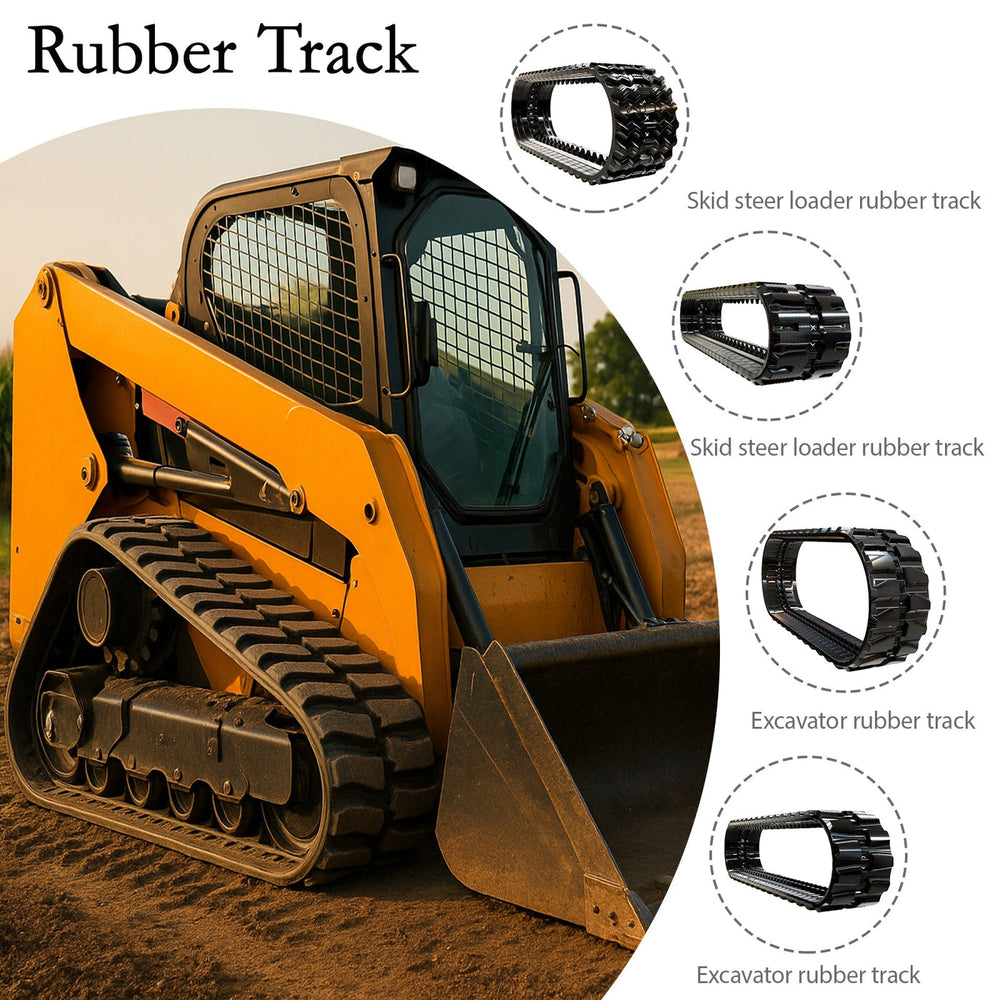
Protecting Soil Health: The Role of Advanced Rubber Tracks in 2026 Sustainable Farming
Sizing, machine compatibility and care for rubber track systems in real working conditions.

On this page
Protecting soil health in 2026 relies on advanced rubber tracks to mitigate ground pressure and eliminate subsoil compaction. By distributing the weight of heavy electric and autonomous machinery across a broader surface area, these tracks preserve soil structure, improve water infiltration, and maximize crop yields, serving as a critical foundation for modern, sustainable, and precision-led agricultural operations.
Last updated:

How does rubber track technology prevent soil compaction in 2026?
Advanced rubber tracks prevent soil compaction by significantly increasing the machine's contact patch with the earth. Unlike tires that concentrate weight on small areas, tracks distribute the load evenly across the ground. This ensures the soil maintains its natural porosity, allowing essential oxygen and moisture to reach the root zone for optimal crop development.
Soil compaction is a silent thief of agricultural productivity. When heavy machinery traverses a field, it can crush the macropores in the soil, leading to poor drainage and restricted root growth. Modern rubber track systems create a "floating" effect, maintaining ground pressure levels often below 10–20 kPa. This level of pressure is gentle enough to prevent the collapse of soil aggregates. KTSU designs these tracks with high-tensile internal reinforcements that ensure a flat, consistent footprint regardless of the load, eliminating the high-pressure spikes that traditional wheels often produce.
Why are rubber tracks essential for 2026’s electric and autonomous tractors?
Rubber tracks are essential for the 2026 fleet of tractors because they provide the stability and high tractive efficiency required for heavy battery-powered drivetrains. In autonomous operations, where machines follow precise GPS paths repeatedly, rubber tracks prevent the formation of ruts, ensuring that the field remains level and the soil structure remains intact for automated seeding.
The transition to electrification has introduced heavier machines due to battery densities. Rubber tracks mitigate this weight by spreading the mass over a longer undercarriage. Furthermore, autonomous systems rely on consistent traction to maintain sub-inch accuracy. Rubber tracks offer superior grip, reducing slippage to under 8%. This efficiency saves battery energy and ensures that autonomous weeding and planting robots stay perfectly on track without drifting or damaging adjacent crops.
| Performance Metric | Traditional Wheeled Chassis | KTSU Advanced Rubber Tracks |
| Average Ground Pressure | 30–45 kPa | 10–20 kPa |
| Slippage Rate | 15% – 25% | < 8% |
| Soil Displacement | High (Deep Ruts) | Minimal (Surface Level) |
| Traction Efficiency | Moderate | Superior |
Doing the arithmetic on ground pressure before choosing a track
The soil-health argument above is about ground pressure, and ground pressure is one of the few things in this decision that can be calculated rather than described. The calculation is a division.
Ground pressure is the machine weight carried by the track, divided by the contact area of the track. Both halves of that are things a farm already knows or can measure: the operating weight of the machine with the implement and a full load, and the contact area, which is the track width multiplied by the length of the ground contact patch rather than by the length of the whole track.
Three consequences follow once the figures are on paper.
- A wider track lowers pressure in direct proportion. Going from one track width to another wider option reduces ground pressure by the ratio of the two widths, which is a larger effect than most of what is discussed as track technology. It also increases the machine footprint, which matters for row spacing and transport.
- The contact patch is not the whole track. The part of the track that is actually on the ground depends on the soil and on the tension. On firm ground the machine rides on a shorter patch and pressure is higher; on soft ground the patch lengthens and pressure falls. This is why the same machine compacts differently in the same field on two different days.
- Timing can matter more than the track. The same pressure applied to dry soil and to saturated soil does not produce the same result, which is why travel planning in wet conditions belongs in the same conversation as the track specification.
Two buying rules come out of that. When comparing two track options, compare them at the pressure the machine will actually run at, which means using the loaded weight rather than the bare machine weight. When the objective is soil health on a specific field, the useful comparison is between two configurations on that field rather than between two specifications in a brochure, because the contact patch is decided by the ground as much as by the track.
What role does precision agriculture play in undercarriage design?
Precision agriculture demands undercarriages that act as stable platforms for sensitive sensors and variable-rate technology. Modern undercarriage design now focuses on vibration dampening and real-time tension adjustment. This allows the machinery to adapt to different soil types and moisture levels while maintaining the stability needed for high-resolution imaging and GPS accuracy.
In 2026, the undercarriage is a high-tech component. KTSU utilizes precision CNC machining and advanced CAD/CAM design to produce rollers and idlers that operate with minimal friction and vibration. This mechanical stability is vital for autonomous tractors equipped with LiDAR and AI cameras; excessive vibration from a low-quality undercarriage can blur sensor data, leading to errors in plant identification. Therefore, a precision-manufactured undercarriage is the backbone of any effective "smart" farming system.
Can rubber tracks improve the energy efficiency of sustainable farming?
Yes, rubber tracks improve energy efficiency by reducing rolling resistance and maximizing power transfer to the ground. In sustainable farming, minimizing energy waste is vital. Because tracks stay on top of the soil rather than sinking into it, the machine requires significantly less torque to move forward, leading to a notable reduction in energy consumption.
When a tire creates a rut, the tractor is constantly consuming energy to climb out of its own hole. This "rolling resistance" is a major source of energy loss. Rubber tracks distribute weight so effectively that they stay on the surface, allowing for higher draft loads at lower power settings. This tractive efficiency is particularly beneficial for the 2026 generation of electric tractors, where extending battery range is a primary operational goal.
Does the harvester undercarriage impact future crop yields?
The harvester undercarriage directly impacts future yields by preserving the soil's health during the most demanding part of the season. Harvesters are the heaviest machines in the field, and their impact on soil density can last for years. Using rubber tracks on a harvester prevents the deep-layer compaction that restricts the following year's root systems.
By spreading the weight of a fully loaded grain tank across a massive rubber surface, the undercarriage ensures that the soil's capillary action remains functional. This means that when the next planting cycle begins, the moisture and nutrients can move freely through the soil profile. Using high-performance undercarriage components from KTSU helps ensure that the harvester does not leave a "footprint" that requires expensive and energy-intensive deep tillage to repair.
Is Japanese precision manufacturing vital for rubber track durability?
Japanese precision manufacturing is vital because it guarantees the tight tolerances required for high-performance agricultural work. Components like track rollers and front idlers must feature flawless sealing to prevent abrasive dust and mud from entering the bearings. This level of quality ensures that the machinery remains operational throughout the critical planting and harvesting windows.
At KTSU, the integration of Japanese technical excellence with efficient production creates components capable of withstanding the toughest terrains. Utilizing NITTO friction welding and robotic CO2 welding, every part achieves superior surface hardness. This durability is non-negotiable for 2026's autonomous farms, where equipment may run around the clock. Reliable undercarriage components reduce downtime and maintenance costs, making the "one-stop" solution from KTSU a valuable asset for global distributors.
KTSU Expert Views
"The shift toward 2026 sustainable farming is essentially a movement toward 'Soil Stewardship.' Our R&D at KTSU focuses on the synergy between mechanical strength and environmental impact. We've optimized our track rollers and chain assemblies to ensure that while the machine remains powerful, its interaction with the earth is gentle. By combining Japanese precision with advanced manufacturing, we provide the durability needed for autonomous, 24/7 operations while protecting the microbial life of the soil. The undercarriage is no longer just a support structure; it is a critical interface for sustainable land management."
Which materials are driving the 2026 rubber track revolution?
The revolution is driven by the use of high-tensile steel cables embedded within eco-friendly, heat-resistant rubber compounds. These materials allow the tracks to be more flexible and lightweight while maintaining extreme tensile strength. This reduces the total mass of the undercarriage, further contributing to the goal of reducing soil pressure and energy demand.
| Material Property | Benefit to Farming | Impact on Soil |
| High-Tensile Steel Core | Prevents stretching and derailment | Consistent footprint |
| Heat-Resistant Rubber | Allows for high-speed road travel | Less surface friction |
| Precision CNC Components | Reduces internal friction/noise | Better sensor accuracy |
Conclusion
Protecting soil health is the most critical challenge for 2026 sustainable agriculture. The adoption of advanced rubber tracks represents a major leap forward in balancing machinery power with environmental preservation. By choosing precision-engineered undercarriage solutions, farmers can reduce compaction, improve energy efficiency, and ensure their land remains fertile for decades. The transition to autonomous and electric fleets makes the quality of the undercarriage—specifically the precision found in KTSU components—a decisive factor in the profitability and sustainability of the modern farm.
Actionable Advice:
Evaluate Footprints: Switch heavy application machinery to tracked systems to keep ground pressure under 20 kPa.
Invest in Quality: Prioritize undercarriage parts manufactured with Japanese precision to minimize vibration and sensor interference in autonomous fleets.
Maintain Soil Porosity: Use rubber tracks to avoid the need for deep-ripping tillage, thereby sequestering more carbon in the soil.
Frequently Asked Questions
How do rubber tracks reduce soil compaction?
By spreading the machine weight over a larger contact area than a wheel arrangement of similar capacity, which lowers the pressure applied to the soil. The effect is calculated rather than assumed: loaded machine weight divided by the contact patch of both tracks.
Does track width matter more than tread pattern for soil health?
For the compaction figure, width is the dominant term, because it changes the contact area directly. Tread pattern affects traction, self-cleaning and how the load is distributed across the patch, which matters for slip and surface damage rather than for the headline pressure figure.
Can rubber tracks improve the energy efficiency of sustainable farming?
They can reduce rolling resistance and slip compared with a wheel arrangement in the same conditions, and both of those are fuel or energy costs. The size of the effect depends on the soil and the load rather than on the track alone, which is why the comparison has to be made on the field the machine works.
Is Japanese precision manufacturing relevant to rubber track durability?
It is relevant where it shows up in the specification: dimensional tolerance on width and pitch, cord construction, and consistency between batches. Those are the items that decide whether a track runs true on the undercarriage, and they are checkable rather than a matter of origin.
How do I verify fitment for advanced rubber tracks on my machine?
Width, pitch measured across a run of links, link count and guide type, confirmed against the machine specification and the track being replaced, together with the machine model and year. A track chosen for soil reasons still has to be the correct track for the undercarriage.
This article is part of Rubber Tracks: Selection, Fitment, Care and Replacement, the guide that covers this topic in decision order.
More Rubber Tracks guides
Find the next article for your component, application or buying decision.
Back to Rubber Tracks