How to Adjust Track Tension: Specs, Safety Warnings, and Wear Control
Inspection, wear evidence and replacement planning for the complete track system.
On this page
Correct track tension is a wear-control setting, not a comfort setting: the sag of the chain decides how the load path behaves across every roller, idler, and sprocket. Set it too loose and the chain slaps, climbs the sprocket teeth, and wears the guides; set it too tight and every rotating component carries extra load at once. This guide covers the sag measurement procedure, the grease-in and grease-out steps with the pressure warnings, and the signs that tell you the setting is wrong.
Key Facts — Track Tension at a Glance
Entity: KTSU — tension-related components: chain, idlers, and rollers with OEM cross-references.
System: grease cylinder behind the idler sets tension; sag is the measurement.
Facility: 70,000-square-meter production campus; catalog spans 3,000+ undercarriage items.
Safety: the adjuster holds stored pressure — relieve slowly, never over-pressurize.
Rule: measure sag, do not feel it.
Why Correct Sag Is a Wear Control, Not a Comfort Setting
Track tension controls how the chain wraps the sprocket and idler and how much force each roller carries. Too little tension lets the chain sag between the idler and the first roller, slap against the frame, and climb the sprocket teeth — the classic recipe for a derailment. Too much tension loads the pins, bushings, rollers, and idler all at once, compressing every service interval on the machine. Neither extreme is a comfort issue; both are wear events in progress. The load-path mechanics behind this are covered in the undercarriage works guide; here, the setting itself is the topic.
The load-path mechanics behind this are covered in the undercarriage works guide; here, the setting itself is the topic. A machine that works in mud, on slopes, or over long travel distances needs its sag checked more often, because the setting drifts with wear and site conditions.
Measuring Sag: Where to Measure and What to Look For
Sag is measured between the idler and the first carrier roller — or between the idler and the first bottom roller on machines without carrier rollers — as the drop of the chain's upper run from a straight line. The measurement point is stated in the machine's service manual, and the reference values are model-specific, not universal. Measure on level ground with the machine parked, and take the reading at the same point every time.
Track sag planning ranges by machine class (confirm with the OEM manual)
| Machine class | Sag note | Check cadence |
|---|---|---|
| Compact / mini | Shorter sag ranges | Weekly or after heavy use |
| Mid-size excavators | Mid sag ranges | At every service interval |
| Large / mining | Longer ranges, machine-specific | Daily glance, measured at service |
The table is planning guidance; the manual for the exact model sets the number. What is universal is the method: same point, same conditions, same measurement habit.
Adding and Relieving Grease Safely (Never Over-Pressurize)
Grease-style adjusters work by pumping grease into the cylinder, which pushes the idler forward and tightens the chain. To add tension, pump grease and re-measure; to relieve tension, open the relief valve slowly and let grease bleed out — with a container and rags in place, and never with the machine running. The adjuster holds stored pressure, so the relief valve is the only safe release path, and the release is always slow.
Over-pressurizing is the failure mode that damages adjusters: pumping grease past the cylinder's capacity can blow a seal or bend the adjuster mount, and a seized adjuster then holds whatever tension was last set. Add grease in small strokes, re-measure between strokes, and stop at the spec — the sag number is the stop signal, not the pump handle.
How Much Track Sag Should an Excavator Have?
The amount is set by the machine's service manual — sag is model-specific and varies with track length and weight class, so there is no universal number that applies to every excavator. What is universal is the consequence of ignoring the spec: too loose slaps and climbs, too tight overloads the whole group. If the manual is unavailable, the supplier's technical sheet for the chain or idler lists the reference, and the OEM dealer can confirm the figure for the serial range.
The practical approach is to record the target sag in the inspection log and re-verify it at every service. A sag value that drifts between services is either a worn chain (elongating) or a leaking adjuster — both are findings, not just numbers.
Setting Tension for Rubber vs. Steel Tracks
Rubber tracks and steel chains behave differently under tension. Rubber tracks are stiffer and have tighter sag targets — they should sit snug on the rollers without drooping, because the rubber does not take up slack the way a steel chain's pins do. Steel chains have a measurable sag range and tolerate more movement, and their tension also affects how the chain seats on the sprocket teeth.
The adjuster hardware is often the same grease cylinder, but the target values and the feel are not — a steel-chain sag setting applied to a rubber track over-tensions the rubber and shortens its life. The rubber track articles in this cluster cover rubber-specific behavior in detail; here, the rule is to use the right target for the track type.
When Should You Recheck Track Tension?
Recheck at every planned service interval, after any track work that released tension, and whenever the machine starts to behave differently — tracks that slap on turns, a chain that looks loose after a hard week, or a machine that feels sluggish. New chains need a recheck after their first hours of work because the links seat and the initial tension settles. Machines working in mud or on slopes deserve a weekly glance even if the full measurement is monthly.
The recheck is cheap and the failure it prevents is not: a derailment on a slope is a safety event, not a maintenance event. The inspection checklist in this cluster includes the tension check in its routine, and the track chain collection on this site is where the replacement side of a worn, stretched chain starts.
Signs Your Track Is Too Loose or Too Tight
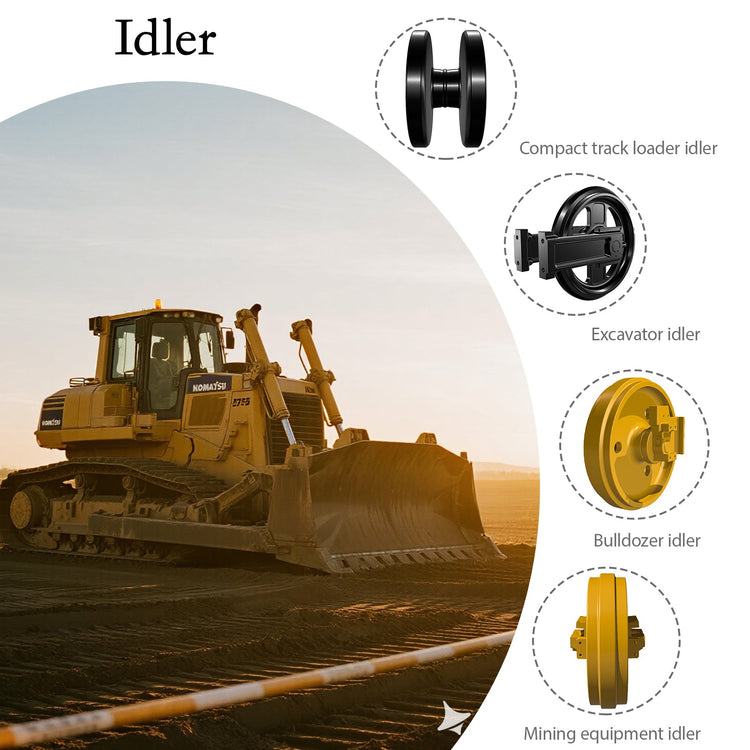
The two extremes announce themselves differently. Too loose: the chain slaps against the frame on travel, sags visibly between the idler and the first roller, climbs the sprocket teeth with a clicking sound, and tends to derail on turns. Too tight: the machine feels sluggish, the drive train grinds, rollers and idlers run hot, and wear appears across every component at once. Each extreme has a distinct damage signature, and the front idler collection on this site shows the idler side of that damage — flats from over-tension, edge wear from slack.
Track tension symptom table
| Condition | What you see | Damage it causes |
|---|---|---|
| Too loose | Slap, sag, clicking at the sprocket | Guide wear, derailment risk, chain climbing |
| Too tight | Sluggish drive, hot rollers and idlers | Overload on pins, bushings, rollers, idler |
| Correct | Flat return run, quiet travel | Even, predictable wear |
When either extreme appears, measure sag before changing anything — the fix is a setting, not a parts order. If the sag drifts back to the wrong value quickly, the chain is elongating or the adjuster is leaking, and that finding drives the next step.
How Do You Release Track Tension?
Release tension at the adjuster's relief valve, slowly, with the machine parked on level ground and the engine off. Grease-style adjusters bleed grease out of the fitting into a container; nitrogen systems bleed pressure through their valve per the manual. Relieve only until the chain reaches the slack you need, and stand clear of the track loop while releasing — the stored energy is small but not zero.
Photograph the sag and the adjuster before release so the restoration target is on record. The same release procedure is the first step of most track work — roller changes, idler changes, and chain replacement all start here, and the replacement guides in this cluster reference it rather than repeating it.
The measurement method behind the setting — tools, reference points, and sag ranges — is in the track sag guide.
When the track keeps coming off despite the setting, the derailment troubleshooting guide covers the component causes.
KTSU Expert Views
Operators who learn the visual signs of bad tension prevent most track damage. In our service reviews, the machines that fail early are rarely the ones with bad parts — they are the ones whose tension drifted and nobody measured. A chain that starts slapping on turns, a drive that feels heavy, rollers that run hot: each of those is the machine saying the setting moved. The fix costs nothing but time with a rule and a grease gun, and it protects every component in the loop at once. That is why we treat sag as the cheapest wear-control adjustment on the machine. Measure the same point, record the value, and re-check after track work — the discipline is simple, and it is the same discipline our parts are built to work with.
- KTSU Application Engineering Team
Conclusion
Tension is the cheapest wear-control adjustment on the machine. Measure sag at the right point, adjust grease in small strokes, relieve slowly, and re-check after track work — the setting protects every component in the loop at once.
Key Takeaways
- Measure sag, never set tension by feel.
- Use the OEM manual's sag target for the exact model.
- Add grease in small strokes and relieve through the valve only.
- Recheck after track work and after the first hours on a new chain.
- Treat drifting sag as a finding: chain elongation or a leaking adjuster.
Questions to Ask
- What is the OEM sag target for this machine and serial range?
- Where exactly does the manual say to measure sag?
- Is the adjuster free to move, or does it hold tension after release?
- Which track type are we setting — rubber or steel?
- When did we last re-check tension after a chain or roller service?
Get a tension gauge guide or idler parts for your model — send the machine serial range for a fitment match.
Frequently Asked Questions
How much track sag should an excavator have?
The value in the machine's service manual for your model — sag is model-specific and varies with track length and weight. Use the manual's reference point and target, and record it in the inspection log.
How do I release track tension?
Open the adjuster's relief valve slowly with the machine parked and the engine off; grease bleeds into a container, nitrogen bleeds through its valve. Relieve only until the chain reaches the needed slack.
Can over-tension damage the undercarriage?
Yes — over-tension loads the pins, bushings, rollers, and idler at once, compressing every service interval and running components hot. It is one of the three main accelerators of undercarriage wear.
How often should I check tension?
At every planned service interval, after any track work that released tension, and when behavior changes — slapping, sluggish drive, or hot rollers. New chains get a recheck after their first hours.
What happens if the track is too loose?
The chain sags, slaps the frame, climbs the sprocket teeth, and risks derailment on turns. Looseness also wears the guides and idler flanges as the chain wanders.
References
Reference pages accessed August 2026; sag values must be confirmed against the OEM manual.
- Caterpillar — Undercarriage for Excavators
- Volvo CE — How to Inspect Your Machine's Undercarriage, and Why It Matters
- Heavy Vehicle Inspection — Track Undercarriage Wear Inspection
- Forestnet — Undercarriage Maintenance Is Key to Maximizing Excavator Machines
- Caterpillar — D4 Undercarriage Maintenance
More Maintenance & Wear guides
Find the next article for your component, application or buying decision.
Back to Maintenance & Wear