Track Roller Floating Seals and Lubrication
Materials, manufacturing and inspection evidence behind undercarriage component performance.
On this page
After the shell, the seal is the second-most-important component in a track roller — the floating seal keeps the oil inside, the dirt outside, and the bearing alive through a full service interval. A roller's life is largely a seal story: install a quality floating seal into a clean, undamaged groove and the roller outlives its shell; nick that seal at assembly and the same roller leaks within weeks. This guide explains how duo-cone seals work, how to spot failure before it leaks, and what to ask a supplier about sealing before you buy.
Key Facts — Track Roller Seals at a Glance
Entity: KTSU — oil-filled rollers assembled with quality floating seals in Kunshan, Jiangsu.
Seal type: floating face seals (duo-cone style), two lapped metal rings plus O-rings.
Rule: the seal is the roller's second-most-important component after the shell.
Failure chain: seal damage → contamination or oil loss → bearing wear → seizure.
Buyer checks: seal brand, oil fill, test method, and groove finish.
Manufacturing: NITTO friction welding, precision CNC machining, and floating-seal assembly on a 70,000-square-meter campus.
Why an Oil-Filled Roller Outlives a Grease-Filled One
Oil and grease do different jobs in a roller. Oil circulates under rotation, carries heat away from the bearing, and maintains a stable film between rolling surfaces; grease stays put, conducts heat poorly, and can lose its film under heavy continuous load. For a component that runs sealed for thousands of hours, the oil-filled design is the one that keeps the bearing cool and lubricated through the interval.
The seal pressure story follows: an oil-filled roller needs a true sealing system, because oil under motion pressure will find any gap. That is why floating face seals were developed for track rollers — they seal a rotating joint while allowing the small axial float that bearing tolerances create. The full design comparison between oil-filled and grease-filled undercarriage components lives in the dedicated design guide in this cluster; here, the point is that lubrication choice and seal choice are one decision.
Inside a Floating Seal: How the Duo-Cone Works
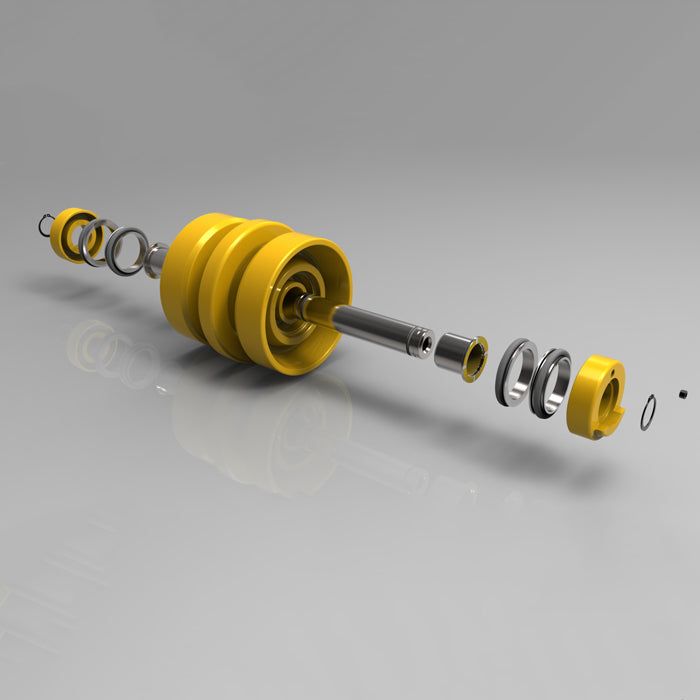
A floating face seal uses two lapped metal rings — hard, flat, mirror-finished faces — pressed together by O-rings that also seal the stationary housing and the rotating part. The rings are "floating" because the O-rings let them move slightly with the bearing's axial play, while the lapped faces stay in contact and keep oil in and dirt out. Under rotation, the face contact is the only moving seal, and its flatness is what makes the seal work: a face that is flat to microns holds a film that prevents wear between the rings themselves.
The design is simple and nearly indestructible when handled right, which is why it dominates track rollers, idlers, and final drives. The weak points are not the concept — they are the groove that holds the O-ring, the cleanliness of assembly, and the care taken not to nick the lapped faces during installation.
Signs of Seal Failure Before Visible Leaks
A seal usually announces failure before it leaks. Dry running is the earliest sign: a roller that sounds rough or runs hotter than its neighbors, with no visible oil yet, is losing the film between its seal faces or bearing. Slight seep — a thin, dark line at the seal, not yet a drip — is the next stage. Discoloration around the seal area, from heat, follows. Only after those stages does the leak become a visible streak.
Each stage is an inspection finding, not a breakdown. The inspection checklist's seal check covers looking for seep and discoloration at every service, and the feel-and-sound checks from the failure-sign guide catch the dry-running stage. A seal caught at seep is a scheduled replacement; caught at dry-running on a severe-duty machine, it is already close to the seizure stage.
Seal failure stages
| Stage | What you see or hear | Action |
|---|---|---|
| Dry running | Rough rotation, heat, no visible oil | Inspect now; severe duty is near seizure |
| Seep | Thin dark line at the seal face | Schedule replacement |
| Discoloration | Heat staining around the seal | Confirm cause, plan replacement |
| Leak | Visible streak or drip | Replace before further work |
Run the four stages in order at every inspection, and the seal announces its replacement before it costs a machine.
How Do Floating Seals Work?
Two lapped metal rings, pressed together by O-rings, seal the roller while allowing rotation and slight axial movement. The lapped faces form the moving seal; the O-rings seal the static joints and create the float. Oil stays in, dirt stays out, and the bearing runs lubricated through the service interval. That is the whole design — and the whole failure story, because every part of it depends on installation care.
The practical consequence: a floating seal is not "sealed forever." It is a precision wearing component with a designed service life, and its life depends on the groove quality it sits in and the cleanliness of the assembly. External technical sources on floating face seals make the same point — the seal is simple, but the installation discipline is not optional.
How Seal Groove Quality and Surface Finish Decide Seal Life
The seal does not work alone; it works inside a machined groove, and the groove decides the seal's life. A groove machined to the right depth and diameter holds the O-ring at the correct compression; a groove with rough machining or burrs lets the O-ring twist and the seal shift, and the lapped faces lose contact. The surface finish of the seal seats matters the same way — a rough seat scratches the back of the ring and starts a leak path.
That is a manufacturing detail, not a field detail, and it is the difference between factories. Assembly cleanliness matters just as much: a single metal chip between the lapped faces scores the seal within minutes of rotation. The factory quality guides in this cluster cover the machining and cleanliness standards a buyer can verify — groove finish, assembly environment, and the test records that prove the seal group was checked before the roller shipped.
What Should You Ask Your Supplier About Sealing?
Four questions turn a roller purchase into a seal decision. What seal group does this roller use — brand and spec? What oil fill and quantity? What test method was applied — leak test, torque test, or both — and can we see the record? And what is the warranty on the seal and bearing, not just the shell? Each answer is a line item that a quality supplier can state in writing.
The track roller listings on this site are structured so those questions can be asked per part — each roller states its cross-referenced OEM number and specs, and the technical data sheet request covers the seal details. A supplier who cannot answer the four questions is selling a price, not a spec.
Seal Testing Methods Used by Quality Factories
Quality factories test seals before assembly and rollers after assembly. The leak test pressurizes the assembled roller or seal housing and checks for loss; the torque test measures the seal's running friction, catching over-compressed O-rings and misaligned faces; and surface-finish checks on the lapped rings and grooves catch the manufacturing defects that leak later. Together the three catch most of the failures that would otherwise appear as early leaks in service.
Buyers should request the records, not just the claim. A test record shows the method, the pass threshold, and the date; a claim without a record is marketing. The same logic applies to the seal brand — a documented spec, not a photo. The Cat 178-7293 track roller listing is an example where the cross-reference and spec notes are stated together, so the seal question can be asked against a concrete part number.
How Long Do Roller Seals Last?
As long as the roller's designed service interval, when installed into a clean, correctly machined groove and run under its rated duty. There is no separate seal clock: the seal is specified to match the roller's interval, and the roller's life-expectancy range by duty class is the planning reference. What shortens seal life is not time — it is installation damage, contamination, over-temperature, and misalignment.
So the practical answer is: a seal lasts the roller's interval when the roller is assembled and run right, and fails early when it is not. That is why the field side of seal care — clean the track group, keep mud off the seal area, check for seep — is as important as the factory side.
The fill-type question — grease versus oil — is covered in the lubrication design comparison.
KTSU Expert Views
We see seals fail early from installation damage far more often than from material defects. In our factory reviews, the failed seal with the nicked lapped face tells a story about the assembly bench, not the seal supplier — a chip caught between the faces, a groove with a burr, an O-ring twisted into place. The seal is a precision component, and precision components fail on handling errors. That is why our assembly process cleans the groove, checks the face, and tests the assembled roller before it ships. The buyer side matters too: ask for the seal brand and the test record, because those are the fields that decide whether the roller's interval is real. A roller with a quality shell and a cheap seal group is a shell that will outlive its own bearing. The two components have to match, and the spec sheet should say so.
- KTSU Application Engineering Team
Conclusion
A quality seal only performs if it is installed into a clean, undamaged groove. Understand how the duo-cone works, catch seal failure at the seep and heat stages, and ask the supplier for the seal spec, test records, and warranty — because the seal is the component that decides whether the roller lives to its interval.
Key Takeaways
- Oil-filled rollers with floating seals outlive grease-filled designs on heat and film.
- The duo-cone seal is two lapped rings plus O-rings — simple, and installation-critical.
- Catch seal failure early: dry running, heat, seep, then the visible leak.
- Ask for seal brand, oil fill, test method, and warranty in writing.
- Request test records — a claim without a record is marketing.
Questions to Ask
- What seal group and spec does this roller use?
- What oil fill and quantity, and what test method was applied?
- Can we see the leak and torque test records for this batch?
- What does the warranty cover — seal and bearing, or shell only?
- Does our inspection check for seep and heat at every service?
Request the technical data sheet for KTSU sealed rollers, and ask the seal questions against a concrete part number before you order.
Frequently Asked Questions
How do floating seals work?
Two lapped metal rings are pressed together by O-rings: the lapped faces form the moving seal, and the O-rings seal the static joints and allow axial float. Oil stays in, dirt stays out, and the bearing runs lubricated.
How long do roller seals last?
As long as the roller's designed service interval when installed into a clean, correctly machined groove and run under rated duty. Early failure is almost always installation damage, contamination, heat, or misalignment — not the seal material.
Can seals be replaced instead of the roller?
On some roller designs with serviceable seal groups, yes — but the shell, bearing, and groove must be within spec. On most sealed-for-life rollers, replacement of the complete roller is the reliable route.
What causes a seal to fail early?
Installation damage — a nicked lapped face, a twisted O-ring, a burr in the groove — plus contamination and over-temperature. All are preventable with clean assembly and good inspection habits.
What seal test records should I request?
Leak test results, torque test results, and surface-finish checks for the seal faces and grooves, with the method and pass threshold stated. Records prove the process; claims only describe it.
More Engineering & Quality guides
Find the next article for your component, application or buying decision.
Back to Engineering & Quality